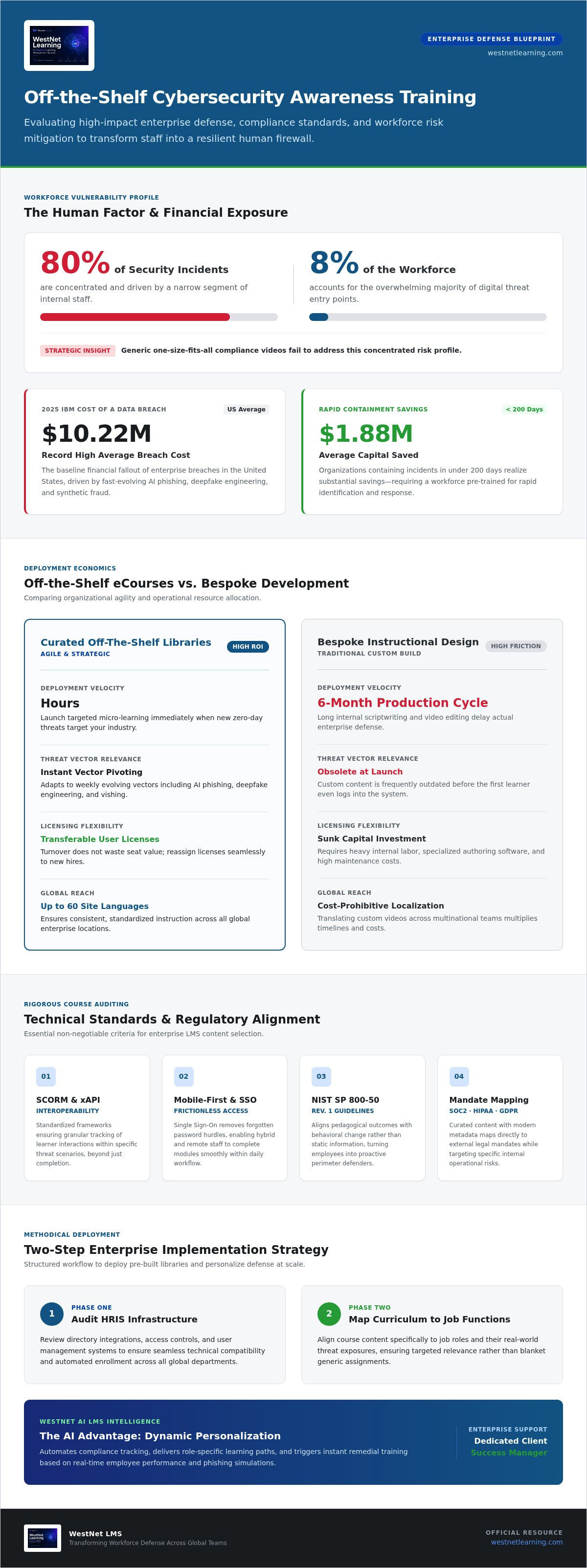
A staggering 80% of security incidents are driven by just 8% of your workforce. This concentrated risk profile proves that generic, one-size-fits-all compliance videos are no longer sufficient to protect the modern enterprise. You've likely felt the frustration of high costs and low participation rates associated with traditional training methods. Most security leaders agree that while compliance is mandatory, true resilience requires a fundamental shift in how employees perceive and react to digital threats.
Selecting the right off the shelf cybersecurity awareness training courses is the first step toward transforming your staff from a liability into a resilient human firewall. Our 2026 guide provides a strategic framework to evaluate and deploy high-impact training that moves beyond simple checkboxes to drive measurable behavioral change. You'll discover how to automate compliance tracking, reduce phishing click-rates, and utilize the WestNet AI LMS to scale defense across global teams. We will break down the latest regulatory demands and show you how to build a sophisticated culture of security that actually sticks.
Key Takeaways
- Prioritize speed and ROI. Learn why off-the-shelf libraries outperform bespoke instructional design in the rapidly evolving 2026 threat environment.
- Verify technical compatibility. Ensure your off the shelf cybersecurity awareness training courses utilize SCORM and xAPI standards for seamless integration and granular behavioral tracking.
- Personalize the learner journey. Use AI-driven recommendations to assign role-specific modules and automate remedial training based on real-time performance data.
- Streamline enterprise deployment. Follow a methodical two-step process to audit your HRIS infrastructure and map curriculum requirements to specific job functions.
- Scale with professional confidence. Explore how the WestNet AI LMS and a Dedicated Client Success Manager turn standard training into a sophisticated, global defense strategy.
The Business Case for Off-the-Shelf Cybersecurity Awareness Training Courses
Speed defines survival. In a landscape where AI-driven phishing and deepfake social engineering evolve weekly, your defense can't wait for a six-month bespoke production cycle. Custom content is often obsolete before the first learner logs in. Transitioning to off the shelf cybersecurity awareness training courses allows your organization to pivot instantly as new vectors emerge. This agility is no longer optional. According to the 2025 IBM Cost of a Data Breach Report, the average cost of a breach in the United States reached a record high of $10.22 million. Organizations that contain breaches in under 200 days save an average of $1.88 million; however, achieving this requires a workforce that is already prepared for the next attack.
The myth that pre-built content is generic has been dismantled by modern metadata and AI-enhanced delivery. High-quality libraries are now mapped directly to rigorous frameworks like SOC2, HIPAA, and GDPR. This ensures that your security awareness training meets legal mandates while remaining relevant to specific operational risks. By utilizing curated content, you shift from being a content creator to a strategic architect of human risk management.
Speed and Scalability in Cyber Defense
Deploying training in hours instead of months is a tactical necessity. When a new zero-day threat targets your industry, you can launch a targeted micro-learning module immediately. This rapid response counters emerging threats before they penetrate your perimeter. Pre-built content allows your L&D teams to focus on high-level strategy rather than the minutiae of scriptwriting or video editing. Furthermore, standardized off-the-shelf eCourses ensure global organizational alignment. With support for up to 60 site languages, every employee receives the same high-standard instruction, regardless of their location.
Cost-Efficiency and Resource Allocation
Analyzing the total cost of ownership reveals that pre-built libraries offer superior ROI compared to bespoke design. Custom development requires significant internal labor, specialized software, and ongoing maintenance. In contrast, off the shelf cybersecurity awareness training courses provide a predictable, scalable expense. WestNet AI LMS further optimizes this investment through transferable user licenses. If a department experiences high turnover, you don't lose the value of the seat; you simply reassign the license to the next hire. This flexibility reduces the burden on IT and security teams, allowing them to verify content quality quickly and return to core technical defense tasks. It's an efficient path to modernization that values both time and capital.
Key Evaluation Criteria: What to Look for in a Cybersecurity Course
Selecting off the shelf cybersecurity awareness training courses requires a shift from superficial content audits to rigorous technical and pedagogical evaluation. Static material fails against 2026 vectors like AI-driven vishing and synthetic identity fraud. You must verify that your chosen library reflects the current threat environment while aligning with NIST SP 800-50 Rev. 1 guidelines for behavioral outcomes. Effective training doesn't just inform; it transforms the employee from a target into a proactive defender. Reviewing compliance training best practices can further help you align these courses with your broader regulatory and risk-mitigation strategy.
Technical Standards and Interoperability
Technical compatibility is the foundation of a frictionless rollout. SCORM and xAPI compliance are non-negotiable requirements for any enterprise LMS integration. These standards allow you to track more than just completion; they provide granular data on how learners interact with specific scenarios. Ensure the content utilizes a mobile-first design to support your hybrid and remote workforce. Frictionless access is equally critical. Implementing Single Sign-On (SSO) removes the barrier of forgotten passwords, ensuring that security training remains a seamless part of the daily workflow rather than a logistical hurdle.
Pedagogical Effectiveness and Engagement
The era of the "click-next" slide deck is over. To drive real change, look for courses that utilize interactive scenarios and behavioral simulations. These tools force learners to make decisions in a controlled environment, mirroring the high-pressure choices they face during a real phishing attempt. Microlearning is the delivery of short, hyper-focused instructional bursts that address a single security concept to minimize cognitive load and maximize knowledge retention. This approach prevents learner fatigue and keeps participation high.
Gamification elements like leaderboards and badges turn mandatory training into a culture of voluntary excellence. When employees compete for security rankings, the concepts become part of the social fabric of the organization. High-quality off the shelf cybersecurity awareness training courses leverage these psychological triggers to ensure long-term retention. If you want to see how these elements integrate into a unified platform, explore WestNet AI LMS features to discover a more sophisticated path toward organizational resilience.
The AI Advantage: Personalizing the Off-the-Shelf Experience
The primary criticism of standardized content is its perceived lack of relevance to specific job functions. AI changes this dynamic entirely. By integrating artificial intelligence into your delivery platform, you can transform off the shelf cybersecurity awareness training courses from a static library into a dynamic, personalized curriculum. This technology identifies the unique risk profile of each employee, ensuring that a developer receives different instruction than a human resources manager. You can read more about how AI is transforming corporate training to understand the broader implications of this shift for your organizational growth.
Strategic leaders use these tools to move beyond the "one-size-fits-all" approach that often leads to employee disengagement. While government bodies provide excellent foundational CISA cybersecurity awareness resources, an AI-enhanced LMS applies those principles at an individual level. It bridges the gap between general theory and specific operational reality, ensuring that every minute spent in training contributes to a measurable reduction in risk.
Adaptive Learning Paths
Efficiency drives engagement. AI-powered systems allow learners to skip concepts they've already mastered, focusing strictly on individual knowledge gaps. This "one-size-fits-one" model prevents the frustration of repetitive content and respects the learner's time. AI Course Recommendations further increase participation by suggesting relevant deep-dives based on a learner's past performance or emerging industry threats. It's a methodical way to ensure that training time is spent where it provides the most value, turning a generic course into a bespoke learning journey.
Predictive Analytics and Risk Management
Data provides a clear roadmap for defense. By mapping training completion data to real-world security incidents, organizations can identify which departments are most susceptible to social engineering. LMS analytics predict high-risk areas before a breach occurs, allowing for proactive intervention. This level of insight turns your training platform into a strategic risk management tool rather than a simple compliance archive. Leveraging AI-powered help for both admins and learners also streamlines the process, reducing support tickets and removing operational friction. It's a sophisticated path toward systemic improvement and the removal of organizational obstacles.
Implementation Strategy: Integrating Courses into Your Enterprise LMS
Strategic deployment is the differentiator between a checkbox activity and a hardened defense. While the quality of off the shelf cybersecurity awareness training courses matters, the integration of these materials into your existing infrastructure determines their long-term efficacy. You must move beyond manual tracking. A successful rollout requires a methodical four-step process that bridges the gap between your HR data and your security curriculum. This ensures that every individual, from the executive suite to the remote contractor, is accounted for in your audit trails.
Begin by auditing your current HRIS and LMS for integration readiness. Modern LMS integrations allow for a seamless flow of data, ensuring that job titles are mapped to specific cybersecurity requirements automatically. Once mapped, you can automate enrollment and certification tracking. This level of automation is essential for maintaining audit readiness for frameworks like SOC2 or HIPAA. Finally, launch with a multi-language approach. A global team requires localized content that speaks to regional threats and cultural nuances, rather than simple word-for-word translation.
Automating the Administrative Burden
Efficiency is the enemy of human error. Automated enrollment saves hundreds of manual hours for L&D admins by synchronizing HRIS data in real time. When you hire a new team member, the system immediately assigns their foundational security basics. You don't have to worry about manual entry or missed deadlines. Setting up automated certification reminders further ensures that your organization maintains 100% compliance without constant intervention. It creates a stabilizing force that handles complexity with ease, allowing your security team to focus on technical monitoring.
Global Deployment and Localization
Scale requires sophistication. Managing training across diverse regions is simplified with support for up to 60 site languages. Localized content matters because cybersecurity risks often vary by geography; a phishing attempt in Europe may look very different from one in North America. By assigning regional supervisors to manage localized compliance dashboards, you empower local leaders to own their security outcomes. This structured approach ensures organizational growth while maintaining a rigorous security posture. To see how this works in practice, schedule a demo of WestNet AI LMS and experience a streamlined deployment today.
Scaling Your Defense with WestNet AI LMS and eCourse Libraries
Scaling a global defense requires more than just a library of content; it requires a sophisticated delivery engine. The WestNet AI LMS transforms off the shelf cybersecurity awareness training courses into a strategic asset by providing the infrastructure necessary to manage, measure, and mature your security culture. While the courses provide the knowledge, our platform provides the intelligence. By centralizing these disparate modules within a unified ecosystem, you eliminate the fragmentation that often plagues large-scale training initiatives. This cohesion is the foundation of organizational resilience.
Future-proofing your program is a continuous process. As threat actors deploy increasingly complex AI-driven attacks, your training platform must evolve at the same pace. We provide continuous AI-driven feature updates that ensure your administrative tools and learner experiences remain at the cutting edge of educational technology. You aren't just buying a tool for today; you're investing in a visionary partner that values progress and the empowerment of your workforce.
The WestNet Advantage for Security Training
We don't just host content. We enhance it. Our platform allows you to blend premium off the shelf cybersecurity awareness training courses with our AI Course Creation tools to fill specific internal policy gaps. This hybrid approach ensures your team masters both industry-standard hygiene and company-specific protocols. To drive participation, we utilize gamification features like leaderboards and badges. These elements foster a competitive security culture where employees strive for excellence rather than mere completion. For C-suite stakeholders, our detailed reporting provides the data-driven insights necessary to prove training ROI. You can track the direct correlation between module completion and the reduction of high-risk behaviors across your enterprise.
Ready to Modernize Your Awareness Program?
Transitioning to a sophisticated learning environment should be a stabilizing experience for your organization. WestNet supports enterprise-wide rollouts with a Dedicated Client Success Manager who understands the logistical challenges of large-scale operations. Our enterprise-grade security and robust Service Level Agreements (SLA) make us the trusted choice for 2026. We handle the complexity of global deployment so you can focus on strategic growth. The next step in your modernization journey is evaluating these tools in your own environment. We invite you to start a 30-day trial to experience the impact of high-engagement training firsthand. Request a WestNet AI LMS Demo today to receive a custom walkthrough tailored to your specific industry compliance needs.
Architecting a Resilient Human Firewall
Transitioning from a vulnerable risk profile to a resilient human firewall requires a strategic shift in how you deploy content. We've explored how off the shelf cybersecurity awareness training courses provide the necessary speed to counter 2026 threats while AI personalization ensures every module remains relevant to specific roles. Efficiency and scale are no longer at odds when you utilize a platform built for global integration and automated compliance. By selecting a system that prioritizes technical standards like SCORM and xAPI, you ensure that your defense is both measurable and adaptable.
WestNet AI LMS provides the stabilizing force your organization needs to handle significant operational complexity with ease. With AI-powered help for learners and admins, support for 60+ languages, and a Dedicated Client Success Manager included, we ensure your rollout is seamless and successful. It's time to move beyond fragmented, outdated methods and embrace a future-ready solution. Start your 30-day free trial of WestNet AI LMS today and empower your workforce with the intelligence they need to stay secure. Your journey toward a more sophisticated security culture starts now.
Frequently Asked Questions
What is the difference between custom and off-the-shelf cybersecurity training?
Off-the-shelf courses are pre-built, ready-to-deploy libraries, whereas custom training is built from scratch. Off-the-shelf options provide immediate access to industry standards and cost much less than bespoke design. They allow organizations to launch global programs in hours rather than months. Modern off the shelf cybersecurity awareness training courses use AI personalization to bridge the gap, making them relevant to individual roles without the high development overhead associated with custom content creation.
How often should cybersecurity awareness training courses be updated?
Cybersecurity training requires continuous updates to remain effective against evolving threats like AI-generated phishing. Annual training is a baseline for compliance, but quarterly or monthly micro-learning bursts are better for behavioral change. High-quality libraries are updated in real-time as new vulnerabilities emerge. This ensures your workforce stays ahead of zero-day threats and social engineering tactics. Regular updates prevent content fatigue and maintain a high level of security awareness across the enterprise.
Can off-the-shelf courses be integrated into any LMS?
Most off-the-shelf courses utilize SCORM or xAPI standards, ensuring they integrate seamlessly with any modern enterprise LMS. These technical standards allow for consistent tracking of completion rates and assessment scores across different platforms. WestNet AI LMS specifically supports these formats to facilitate the easy import of third-party libraries. This interoperability prevents vendor lock-in and allows you to build a diverse curriculum that meets your specific organizational needs without technical friction.
Do off-the-shelf courses satisfy SOC2 and HIPAA compliance requirements?
Yes, reputable off the shelf cybersecurity awareness training courses are mapped directly to regulatory frameworks like SOC2, HIPAA, and GDPR. They provide the necessary documentation and audit trails required to prove that employees have received mandatory security instruction. Automated enrollment and certification tracking within the WestNet AI LMS further simplify this process. This ensures your organization remains audit-ready at all times while reducing the administrative burden on your compliance and security teams.
What are the most important topics to cover in staff security training?
Effective programs must cover foundational topics such as phishing defense, credential hygiene, and social engineering. In 2026, it's also critical to include modules on generative AI acceptable use and deepfake recognition. Training should address both technical vulnerabilities and the human element of security. Focusing on these high-impact areas helps reduce the 60% of breaches that involve human error. A comprehensive catalog ensures that every department understands its specific role in protecting organizational data.
How can we measure the effectiveness of our cybersecurity training program?
Effectiveness is measured through granular learning analytics and real-world behavioral changes. Track metrics such as module completion rates, assessment scores, and the reduction in phishing simulation click-rates. WestNet AI LMS provides advanced reporting tools that allow C-suite stakeholders to see the direct ROI of their training investment. By mapping training data to security incident trends, you can identify knowledge gaps and assign remedial modules to high-risk departments before a breach occurs.
Is gamification effective for cybersecurity training in a corporate setting?
Gamification is highly effective for driving voluntary engagement and long-term knowledge retention. Features like leaderboards, badges, and points turn mandatory compliance into a competitive, social experience. This approach leverages psychological triggers to encourage employees to complete modules and achieve high scores. When security becomes a part of the corporate culture rather than just a chore, participation rates soar. WestNet AI LMS integrates these features to foster a proactive and resilient security mindset.
What languages are available for WestNet's cybersecurity courses?
WestNet AI LMS supports up to 60 site languages, allowing users to select their preferred language at login. This extensive support ensures that global teams receive consistent, high-quality instruction in their native tongue. Localized content is essential for managing training across different regions and ensuring that cultural nuances in security are addressed. By removing language barriers, you empower your entire workforce to participate in your defense strategy with professional confidence and clarity.