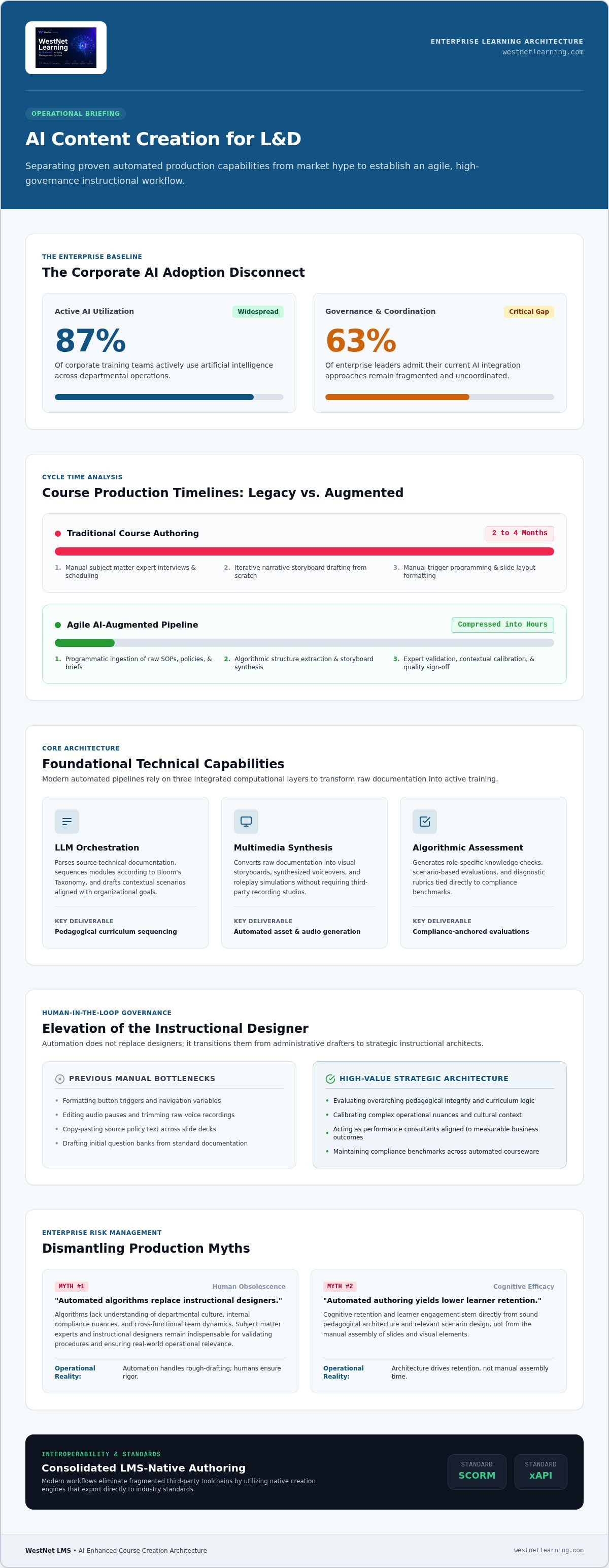
While 87% of corporate training teams actively use artificial intelligence, 63% of leaders admit their approaches remain fragmented and uncoordinated. The enterprise conversation around AI content creation for L&D often swings between breathless vendor hype and genuine anxiety. You don't need another speculative pitch claiming automated algorithms will replace instructional designers overnight. Nor can you afford sluggish course development cycles, hallucinated compliance data, or bland, off-brand modules that subject matter experts immediately reject.
The enterprise reality is far more grounded and infinitely more practical. This guide separates proven automated production capabilities from market noise, showing you how to establish an agile instructional workflow that pairs human pedagogical strategy with generative acceleration. We'll examine the shift from disconnected individual prompts to integrated authoring, practical methods to preserve strict compliance, and the structural frameworks required to eliminate your training backlog with measurable organizational impact.
Key Takeaways
- Demystify AI content creation for L&D by understanding how automated ingestion transforms unstructured source files into structured, interactive courseware.
- Dismantle the four major enterprise myths surrounding compliance risk, intellectual property ownership, and automated instructional quality.
- Compare legacy authoring workflows directly against augmented rapid production to uncover sustainable time and maintenance advantages.
- Deploy a practical 5-step strategic framework that pairs human instructional expertise with automated authoring governance.
- Consolidate fragmented third-party authoring toolchains by leveraging native LMS creation capabilities that output standard SCORM and xAPI packages.
What Is AI Content Creation for L&D in Modern Corporate Training?
AI content creation for L&D is the programmatic synthesis of instructional material using machine learning models to ingest raw operational documentation and convert it into structured, standards-compliant courseware. Rather than drafting narrative modules from scratch, corporate learning teams deploy algorithms to parse dense standard operating procedures, policy manuals, and technical briefs. These systems extract key pedagogical concepts, map clear learning objectives, and generate interactive training sequences that directly align with organizational goals.
Traditional course production operates on sluggish timelines. Instructional designers often spend between two to four months conducting subject matter expert interviews, drafting storyboards, and manually configuring slide layouts. Agile automated workflows compress this drafting phase into hours. By centralizing automated production, enterprise departments eliminate routine development backlogs, letting them deploy business-critical training right when strategic updates happen.
The Technology Powering Modern L&D Authoring Workflows
Modern automated instructional pipelines rely on three foundational technical capabilities:
- Large language model orchestration: Algorithms parse source documentation to extract key concepts, sequence modules using Bloom's Taxonomy, and generate contextual workplace scenarios. The broader evolution of Artificial Intelligence in Education demonstrates how intelligent tutoring systems and generative frameworks continue to formalize curriculum design across institutional settings.
- Automated multimedia synthesis: Systems turn raw text into structured visual storyboards, synthesized voiceovers, and roleplay simulations without requiring third-party audio studios or complex video editing tools.
- Algorithmic assessment engines: Platforms immediately generate role-specific knowledge checks, scenario-based evaluations, and diagnostic rubrics tied directly to compliance benchmarks.
Shifting from Manual Drafting to Strategic Instructional Architecture
Automation does not eliminate instructional designers. It elevates them into strategic architects. Instead of formatting button triggers, cutting out audio pauses, or copying text across slide decks, designers evaluate pedagogical integrity and contextual relevance. They review algorithmic drafts, calibrate complex technical nuances, and ensure every module reinforces measurable organizational capabilities.
Enterprise teams using native AI course creation tools build a sustainable production engine right inside their learning ecosystem. This shifts talent development away from mechanical content production toward high-value performance consulting. For an actionable blueprint on modernizing these workflows, explore our guide to modernizing corporate learning systems. By removing production friction, organizations deliver timely training while maintaining complete control over curriculum quality.
The Top 4 Myths About AI Content Creation in Corporate Learning
Unexamined assumptions stall modernization. While forward-looking organizations capture significant velocity gains, many enterprise leaders hesitate because outdated preconceptions cloud their judgment. Misconceptions around cognitive retention, data liability, and instructional design roles create false friction. Evaluating the actual operational realities of AI content creation for L&D dismantles these barriers and clarifies the strategic path forward.
Myth 1 & 2: Human Replacement and Inferior Learning Outcomes
The belief that automation renders instructional designers obsolete misses how enterprise learning actually functions. Algorithms do not understand departmental culture, internal compliance nuances, or cross-functional team dynamics. Subject matter experts remain essential for validating complex procedures and anchoring curricula in real operational outcomes. Instead of replacing professionals, machine models eliminate the administrative friction of rough-draft creation.
Equally unfounded is the assumption that automated authoring yields lower learner retention. Cognitive engagement stems from sound instructional architecture, not manual slide assembly. An authoritative analysis by the Harvard Business Review on transforming learning and development demonstrates that generative technology enables adaptive practice, situational coaching, and rapid scenario generation at enterprise scale. When instructional designers steer the prompt architecture and rigorously edit the output, active learning scenarios become more engaging, interactive, and pedagogically sound.
Myth 3 & 4: Security Compromises and Impersonal Training Delivery
Enterprise risk teams often worry about data leakage, but modern learning ecosystems operate under strict architectural controls:
- Data boundaries: Enterprise authoring platforms execute within dedicated tenant environments, guaranteeing proprietary standard operating procedures are never leaked into public foundational models.
- Regulatory compliance: Built-in governance aligns automated generation with emerging legal standards, including regional workplace disclosure requirements and human-in-the-loop validation frameworks.
- Contextual microlearning: Far from producing generic, one-size-fits-all content, native engines leverage role profiles and operational parameters to tailor instruction directly to frontline workflows.
Automated course creation does not dilute corporate training. It sharpens relevance by producing targeted modules calibrated to specific job functions. Leaders ready to build an agile, defensible infrastructure can explore how to deploy an enterprise AI learning platform that safeguards organizational intelligence while accelerating delivery.
Evaluating the Structural Reality: AI vs. Traditional Course Production
Traditional corporate course authoring is defined by friction. Instructional designers, visual developers, and subject matter experts juggle linear revision cycles that turn minor policy updates into multi-month projects. Research across the learning sector indicates that integrating artificial intelligence can reduce corporate training development time by 45% to 70%. Deploying AI content creation for L&D transforms these cumbersome handoffs into an iterative, real-time authoring pipeline that slashes external agency dependencies while keeping operational content accurate.
Production Velocity and Iterative Course Maintenance
Legacy instructional development typically requires eight to twelve weeks to move from initial intake to final LMS deployment. Augmented workflows compress that timeline into 48 hours. The most profound advantage lies in ongoing course maintenance across distributed operations:
- Instant regulatory alignment: When compliance policies or statutory guidelines shift, teams update the core source file, allowing the engine to re-render the module without a ground-up redesign.
- Resource reallocation: Senior designers spend less time on slide layouts, redirecting their bandwidth toward strategic workforce initiatives and high-impact talent programs.
- Cost containment: In-house teams produce polished, SCORM-compliant modules internally, cutting out recurring third-party multimedia agency fees.
Pedagogical Scaffolding and Assessment Integrity
Speed carries no business value if the resulting instruction fails to drive measurable retention. Early generative attempts often produced shallow, generic multiple-choice questions that tested rote recall instead of competence. Modern enterprise systems overcome this limitation by anchoring automated drafting directly to internal source documents.
By constraining the generation engine to verified organizational policy manuals and technical specifications, teams systematically eliminate data hallucinations. The platform generates nuanced, branch-style decision scenarios that test actual situational judgment. Instructional designers review these diagnostic checks, calibrate the grading rubrics, and ensure assessments directly reinforce operational mastery.
This balance preserves instructional rigor while delivering unprecedented agility. To see how structured authoring combines with robust compliance delivery across large workforces, explore our overview of LMS for compliance training. Implementing agile, grounded AI content creation for L&D ensures enterprise curriculums remain current, compliant, and cost-effective.
A 5-Step Strategic Framework for Implementing AI Authoring in L&D
Adopting automated authoring requires methodical governance rather than ad-hoc prompting. Without a clear execution framework, teams encounter tool sprawl, inconsistent voice, and validation bottlenecks. Establishing an institutional roadmap ensures that AI content creation for L&D operates as a reliable operational engine that protects data boundaries while accelerating instructional throughput.
Phase 1 to 3: Audit, Prompt Governance, and Pilot Validation
Execution begins by structuring the underlying knowledge base before generating a single slide:
- Phase 1: Knowledge audit. Catalog verified standard operating procedures, compliance manuals, and product documentation. Scrub obsolete materials so the model processes only pristine, authoritative company data.
- Phase 2: Governance and persona calibration. Establish standardized system instructions that dictate tone, pedagogical style, and reading levels. These prompt boundaries enforce brand voice and prevent stylistic drift across departmental authors.
- Phase 3: Targeted pilot validation. Deploy the authoring system against a defined, high-frequency cohort, such as operational onboarding or role-specific safety compliance. Track completion velocity, diagnostic scores, and learner feedback to calibrate prompts before expanding scope.
Phase 4 to 5: Technical Standards and Scaled Organizational Deployment
Isolated courses create administrative friction. Enterprise deployment succeeds only when generated material integrates cleanly into existing corporate systems.
Phase 4 centers on interoperability standards. Generated training assets must export natively as standard SCORM 1.2, SCORM 2004, or xAPI packages. This technical conformance guarantees that completion records, interaction metrics, and score distributions register accurately inside your Learning Record Store or core platform. Modern enterprise authoring tools produce these standard packages automatically, eliminating intermediate manual conversion tools.
Phase 5 scales distribution across the enterprise. Synchronizing your authoring and delivery environment with central HRIS databases automates user provisioning, role assignments, and recurring certification schedules. For a detailed breakdown of core platform requirements and operational selection criteria, review our analysis of how to choose a learning management system.
Structuring your workflow across these five phases turns automated authoring into a sustainable competitive advantage. To see how integrated native authoring and automated distribution operate in a unified enterprise environment, schedule a live demo to experience modern talent architecture in action.
Scaling Modern Training with WestNet AI Enhanced LMS
Fragmented toolchains degrade operational agility. When instructional teams must generate text in one tool, assemble graphics in another, and manually upload output to an external platform, administrative overhead multiplies. Deploying an integrated platform like WestNet AI LMS resolves this disconnect. Native AI-Powered e-learning Creation bridges the gap between drafting and distribution, eliminating costly standalone authoring subscriptions while centralizing curriculum governance.
Unified Authoring and Seamless Enterprise Interoperability
Native authoring simplifies the path from raw source documentation to measurable workplace competence:
- Universal format compatibility: Generate robust SCORM and xAPI course packages out of the box, ensuring granular tracking of learner interactions, diagnostic scores, and completion statuses across any standards-compliant environment.
- Integrated content synthesis: Purpose-built WestNet AI course creation capabilities allow in-house talent teams to transform technical operating procedures into interactive modules instantly.
- Automated progression rules: Configure dynamic prerequisite pathways, automated recurring recertifications, and competency benchmarks that adjust automatically based on learner performance data.
Empowering Global Workforces Through Scalable Technology
Operating across distributed business units requires technological consistency. WestNet LMS supports seamless global delivery with up to 60 system interface languages selectable directly at login. Rather than navigating separate instances or disparate localization tools, international staff access unified instruction calibrated to organizational standards.
Administrative hierarchy management lets enterprise leaders delegate custom administrative roles across departments, divisions, or operating units. Pair this with transferable user license structures, and organizations maximize their technology investments by reassigning seats as staffing requirements fluctuate. Integrated gamification engines, custom leaderboards, and verifiable digital badges further drive sustained employee participation without manual intervention from L&D coordinators.
Sustained operational continuity anchors the entire ecosystem. WestNet backs its platform with a dedicated Client Success Manager and rigorous enterprise Service Level Agreements, ensuring your instructional architecture remains dependable. Strategic AI content creation for L&D achieves its full potential when paired with modern delivery infrastructure. To see how a unified architecture modernizes talent development across your organization, review the core capabilities across our full LMS features suite.
Transform Instructional Velocity into Enterprise Impact
Modern workforce training no longer tolerates multi-month authoring backlogs or fragmented software stacks. Successfully deploying AI content creation for L&D comes down to pairing human instructional strategy with unified infrastructure. By anchoring automated generation to validated internal documentation and establishing disciplined prompt governance, talent leaders eliminate production bottlenecks while preserving pedagogical rigor.
Sustainable acceleration requires a cohesive technical foundation. WestNet AI LMS consolidates your training architecture by pairing native AI-Powered e-learning Creation with standard SCORM and xAPI exports. Your global teams gain immediate accessibility with up to 60 interface languages selectable directly at login. Backed by enterprise Service Level Agreements and a dedicated Client Success Manager, your organization secures both technical reliability and measurable curriculum outcomes.
Equip your instructional designers with the tools they need to drive measurable business transformation. Accelerate your instructional workflows with a WestNet LMS demo and lead your enterprise into the future of corporate learning.
Frequently Asked Questions
Can AI content creation completely replace enterprise instructional designers?
No, automation cannot replace skilled instructional designers. While generative engines excel at drafting text, synthesizing voiceovers, and generating initial quizzes, they lack strategic business context and pedagogical judgment. Instructional designers evolve into learning architects who define prompt governance, ensure contextual alignment with company culture, and validate complex technical workflows that algorithms cannot fully evaluate on their own.
How do L&D teams ensure AI-generated training content remains factually accurate?
Teams secure accuracy by grounding generation engines exclusively in verified internal documentation. Restricting source data to approved policy documents, standard operating procedures, and product manuals prevents factual hallucinations. Adding mandatory human-in-the-loop editorial review cycles ensures that subject matter experts review every scenario, rubric, and assessment prior to enterprise rollout.
What e-learning technical standards do AI course creation platforms typically support?
Enterprise AI authoring systems generate standard SCORM 1.2, SCORM 2004, and xAPI packages out of the box. Conforming to these technical specifications ensures your courses maintain complete interoperability. It enables comprehensive tracking of user progression, score distribution, and detailed learning interactions across modern Learning Record Stores and standard enterprise platforms.
Does using generative AI for corporate training risk leaking proprietary company data?
Enterprise platforms eliminate data leakage by enforcing dedicated tenant environments and strict data boundaries. Unlike public generative chatbots that utilize user prompts to train foundational models, enterprise solutions isolate company data within private architectural parameters. These controls ensure sensitive operating manuals and proprietary training materials remain secure and compliant with internal IT governance.
How much time does automated course creation realistically save during development?
Adopting AI content creation for L&D typically compresses initial course development cycles by 45% to 70%. Converting unstructured source files into complete, interactive draft modules happens in hours rather than weeks. This massive acceleration frees internal talent development teams to spend their time refining assessments and delivering targeted performance coaching.
Can AI-powered authoring tools generate training in multiple languages simultaneously?
Modern platforms streamline international delivery across global operations. Advanced systems like WestNet AI LMS support up to 60 system interface languages selectable directly at login. This multi-language support allows corporate learning teams to deploy unified curriculums across distributed international workforces without building separate regional instances or maintaining disjointed external translations.
What is the difference between standalone AI writing tools and native LMS authoring?
Standalone writing tools only generate unformatted raw copy, forcing designers to transfer text between external slide software, voice generators, and packaging tools. Native LMS authoring integrates generation directly into the administrative core. Platforms featuring native AI content creation for L&D export compliant SCORM or xAPI files instantly, syncing enrollments with HRIS databases and tracking completions without tool sprawl.