Organizations that fail to modernize their L&D workflows are now spending up to 120 hours on a single course module that their competitors are finishing in less than 30. It's a staggering inefficiency that drains resources and stalls organizational growth. You've likely felt the friction of fragmented tools that don't talk to each other, making the search for effective AI powered course authoring software a matter of operational survival. Maintaining brand consistency across global teams shouldn't feel like a logistical nightmare when your scale demands absolute precision.
We understand that enterprise learning requires more than just speed; it demands stability and strategic foresight. This 2026 strategic guide shows you how to leverage advanced automation to reduce development time by 70% without sacrificing the compliance your industry requires. We'll explore how to transition from outdated, manual methods to a unified ecosystem that supports seamless SCORM and xAPI exports. You'll learn to move beyond basic generative tools toward a future-ready strategy that delivers personalized learning paths to thousands of employees instantly. Let's bridge the gap between your current operational state and a state of total instructional agility.
Key Takeaways
- Modernize your L&D workflow by implementing AI powered course authoring software to reduce production time by 70% while ensuring global brand consistency.
- Transition from fragmented standalone tools to integrated LMS authoring environments that guarantee seamless SCORM and xAPI compliance across all modules.
- Develop high-impact training scripts grounded in specific organizational objectives to drive measurable employee engagement and performance.
- Implement human-in-the-loop validation workflows to maintain audit-proof accuracy and meet rigorous enterprise-grade compliance standards.
- Empower a global workforce by leveraging automated localization in 60 languages and delivering personalized, AI-driven learning paths at scale.
Beyond Manual Design: The Shift to AI Powered Course Authoring
The landscape of corporate learning has reached a definitive pivot point. Traditional methods, once the standard for excellence, now act as anchors on organizational agility. AI-powered course authoring represents the sophisticated intersection of generative intelligence and rigorous instructional design. It replaces the fragmented, manual processes of the past with a cohesive system that automates the heavy lifting of content structure. This shift democratizes content creation, moving it from the exclusive domain of technical specialists to the hands of subject matter experts who understand the core business needs. Enterprise speed now requires these AI-native workflows to maintain a competitive edge in a market that moves faster than manual builds can support.
The Limitations of Legacy Authoring Tools
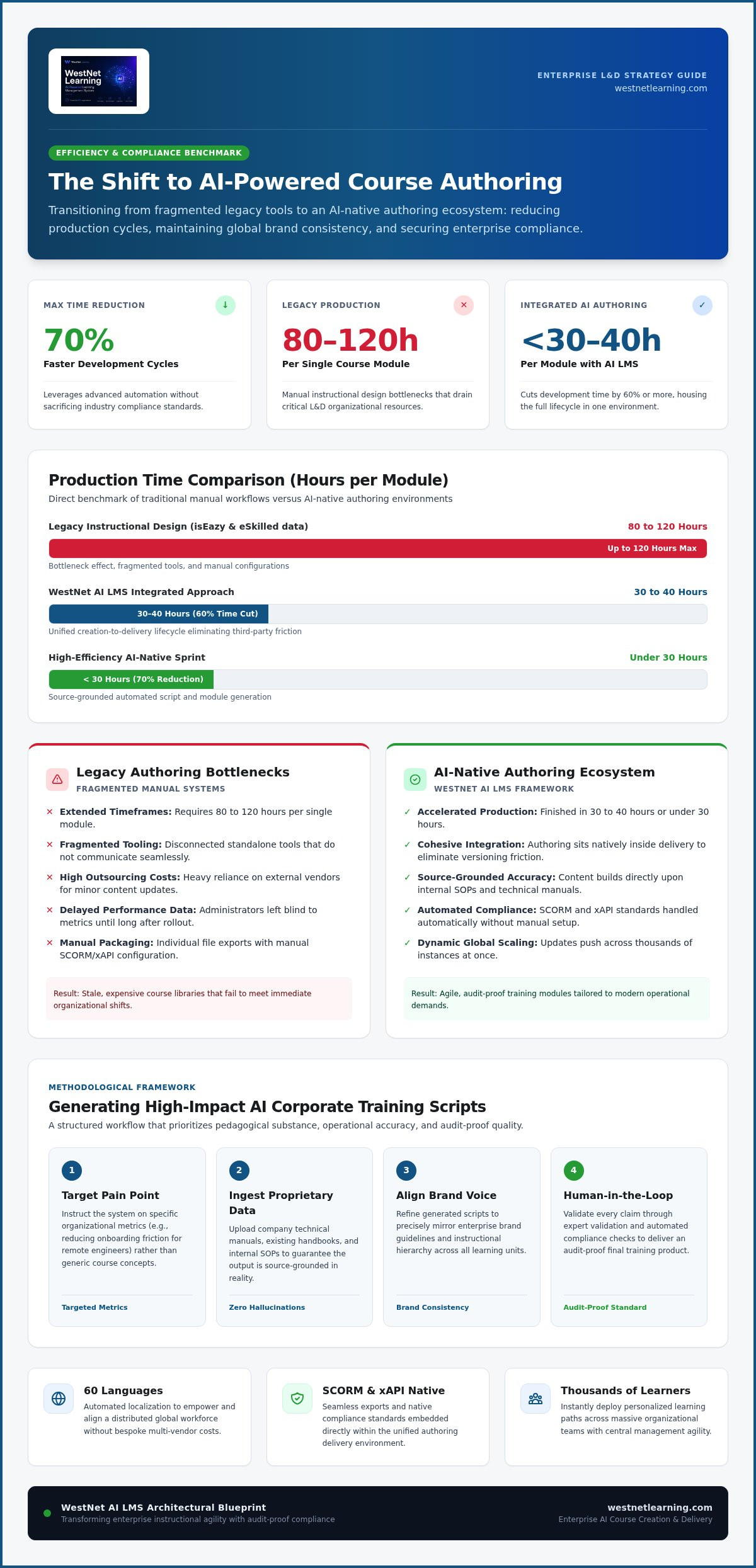
Legacy software often creates a "bottleneck effect" where small L&D teams struggle to keep pace with rapid business shifts. Data from isEazy and eSkilled indicates that traditional instructional design cycles typically require 80 to 120 hours to complete a single module. This delay is compounded by the high costs of outsourcing bespoke content for every minor update. Standalone legacy tools also suffer from a lack of real-time data feedback. Administrators are often left blind to how content performs until long after deployment, making iterative improvement nearly impossible. The result is a library of stale, expensive content that fails to meet the immediate needs of a modern workforce.
Defining the AI-Native Authoring Ecosystem
True AI powered course authoring software is fundamentally different from legacy platforms that merely add a generative plugin. An AI-native ecosystem uses Large Language Models to architect educational hierarchies from the ground up, ensuring that every lesson flows logically toward a defined learning objective. This architecture supports source-grounded generation, where the AI utilizes your internal SOPs and manuals to create accurate, hallucination-free scripts. Key characteristics of these systems include:
- Cohesive Integration: The authoring environment exists within the delivery platform, removing the friction of versioning.
- Automated Compliance: Systems natively handle SCORM and xAPI standards without requiring manual configuration.
- Dynamic Scaling: Content can be updated across thousands of instances simultaneously rather than through individual file exports.
WestNet AI LMS bridges the historical gap between creation and delivery. By housing the entire lifecycle in one secure environment, it eliminates the need for fragmented third-party tools. Organizations utilizing this integrated approach report completing modules in 30 to 40 hours, effectively cutting development time by up to 60%. It's a stabilizing force that handles significant complexity with ease, allowing your team to focus on strategy rather than technical troubleshooting.
How to Generate High-Impact AI Corporate Training Scripts
A course is only as strong as its underlying architecture. While visual elements capture attention, AI generated corporate training scripts provide the pedagogical substance required for actual skill acquisition. Moving from generic content to high-impact training requires a methodical approach that prioritizes organizational accuracy over mere speed. By following a structured workflow, you can ensure that your AI powered course authoring software produces content that is both engaging and operationally sound.
The process begins by defining a specific organizational pain point. Instead of requesting a general "management course," instruct the system to address a specific metric, such as reducing onboarding friction for remote engineers. Once the objective is set, feed the AI your proprietary source material. Uploading technical manuals, internal PDFs, and existing handbooks ensures the output is grounded in your company's unique reality. This prevents the generic "hallucinations" common in standard generative tools. Finally, refine the script to mirror your corporate brand voice and validate every claim through automated compliance checks. This human-in-the-loop approach is essential for maintaining audit-proof standards.
Prompt Engineering for Instructional Designers
Effective prompting is the bridge between raw data and structured learning. Strategic architects use Retrieval-Augmented Generation (RAG) principles to ensure the AI only draws from verified internal documents. When drafting prompts, focus on defining the learner's persona and the desired behavioral outcome. Ask the system to structure content using proven educational hierarchies to ensure cognitive depth. This transforms dry technical data into compelling narratives that resonate with employees. If you want to see these principles in action, you can explore how WestNet AI LMS automates this scripting process to eliminate manual drafting entirely.
Optimizing Scripts for Different Media Formats
A single script should serve as the foundation for multiple delivery methods. Modern AI powered course authoring software allows you to adapt a core narrative into video-based microlearning modules or interactive branching scenarios with a few clicks. The AI can instantly extract key concepts to generate interactive quiz questions, ensuring that assessment is directly aligned with the instructional material. This modularity is key to building a flexible training library that meets learners where they are. To maximize the impact of these scripts, learn more about Microlearning Strategies to understand how short, targeted content improves long-term retention.
Evaluating AI Course Creation Software: A Comparison Framework
Selecting the right AI powered course authoring software requires a shift in perspective. Many organizations begin by looking for a standalone creative tool, yet this often leads to a "versioning trap" where designers must manually export and re-upload content for every minor update. An integrated approach, where authoring lives natively inside the LMS, eliminates this friction entirely. It creates a unified ecosystem where content creation and learner delivery exist in a single, secure environment. This integration ensures that your security posture remains robust, as data never leaves your controlled stack during the generation process.
Reliability at scale is another non-negotiable criterion. A tool that works for a small pilot group must perform identically for a global workforce of 50,000 users. This requires deep integration with your existing HRIS and data stacks to handle automated user provisioning and reporting. Enterprise-grade solutions prioritize SCORM and xAPI compliance from the start, ensuring that your data remains portable and your tracking remains precise across all learning modules. When you remove the need for fragmented third-party plugins, you gain a stabilizing force that can handle significant complexity with ease.
Features That Distinguish Enterprise-Grade Tools
Sophisticated platforms offer more than just text generation. They provide multi-branding capabilities that allow different departments or franchises to maintain unique logos and banners within a shared infrastructure. Task automation features handle the administrative burden of enrollment, triggering specific learning paths based on role changes or compliance deadlines. Security is further reinforced through Single Sign-On (SSO) and multiple authentication protocols, ensuring that access remains both seamless for employees and strictly controlled for the organization. These features transform a simple creation tool into a strategic architect for your entire workforce.
The ROI of Integrated AI Authoring
The financial argument for integrated systems is compelling. Beyond reducing the literal cost-per-course through automated scripting and structuring, these platforms offer unique ROI levers like transferable user licenses. In high-turnover industries, the ability to reuse a seat for a new hire without purchasing additional credits is a significant stabilizer for the L&D budget. This systemic efficiency turns training from a cost center into a strategic asset. To dive deeper into these metrics, it's helpful to start by Understanding ROI in Learning Management Systems to see how integrated AI powered course authoring software impacts the bottom line.
Ensuring Compliance and Accuracy in AI-Generated Content
Enterprise L&D operates within a strict regulatory environment. Audit-proof content is no longer a luxury; it's a non-negotiable standard for any organization facing rigorous oversight. While AI powered course authoring software accelerates production, it must never bypass the human-in-the-loop (HITL) workflow. This verification stage ensures that every claim, statistic, and instructional prompt aligns with current legal and safety requirements. Subject matter experts act as the final stabilizers, confirming that the AI has interpreted internal policies with absolute precision.
Beyond mere verification, sophisticated AI systems now map content directly to competency and certification trackers. This automation removes the administrative burden of manually tagging modules to specific job roles or regulatory requirements. It creates a seamless bridge between learning activities and organizational compliance dashboards. At WestNet, this process is supported by a Dedicated Client Success Manager. Unlike generic SaaS tools, this expert partner understands your specific industry challenges and provides a clear, sophisticated path through complex content validation.
SCORM and xAPI: The Technical Bedrock
Interoperability remains the foundation of a future-ready training strategy. Your authoring tool must export to standard formats like SCORM 1.2 or 2004 to ensure it functions across different environments. However, moving toward xAPI allows for the tracking of granular data points that traditional standards miss. You can monitor mobile interactions, offline learning, and specific decision points within a branching scenario. This level of detail provides the real-time data feedback needed to optimize your training for maximum impact. For more insights on maintaining these standards, explore our Best Practices for Compliance Training.
Data Security and AI Ethics in Training
Trust is the most valuable currency in enterprise technology. A primary concern for L&D leaders is ensuring that proprietary training data isn't leaked into public Large Language Models. WestNet AI LMS utilizes a secure, closed-loop environment where your internal SOPs and handbooks remain private. Our approach to data migration ensures that your legacy content is transitioned without loss of integrity. We maintain a strict Service Level Agreement (SLA) for uptime, positioning our platform as a stabilizing force for your operations. This commitment to ethics and reliability ensures that your move toward automation is both ambitious and grounded in practical safety.
If you're ready to secure your L&D infrastructure with a partner that values precision, start your transition to WestNet AI LMS today.
The WestNet Advantage: Scaling Global Training with WestNet AI LMS
Scaling an enterprise workforce requires a platform that transcends geographical and linguistic barriers. WestNet AI LMS provides the infrastructure needed to deploy high-impact training across diverse global teams without the friction of manual translation. By utilizing AI powered course authoring software that supports up to 60 site languages, organizations can ensure that every employee engages with content in their native tongue from the moment they log in. This localized approach is augmented by AI-generated course recommendations that personalize the learner journey based on individual performance and career trajectories. Engagement is further sustained through integrated gamification elements, such as leaderboards and badges, which transform routine training into a competitive, rewarding experience.
Strategic growth is only possible when your learning ecosystem talks to your core business data. WestNet facilitates this through seamless HRIS integrations that automate user management and reporting. When a new hire is added to your HR system, they are instantly provisioned into the appropriate learning paths, removing administrative hurdles. This systemic cohesion allows you to focus on high-level strategy while the platform handles the logistical complexities of a large-scale operation. It's a stabilizing force that ensures your training remains as agile as your business.
From Content Creation to Global Distribution
Managing multiple brands or subsidiaries within a single platform is a core strength of the WestNet architecture. You can deploy unique logos, banners, and themes for different regions, ensuring brand consistency while respecting local identity. In a hybrid work environment, the platform supports a blend of asynchronous eCourses and Virtual Instructor-Led Training (vILT) modules. This flexibility allows you to scale from small pilot teams to tens of thousands of users without experiencing performance degradation or operational friction. The system acts as a catalyst for speed, ensuring that modernization happens across the entire organization simultaneously.
Take the Next Step in Your L&D Transformation
Transitioning to an AI-native workflow is a significant strategic move that requires a partner you can trust. Evaluating AI powered course authoring software firsthand is the most effective way to understand its impact on your organization. We offer a 30-day free trial to allow your team to experience the speed and precision of our automation tools in a real-world environment. Contact our specialized team at 303.424.9168 to discuss your specific integration needs and data migration requirements.
Ready to see the future of enterprise learning? Request a Demo of WestNet AI LMS and begin your journey toward total instructional agility.
Leading the Transition to Instructional Agility
The transition from fragmented, manual course development to a unified, automated ecosystem is no longer a choice for enterprises seeking to remain competitive. By implementing AI powered course authoring software, you bridge the gap between operational complexity and streamlined execution. You've seen how grounding scripts in proprietary data eliminates hallucinations and how integrated LMS environments remove versioning friction. These strategies ensure your workforce remains skilled, compliant, and ready for the demands of a global market.
WestNet AI LMS supports this evolution with native capabilities for 60+ site languages and full HRIS and SSO integration. You don't have to navigate this technological shift alone. Every partnership includes a Dedicated Client Success Manager to ensure your transition is seamless and your ROI is maximized. It's time to replace outdated bottlenecks with a stabilizing force that values both intelligence and speed. Experience the future of L&D with a WestNet AI LMS Demo today. For a direct consultation regarding your specific organizational needs, contact our team at 303.424.9168. Your path to a more empowered workforce starts here.
Frequently Asked Questions
What is AI powered course authoring software?
AI powered course authoring software is a sophisticated tool that integrates generative artificial intelligence with instructional design principles to automate content production. It uses Large Language Models to structure educational hierarchies, generate scripts, and create interactive elements from raw data. This technology allows L&D teams to transition from manual, fragmented workflows to a cohesive ecosystem. By automating the heavy lifting of course architecture, organizations can focus on high-level strategy while reducing development time by up to 70%.
Can AI really generate accurate corporate training scripts?
Yes, AI can generate highly accurate corporate training scripts when grounded in proprietary source material. By feeding the system internal PDFs, technical manuals, and SOPs, you ensure the output is specific to your organization's unique requirements. This source-grounded approach eliminates the risk of generic hallucinations. WestNet AI LMS utilizes these principles to produce scripts that reflect your corporate brand voice while maintaining the pedagogical depth required for effective skill acquisition and professional development.
Is AI-generated content SCORM compliant?
AI-generated content is fully SCORM and xAPI compliant when produced through an enterprise-grade platform. WestNet AI LMS natively handles these industry standards, ensuring that every course module is interoperable across different learning environments. This technical bedrock allows for granular tracking of learner activity, including mobile interactions and specific decision points. You don't have to worry about manual configuration or versioning friction, as the system automates the export process to meet rigorous compliance standards.
How does AI authoring reduce course development time?
AI authoring reduces development time by automating the most labor-intensive stages of instructional design, such as outlining, scriptwriting, and quiz generation. Traditional methods often require 80 to 120 hours per module, but AI-native workflows can complete the same tasks in 30 to 40 hours. This efficiency stems from the tool's ability to instantly process raw data into structured learning paths. It removes the bottleneck effect of legacy tools, allowing your team to deploy critical training in days rather than months.
Do I need a separate tool for AI authoring and my LMS?
You don't need a separate tool if you utilize an integrated solution like WestNet AI LMS. Having authoring capabilities built directly into your LMS removes the friction of exporting and re-uploading SCORM packages. This unified ecosystem ensures that content creation and delivery exist in a single, secure environment. It simplifies your technology stack, reduces software costs, and provides a stabilizing force for your L&D operations by keeping all data within a controlled, cohesive infrastructure.
How does WestNet AI LMS handle multi-language course creation?
WestNet AI LMS handles global scaling by supporting up to 60 site languages, allowing users to select their preferred language at login. The platform utilizes advanced automation to translate and localize content across different regions and subsidiaries. This capability ensures that global teams engage with training in their native tongue, which significantly improves comprehension and retention. By removing linguistic barriers, the system acts as a catalyst for speed and standardization across your entire international workforce.
What are the security risks of using AI for internal training?
The primary security risk involves the potential leakage of proprietary data into public AI models. WestNet mitigates this by providing a secure, closed-loop environment where your internal manuals and SOPs remain strictly private. We ensure that your training data is never used to train external models. Our platform utilizes multiple authentication options, including Single Sign-On (SSO), and maintains a strict Service Level Agreement (SLA) to guarantee the reliability and security of your corporate intelligence.
Can I migrate my legacy training data into an AI-powered LMS?
Yes, you can migrate legacy training data seamlessly with the support of our dedicated experts. WestNet AI LMS provides full HRIS integration, data migration, and administrator support to ensure a smooth transition from your previous system. We handle the import of historical user records and existing course libraries without loss of integrity. This process is managed by a Dedicated Client Success Manager, positioning WestNet as a visionary partner that simplifies the transition to a modern, future-ready learning state.