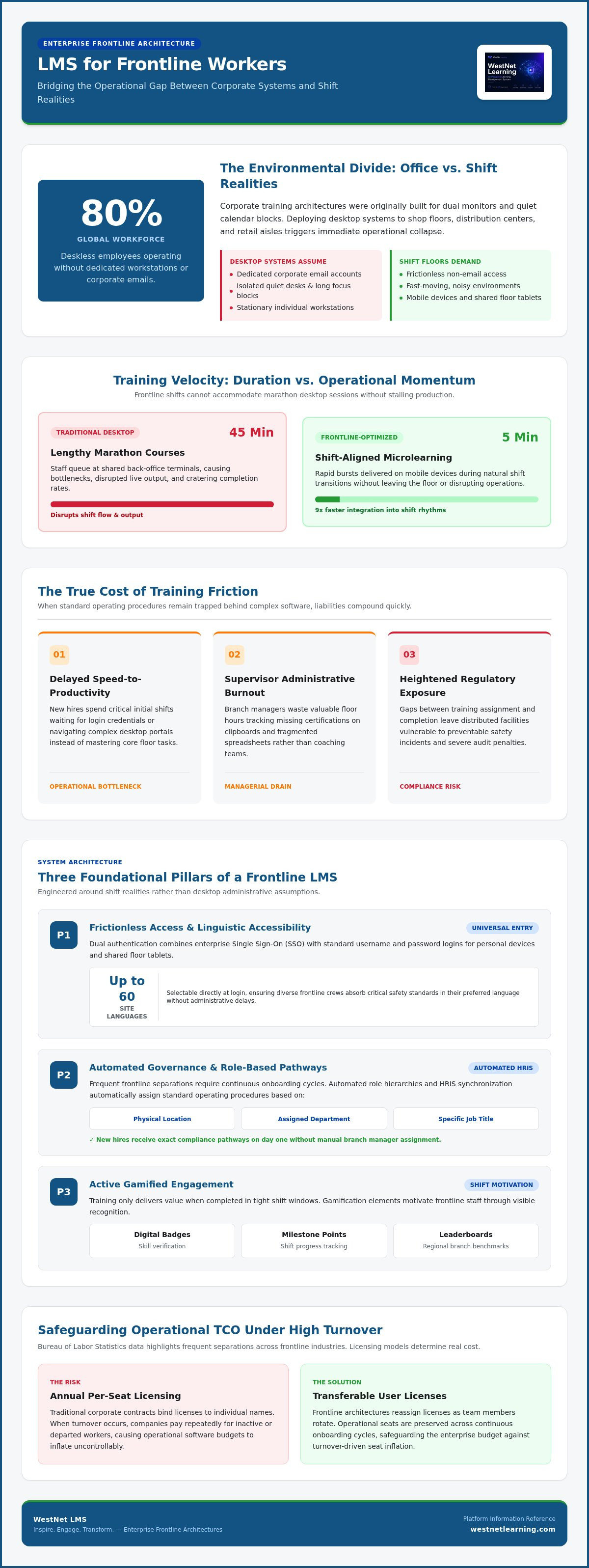
Roughly 80% of the global workforce is deskless, yet traditional enterprise systems still assume employees sit behind a dedicated workstation with a corporate email account. When operations push office-bound software onto dynamic shop floors and retail aisles, adoption collapses and training stalls. Selecting the right LMS for frontline workers requires software engineered around shift realities rather than desktop expectations.
You already know the operational friction: elevated turnover inflates user seat costs, supervisors struggle to verify shift compliance in real time, and centralized training materials often become obsolete before reaching distributed branches. You shouldn't have to absorb administrative waste just to keep field teams certified. In this enterprise guide, you'll discover how to evaluate and select the right frontline LMS to eliminate operational bottlenecks, slash onboarding time, and drive measurable frontline performance. We examine the essential platform criteria, flexible licensing structures, and automated workflows required to empower your distributed workforce.
Key Takeaways
- Understand the operational friction behind deskless software adoption and how mobile-first access eliminates daily workflow barriers.
- Identify the core architectural requirements for an LMS for frontline workers, including frictionless authentication, multilingual logins, and automated HRIS synchronization.
- Uncover why traditional annual per-seat licensing models break under high turnover and how transferable user licenses safeguard your operational budget.
- Master a five-stage procurement framework to pilot and evaluate frontline platforms effectively under real shift conditions.
- Learn how rapid AI course creation and automated microlearning keep distributed teams aligned with evolving safety and operational standards.
Why Traditional Learning Platforms Fail Deskless Frontline Workers
Corporate training architectures were originally designed for employees with dual monitors, corporate email accounts, and quiet calendar blocks. Deskless employees operate under completely different physical realities. When enterprises deploy traditional learning management systems built for white-collar workflows to plant floors or logistics hubs, the outcome is predictable: low adoption, disengagement, and critical operational blind spots. Implementing an effective LMS for frontline workers demands recognizing that a distribution center or retail sales floor cannot be managed like a corporate office.
The Environmental Reality of the Deskless Employee
Desktop e-learning assumes a silent room and sustained stationary focus. In contrast, warehouse associates, retail staff, and field technicians work in noisy, fast-moving environments where stepping away disrupts live output. Requiring staff to queue at a single shared back-office computer terminal creates immediate operational bottlenecks and causes training completion rates to crater. Furthermore, frontline shifts do not accommodate 45-minute courses. Operational momentum requires rapid, five-minute microlearning bursts delivered on mobile devices during natural shift transitions rather than marathon sessions in a back room.
The True Cost of Training Friction on Operational Metrics
Training friction carries direct operational and financial consequences. When standard operating procedures or updated safety protocols remain trapped behind complex software logins, new hire speed-to-productivity stalls. Operational liabilities compound quickly:
- Delayed speed-to-productivity: New hires spend their initial shifts waiting for login credentials or navigating complex desktop portals instead of mastering critical floor tasks.
- Supervisor administrative burnout: Location managers waste hours tracking down missing certifications on clipboards and fragmented spreadsheets rather than coaching floor teams.
- Heightened regulatory exposure: Gaps between training assignment and completion leave distributed facilities vulnerable to preventable safety incidents and severe audit penalties.
A purpose-built LMS for frontline workers eliminates this friction, transforming mandatory compliance tracking into an automated, shift-aligned routine.
Core Architectural Capabilities Every Frontline LMS Must Deliver
Deploying software across distributed field sites requires robust technical infrastructure built specifically for operational velocity. An enterprise LMS for frontline workers cannot rely on assumptions made for corporate headquarters. Instead, it must rest on three foundational pillars: frictionless access, automated governance, and active engagement mechanics.
Frictionless Authentication and Native Mobile Accessibility
Frontline staff rarely have corporate email accounts or Active Directory profiles. Effective platforms solve this through dual authentication models, combining enterprise Single Sign-On (SSO) with standard username and password logins for personal devices or shared floor tablets. Most importantly, diverse workforces require immediate linguistic accessibility. While standard platforms offer generic microlearning, enterprise systems must provide native support for up to 60 site languages selectable directly at login. This ensures crew members absorb critical safety instructions in their preferred language without administrative delays.
Automated Enrollment and Dynamic Role-Based Pathways
Manual course assignment fails across multi-unit operations. As documented in Bureau of Labor Statistics turnover data, frequent frontline separations require continuous onboarding cycles that quickly overwhelm branch supervisors. Modern architectures use automated role hierarchies and HRIS synchronization to assign standard operating procedures automatically based on location, department, or job title. Deploying structured onboarding excellence frameworks ensures that new hires receive their exact compliance pathways on day one, slashing ramp-up times without managerial intervention.
Gamified Engagement to Motivate Shift-Based Completion
Operational training succeeds when employees actually complete it during short shift windows. Digital badges, milestone points, and regional branch leaderboards transform standard compliance into healthy team competition. These mechanics counteract workplace disengagement, turning safety protocols and operational checklists into clear daily habits. Exploring modern platform features reveals how automated incentives drive voluntary completion without pulling managers away from operational priorities.
Calculating TCO: Why Seat Licensing Models Break Under High Turnover
Traditional SaaS subscription models rely on an assumption that rarely holds true in frontline operations: stable, year-round headcount. When organizations buy conventional software licenses, they pay an annual fee per named user. In sectors like retail, hospitality, and light manufacturing, where annual turnover regularly exceeds 50% to 70%, that pricing model breaks down financially. Selecting an enterprise LMS for frontline workers requires evaluating software architectures that account for high staff churn rather than punishing it.
The Hidden Penalties of Static User Subscriptions
Static seat licenses quietly inflate corporate software waste. Consider a distributed facility with 1,000 hourly workers experiencing a typical 60% annual churn rate. Over twelve months, that facility onboarded 1,600 unique individuals. Under a standard corporate contract, the company must either purchase 1,600 individual annual licenses or pay steep mid-contract seat expansion penalties. Deactivated accounts remain locked, tying up capital on employees who left months ago. Manual deactivations quickly overwhelm HR teams, who spend hundreds of hours reconciling dormant profiles instead of focusing on strategic workforce initiatives.
Transferable Licensing and Automated User Life Cycles
Modern enterprise platforms resolve this disparity through transferable user licenses. Instead of permanently assigning an annual fee to a single individual, transferable licensing treats seats as floating operational capacity. When an employee departs:
- The HRIS integration automatically deactivates the departing profile via continuous data synchronization.
- The vacated seat immediately returns to the company's active license pool.
- A newly hired shift worker assumes the available license on day one at zero additional cost.
Research by McKinsey & Company underscores the strategic value of continuous operational skill building for frontline teams to safeguard productivity and safety standards. Coupling this continuous training with transferable seats protects operating margins over multi-year deployments. Evaluating this structure in your buying guide ensures your chosen LMS for frontline workers aligns directly with operational turnover rather than compounding administrative overhead.
Enterprise Evaluation Framework: How to Select Your Frontline Platform
Selecting software for distributed operations requires testing under actual field pressure rather than polished executive slide decks. Standard procurement scorecards often overlook the daily friction of warehouse floors, delivery routes, and store aisles. Evaluating an LMS for frontline workers demands a structured procurement framework that rigorously examines usability under field conditions, regulatory compliance tracking, and enterprise support architectures.
Stress-Testing Real-World Usability in the Field
Never greenlight a learning platform without conducting pilot tests directly on shift hardware. Evaluate the mobile interface across low-bandwidth environments, high-decibel production floors, and shared floor tablets. Time is scarce during fast-paced shifts. Measure the exact seconds it takes an unfamiliar worker to sign in, open an assigned module, and log completion during a brief five-minute break. Platforms with oversized touch targets, clean layouts, and intuitive pathways succeed because they don't require technical coaching. If an interface demands formal training just to navigate the dashboard, floor adoption will collapse.
Auditing Compliance Governance and Operational Analytics
Regulatory protection requires automated governance rather than manual oversight. Confirm that the platform automates recurring recertification schedules for hazardous materials, heavy equipment operation, and workplace safety before deadlines expire. Shift supervisors must have the tools to generate audit-ready compliance logs instantly during surprise field inspections. Robust platforms leverage centralized data driven training dashboards to surface completion rates across multi-unit operations, helping executives spot regional skill gaps before they turn into costly safety violations.
Analyzing Vendor Support, SLAs, and Long-Term Viability
Distributed shifts don't pause at five o'clock. A platform outage during a night shift halts operational onboarding and delays critical production lines. Audit vendor Service Level Agreements (SLAs) to verify high availability and technical safeguards across round-the-clock operations. Partnering with a provider that supplies a dedicated Client Success Manager ensures smooth data migration, reliable HRIS synchronization, and swift resolution of operational questions. When vetting an LMS for frontline workers, prioritize vendors that stand behind their operational reliability. To see how shift-focused learning architecture supports distributed teams, schedule a tailored LMS demonstration to review live functionality.
Modernizing Operational Training with WestNet AI LMS
Bridging corporate compliance standards and real-time floor execution requires an agile, modern technological bridge. Legacy software traps training directors in administrative overhead while field teams struggle with outdated documentation. WestNet AI LMS delivers a high-velocity architecture engineered specifically to resolve this divide. By uniting rapid authoring, dynamic enterprise governance, and flexible seat economics, it provides a comprehensive LMS for frontline workers who need actionable knowledge without operational delays.
Rapid Content Authoring via AI-Powered Creation
Operating procedures, safety mandates, and equipment protocols evolve constantly across fast-moving industries. While generic course marketplaces fail to address your proprietary standard operating procedures, native AI course creation transforms dense operational manuals into interactive SCORM and xAPI micro-modules within minutes. Training administrators can instantly publish emergency safety updates across every branch on the same shift. In addition, built-in AI course recommendations surface personalized upskilling pathways directly to workers based on role milestones and historical performance.
Enterprise Multi-Unit Hierarchy and Governance
Multi-unit operations require a delicate balance between decentralized regional flexibility and centralized corporate control. The platform achieves this through granular hierarchy mapping:
- Customized multi-branding: Configure distinct branding, divisional logos, and custom course catalogs across different operating subsidiaries.
- Granular administrative roles: Empower local shift leads to track compliance and manage rosters without exposing enterprise-wide administrative controls.
- Automated location mapping: Push regional safety certifications exclusively to designated distribution centers or retail units automatically.
Next Steps to Modernize Your Frontline Operations
Modernizing deskless workforce training eliminates administrative waste, protects operational margins through transferable licensing, and creates real-time compliance transparency across every facility. Transitioning to an agile infrastructure starts with clean directory synchronization, allowing your teams to test automated role mapping on actual shift hardware quickly. You can explore how purposeful technology removes operational training bottlenecks and empowers your deskless workforce today. Schedule a live demonstration to evaluate the platform for your organization.
Equip Your Distributed Workforce for Operational Excellence
Operational leaders can no longer rely on rigid desktop tools to govern dynamic shift teams. Sustaining high output requires an LMS for frontline workers built around immediate mobility, automated compliance, and real-time agility. By leveraging transferable user licenses, enterprises eliminate the recurring waste of high turnover while keeping seat allocations fully flexible. Native platform support for up to 60 selectable site languages guarantees clear comprehension on day one, while native AI course creation delivers audit-ready SCORM and xAPI modules the moment operating standards change.
Closing the operational divide transforms routine shift training from an administrative chore into a measurable competitive advantage. Your frontline teams keep your business moving every day; they deserve technology that works as hard as they do. Request a personalized demo to see how WestNet AI LMS elevates frontline performance across your enterprise.
Frequently Asked Questions
What makes an LMS specifically suitable for frontline workers?
An LMS for frontline workers prioritizes mobile accessibility, rapid microlearning, and simplified authentication over desktop portal architectures. It allows employees to complete short five-minute training bursts directly on shift devices without corporate email addresses. Purpose-built platforms also integrate automated role-based enrollment, multi-language switching, and real-time tracking, ensuring fast-paced operational teams stay compliant without leaving the production floor or retail counter.
How do transferable user licenses reduce software costs in high-turnover industries?
Transferable user licenses eliminate the financial penalty of employee churn by allowing organizations to reuse seats without repurchasing subscriptions. When an hourly worker departs, their account deactivates and the license immediately returns to the active enterprise pool. A newly hired replacement assumes that seat on day one. This flexible architecture prevents companies from paying for dormant profiles or purchasing redundant software seats across fluctuating operational seasons.
Can frontline workers complete training on mobile devices without corporate email addresses?
Yes, modern platforms support flexible authentication models specifically designed for deskless staff. Employees can sign in using standard unique usernames, phone numbers, employee IDs, or shared kiosk credentials alongside enterprise Single Sign-On options. This removes the barrier of provisioning costly corporate mailboxes for hourly or temporary staff, granting shift workers immediate access to critical operating procedures on personal phones or shared facility tablets.
How does an AI-powered LMS accelerate safety and compliance course creation?
Native AI course creation transforms static standard operating procedures and equipment manuals into interactive SCORM or xAPI modules in minutes. Instead of waiting weeks for external instructional design, operations leaders can generate structured quizzes, scenario assessments, and micro-lessons instantly. This allows safety directors to distribute mandatory regulatory updates across every branch on the same shift, closing dangerous compliance gaps before audits or incidents occur.
How do enterprise platforms handle training for multilingual frontline workforces?
Enterprise systems solve language barriers by offering native multi-language interface switching directly at the user login screen. In advanced platforms like WestNet AI LMS, workers can choose from up to 60 site languages instantly. This ensures non-native speakers review safety procedures and operational standards with total clarity, driving higher retention, cutting translation overhead, and standardizing compliance across diverse regional teams.
What role does gamification play in maintaining frontline training engagement?
Gamification replaces routine compliance fatigue with healthy operational momentum. Digital milestone badges, achievement points, and shift leaderboards encourage friendly competition across store locations or warehouse shifts. Rewarding voluntary training completion taps into intrinsic motivation, driving higher participation rates during short operational downtime. This approach reinforces critical safety habits naturally without requiring store managers to constantly police shift progress.
How does HRIS integration streamline frontline employee onboarding and offboarding?
Direct HRIS integration automates user life cycles by synchronizing employee roster changes in real time. When a new hire enters your HR directory, the LMS automatically assigns their role-specific onboarding pathway and regional compliance tracks. Upon employee separation, the system deactivates access instantly, logs completed certifications, and returns the transferable license to your active pool, eliminating hours of manual data entry for administrative teams.