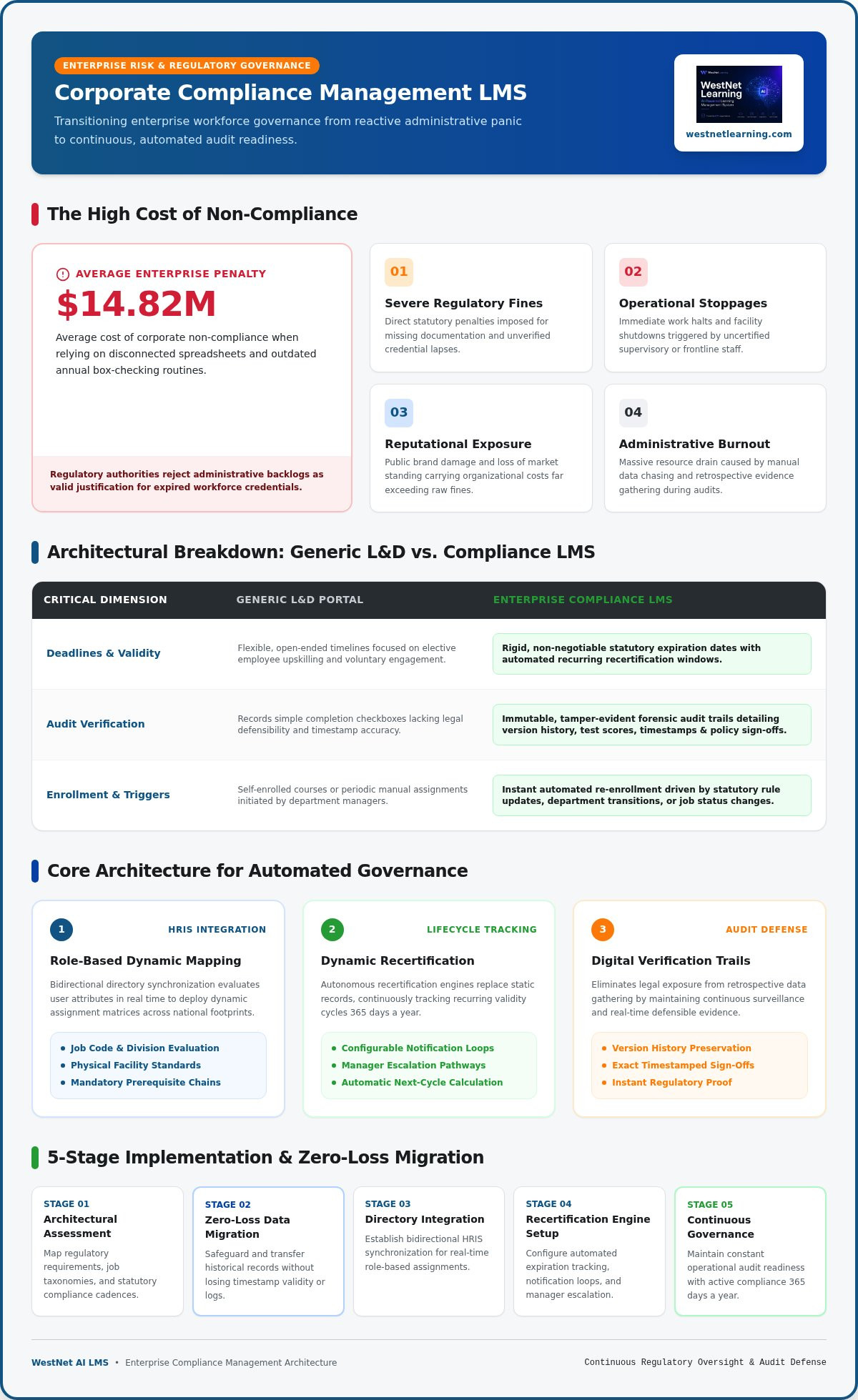
With the average cost of corporate non-compliance reaching $14.82 million, relying on annual box-checking is no longer a viable safeguard against regulatory exposure. You already know the administrative friction firsthand. Tracking recurring certifications across complex organizational structures drains vital resources, while disconnected spreadsheets leave your enterprise vulnerable to severe audit penalties. Adopting an enterprise corporate compliance management LMS resolves this operational divide, shifting your workforce strategy from a reactive administrative scramble to continuous, automated governance.
What core capabilities must a platform deliver to guarantee real-time audit readiness? This guide reveals how modern compliance management LMS architectures automate recertification lifecycles, eliminate regulatory liabilities, and maintain seamless synchronization with enterprise HRIS directories. We'll examine the technical standards, dynamic course generation capabilities, and evaluation benchmarks required to secure and empower your national workforce for 2026 and beyond.
Key Takeaways
- Understand the architectural distinctions between generic employee learning portals and a true corporate compliance management LMS built for continuous audit readiness.
- Eliminate administrative burnout by automating recurring certification lifecycles, role-based assignments, and real-time directory synchronization.
- Compare modern compliance platforms against legacy systems using clear evaluation criteria that prioritize native AI authoring and modern interoperability.
- Follow a five-stage enterprise implementation framework designed to protect historical records during zero-loss certification data migration.
- Discover how WestNet AI LMS transforms compliance governance through dynamic recertification tracking, rapid course authoring, and transferable licensing.
What Defines a Corporate Compliance Management LMS?
While a conventional Learning Management System (LMS) manages general employee upskilling, an enterprise corporate compliance management LMS functions as an authoritative risk governance engine. It automates, verifies, and defends mandatory workforce credentials under strict statutory mandates. In regulated environments, training isn't an elective employee perk; it's an active legal safeguard. Older legacy tools treat compliance as a detached, annual checklist. Modern compliance engines replace that vulnerability with continuous, automated operational oversight, continuously validating worker eligibility and tracking recertification cadences across dynamic workforces.
The Distinction Between General L&D and Compliance Management
Standard learning platforms prioritize course libraries, voluntary learning paths, and broad engagement metrics. However, they lack the forensic architecture necessary for legal defensibility:
- Hard Deadlines vs. Flexible Goals: General L&D tolerates open-ended timelines, whereas statutory compliance enforces rigid, non-negotiable certification expirations.
- Forensic Audit Trails: Elective systems record simple completion checkboxes. Compliance engines log immutable, tamper-evident audit trails detailing version history, test scores, timestamps, and policy sign-offs.
- Automated Enforcement: Compliance platforms automatically re-enroll personnel upon regulatory rule updates or job status changes, closing vulnerability windows instantly.
The Business Stakes of Automated Regulatory Governance
Operating with disconnected spreadsheets or basic training portals exposes an enterprise to severe legal, financial, and operational penalties. Regulatory authorities don't accept administrative backlog as an excuse for expired certifications or missing documentation. Fines represent only a fraction of the total exposure; unexpected work stoppages and reputational harm carry far heavier organizational costs. Implementing an intelligent corporate compliance management LMS establishes continuous surveillance across your organization. It delivers real-time visibility and instant audit defense, transforming regulatory posture from a reactive crisis into a silent operational safeguard.
Core Architecture: How Modern Systems Automate Regulatory Tracking and Audits
Architecture dictates compliance reliability. A modern corporate compliance management LMS replaces manual administration with autonomous synchronization, linking directly to enterprise identity providers and HRIS directories. When an employee switches departments or assumes higher supervisory duties, dynamic mapping engines trigger immediate course assignments without human intervention. Enterprises adopting structured compliance training best practices rely on this continuous framework to eliminate gaps between organizational policy updates and frontline workforce execution.
Automated Enrollment and Role-Based Curriculum Mapping
Manual course enrollment invites human error. Modern platforms solve this friction via bidirectional directory synchronization. The system evaluates user attributes, including job code, division, and physical facility, to populate dynamic assignment matrices. If a technician transitions to a supervisory position, prerequisite chains enforce mandatory safety and ethics modules before elevated permissions unlock. Role hierarchy assignment guarantees that every facility across your national footprint maintains identical regulatory standards.
Dynamic Expiration Tracking and Recertification Engines
Static records let certifications expire unnoticed. Intelligent platforms implement autonomous recertification engines that track recurring validity windows in real time. Configurable notification loops alert personnel weeks before expiration dates, while manager escalation pathways notify department heads of at-risk credentials. Once a recertification cycle completes, the system logs the credential and calculates the next cycle automatically, sustaining active compliance 365 days a year without administrative burnout.
Audit-Ready Reporting and Digital Verification Trails
When regulatory agencies demand proof, retrospective data gathering creates immense legal vulnerability. Modern platforms record immutable audit logs capturing timestamps, test scores, attempt histories, and electronic policy acknowledgments. Similar to the technical benchmarks outlined in the IRS Learning Management System Standards, reliable architectures preserve standardized recordkeeping that withstands rigorous federal scrutiny. Instant dashboard analytics aggregate these records into framework-specific reports. To eliminate data silos across your organization, evaluate how flexible LMS integrations unify workforce directories with real-time audit verification.
Evaluating Compliance LMS Platforms: Essential Features vs. Outdated Checkboxes
Legacy platforms treat compliance as an archived repository, demanding months of custom development to update a single policy module. Selecting a future-ready corporate compliance management LMS requires looking past surface-level checkboxes to evaluate architectural agility, identity assurance, and long-term ownership costs. Before renewing an outdated contract, review how modern platform features protect organizations from regulatory liabilities and administrative drag.
| Evaluation Metric | Legacy LMS Checkbox | Modern Compliance Architecture |
|---|---|---|
| Policy Updates | Manual authoring cycles lasting months | Rapid AI-assisted module creation |
| User Seat Licensing | Rigid named licenses lost during turnover | Transferable user licenses recycled dynamically |
| Identity Assurance | Basic password logins; unverified test-takers | Mandatory SSO and role-based access control |
| Workforce Reach | Monolingual portals requiring bolt-on add-ons | Up to 60 site languages selected at login |
AI-Powered Course Authoring and Standards Compliance
Updating training materials when statutory mandates shift cannot wait on six-month instructional design cycles. Leading systems utilize native AI course authoring to translate internal policy manuals, safety procedures, and legal memos into interactive training modules in hours. Platforms must maintain strict conformance with SCORM 1.2, SCORM 2004, and xAPI specifications. This universal interoperability allows your enterprise to import established third-party course libraries while authoring proprietary modules internally without technical friction.
Identity Security, Authentication, and Enterprise Integration
Regulatory audits collapse if you cannot prove who actually completed an assessment. High-assurance platforms implement Single Sign-On (SSO) integration alongside multi-factor authentication, confirming employee identities at login. Bi-directional synchronization with your core HRIS and ERP directories continuously aligns learner permissions with current organizational structures. Supervisors gain dedicated oversight dashboards to monitor direct reports, approve practical evaluations, and manage remediation immediately.
Licensing Efficiency and Global Workforce Support
Turnover shouldn't inflate your software overhead. While traditional vendors charge non-refundable annual fees for inactive profiles, an adaptable corporate compliance management LMS utilizes transferable user licenses. Deactivated seats can be reassigned instantly to incoming hires. Furthermore, supporting up to 60 native languages selected directly at login ensures clear policy comprehension across diverse, distributed teams without forcing administrators to maintain fragmented localized portals.
Step-by-Step Implementation: Deploying a Compliance LMS Across the Enterprise
Deploying compliance infrastructure across a complex enterprise demands technical precision. If historical records or completion timestamps get corrupted during migration, your organization faces immediate audit exposure. A successful rollout migrates legacy datasets seamlessly while embedding automated governance into everyday operations. Partnering with a dedicated Client Success Manager under a documented Service Level Agreement ensures your technical transition stays on schedule, eliminating downtime and preserving historical certifications.
- Audit Mapping and Baseline Assessment: Catalog statutory mandates across federal, state, and industry bodies, matching them to job titles and divisions.
- Taxonomy Standardization: Standardize course naming conventions, validity durations, and prerequisite scoring thresholds to eliminate duplicate assignments.
- Historical Data Ingestion: Extract, sanitize, and validate legacy completion files through automated pipelines before committing records to the primary database.
- System Integration and Directory Sync: Connect HRIS and ERP data feeds via secure APIs to enable automated user provisioning and role-based assignments.
- Sandbox Verification and Full Cutover: Simulate audit reporting and automated recertification loops in staging environments prior to workforce-wide launch.
Regulatory Audit Mapping and Curriculum Architecture
Begin by systematically auditing all regulatory obligations, from OSHA safety protocols to financial ethics requirements. Define prerequisite chains, renewal cadences, and passing thresholds for every distinct functional role. Standardizing naming taxonomy prevents redundant enrollments when personnel operate across cross-functional divisions.
Legacy Data Migration and System Integration
Preserving historical audit viability requires meticulous data extraction. Ingesting legacy completion archives through structured ingestion pipelines validates that every completion timestamp, test score, and certificate credential transfers cleanly. Bi-directional API integration links your HRIS to the platform, ensuring ongoing organizational changes propagate across all learning profiles instantly.
Rollout, Automation Verification, and Continuous Governance
Validate system automation within controlled pilot groups before launching organization-wide. Test escalation rules, recertification alerts, and real-time audit defense dashboards under simulated audit inquiries. Discover strategic deployment frameworks in our guide on modernizing corporate learning systems. When you're ready to secure enterprise workforce governance, get started with a purpose-built deployment roadmap tailored to your operational structure.
Modernizing Compliance Operations with WestNet AI LMS
Modern compliance governance demands speed, precision, and reliable cost controls. Fragmented spreadsheets and disjointed platforms drain administrative bandwidth while multiplying audit liability. As an enterprise corporate compliance management LMS, WestNet AI LMS centralizes regulatory oversight into an intelligent, automated framework. Organizations gain real-time visibility across every business unit, transforming annual audit preparation into an autonomous operational baseline.
Automated Regulatory Governance and Adaptive Learning
Eliminate administrative overhead with proactive compliance automation. WestNet AI LMS automates certification monitoring and dynamic recertifications, enrolling employees the moment internal policies shift or statutory deadlines approach. The platform delivers native AI Course Creation to generate fully interactive training modules from uploaded policies in minutes. Supporting both SCORM and xAPI standards, the platform pairs with comprehensive off-the-shelf eCourses, while integrated AI assistance guides learners through challenging assessment checkpoints.
Enterprise Infrastructure, Support, and Global Reach
Managing distributed teams requires flexible architectural support. WestNet AI LMS scales effortlessly across national operations, offering comprehensive features designed for complex organizational structures:
- Transferable User Licenses: Reassign active seats dynamically when employees depart, eliminating wasted budget on turnover churn.
- Multilingual Accessibility: Ensure immediate policy comprehension with support for up to 60 site languages selected at login.
- Guaranteed Operational Uptime: Rely on a dedicated Client Success Manager and a documented Service Level Agreement to ensure continuous technical performance.
Next Steps: Securing Your Enterprise Compliance Strategy
Mitigating organizational exposure requires shifting from reactive training administration to autonomous governance. Replacing fragmented tools with an integrated corporate compliance management LMS ensures reliable audit defense, protects enterprise budgets, and frees administrators to focus on strategic growth. Explore our dedicated lms for compliance training capabilities, or schedule an interactive demo to see how WestNet AI LMS automates your workforce governance.
Architecting Continuous Compliance: The Path Forward
Transitioning from fragmented spreadsheets to an intelligent corporate compliance management LMS eliminates operational vulnerability while automating regulatory defensibility across your organization. Continuous audit readiness replaces periodic administrative chaos with calm, structured governance. Modern platforms secure this posture through dynamic recertification engines, automated directory synchronization, and rapid AI authoring that adjusts instantly when statutory requirements evolve.
Sustainable enterprise governance requires infrastructure built to scale alongside operational complexity without budget friction. WestNet AI LMS provides this foundation with native support for up to 60 user-selected interface languages, transferable licensing ensuring zero wasted seats during turnover, and the strategic guidance of a dedicated Client Success Manager backed by a documented Service Level Agreement. Take command of your compliance posture today. Schedule a personalized demo to see how an automated learning architecture protects your enterprise and positions your national workforce for lasting success.
Frequently Asked Questions
How does a corporate compliance management LMS differ from a standard employee training platform?
A corporate compliance management LMS prioritizes legal defensibility, audit trails, and statutory deadlines rather than elective professional development. Standard platforms focus on course libraries and general engagement. Compliance systems enforce mandatory completion dates, maintain immutable version histories, and automate recurring certifications. They link employee credentials directly to operational roles, ensuring your enterprise maintains continuous, verifiable compliance rather than relying on surface-level training checklists.
Can a compliance LMS automate recurring annual certifications and recertification notices?
Yes, automated recertification engines manage the entire lifecycle of recurring credentials without administrative oversight. The platform calculates upcoming expiration windows dynamically, triggering early reminders to workers and escalation notices to managers before deadlines pass. Once an employee completes the assigned module, the system issues a verified digital certificate, updates their record, and resets the renewal clock for the following compliance cycle automatically.
How do AI course authoring tools accelerate compliance training development when regulations change?
AI course authoring tools eliminate months of instructional design backlog by converting raw policy documents directly into interactive e-learning modules in hours. When statutory guidelines shift, administrators can upload updated guidelines to generate structured learning materials, practical assessments, and knowledge checks automatically. Conforming to SCORM and xAPI standards, these tools ensure freshly generated modules deploy seamlessly across your infrastructure with full tracking capabilities.
What happens to existing employee certification records when migrating to a modern LMS?
Historical certification records are sanitized, validated, and ingested into the new database to ensure zero loss of historical compliance status. Structured data migration pipelines map existing completion timestamps, test scores, and credential histories to standardized user profiles. With support from a dedicated Client Success Manager, organizations preserve legal audit trails from legacy databases without disrupting active recertification schedules during cutover.
How does HRIS integration improve corporate compliance management and record accuracy?
Native HRIS integration improves compliance recordkeeping by establishing continuous, bi-directional directory synchronization between human resources platforms and the learning management system. When an employee experiences a promotion, department transfer, or onboarding status update, the system adjusts curriculum assignments automatically. This synchronization maintains accurate role-based compliance tracking, guarantees immediate enrollment for new hires, and deactivates learning access for departing staff without administrative latency.
What are transferable user licenses and how do they benefit organizations with fluctuating workforces?
Transferable user licenses allow enterprises to recycle seat allocations dynamically instead of paying non-refundable fees for inactive users. In organizations with seasonal hiring or high turnover, departing workers have their profiles deactivated while their historical audit records remain archived. Administrators then reassign those open license seats to incoming personnel immediately, maximizing budget predictability and preventing unnecessary subscription overhead across national operations.
Can a compliance management LMS support multinational workforces across multiple languages?
Deploying an enterprise corporate compliance management LMS accommodates distributed workforces by delivering localized interfaces and multilingual course delivery. For instance, WestNet AI LMS provides support for up to 60 site languages that users select directly at login. This capability ensures workers comprehend statutory regulations, company ethics, and safety protocols in their preferred language, driving higher comprehension rates while standardizing corporate governance globally.