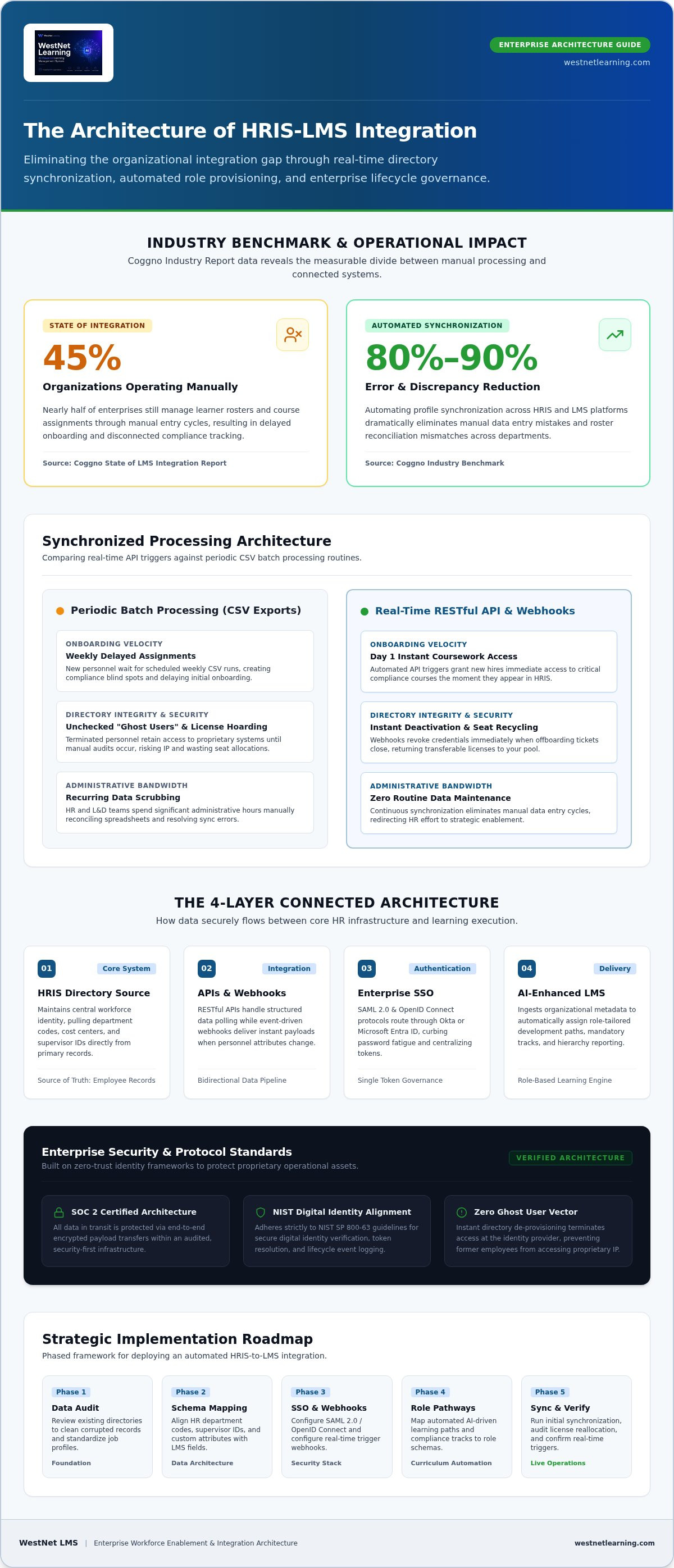
According to the March 2026 Coggno State of LMS Integration Report, 45% of organizations still manage learner rosters and course assignments manually. Every unassigned compliance course, out-of-sync job title, and delayed user deactivation drains administrative hours while exposing your business to severe compliance liabilities. Operating an agile enterprise requires precision, yet disconnected systems continually trap HR and L&D teams in manual data entry cycles. Deploying a modern corporate LMS with HRIS integration bridges this operational divide, transforming static employee records into an automated, synchronized learning pipeline from day one.
You shouldn't have to choose between strict directory security and rapid workforce development. In this guide, you'll discover how integrating your HRIS with a modern LMS eliminates administrative overhead, secures data integrity, and scales personalized AI-driven training across every department. We'll examine the technical mechanics of real-time user provisioning, automated role-based compliance tracking, and unified reporting architectures that align daily administration with long-term strategic growth.
Key Takeaways
- Eliminate administrative silos by pairing your directories; a modern corporate LMS with HRIS integration prevents roster reconciliation errors and automates lifecycle workflows.
- Strengthen data governance and enterprise security using RESTful APIs, webhooks, and Single Sign-On (SSO) protocols that trigger real-time provisioning.
- Reduce total cost of ownership and eliminate wasted seat allocations by recycling transferable licenses the moment departures occur in your HR system.
- Follow a structured five-step implementation roadmap, prioritizing data audits and precise schema mapping to ensure seamless initial synchronization.
- Empower your workforce through the AI Enhanced LMS, transforming raw job role data into personalized, automated development pathways and compliance tracks.
Bridging the Gap: Why HRIS Integrated LMS is Critical for Data Accuracy
HRIS-LMS integration establishes a continuous, bidirectional bridge between your core employee directory and enterprise learning architecture. Instead of treating training as an isolated destination, this automated synchronization turns worker records into real-time triggers for onboarding, compliance tracking, and skill development. When these platforms operate independently, an organizational rift opens up: the integration gap.
Within this gap, outdated records propagate across departments unchecked. A promotion logged in payroll fails to reflect in learning paths, while mandatory certifications earned by front-line staff never report back to human resource files. This friction distorts your L&D reporting, leaving leadership with skewed compliance completion figures and unprovable ROI metrics. Modern learning management systems solve this structural flaw by transforming raw personnel attributes into verifiable, role-based workflows that scale alongside enterprise growth.
The High Cost of Manual User Management
Manual roster maintenance drains administrative resources. According to the March 2026 Coggno Industry Benchmark, organizations that automate profile synchronization reduce manual data entry errors and roster reconciliation discrepancies by 80% to 90%. Relying on manual input introduces dangerous security vectors. Terminated personnel frequently linger as "ghost users" inside disconnected training portals, retaining access to proprietary operational collateral long after their corporate credentials expire. WestNetLMS eliminates these risks by applying automated directory rules that instantly align platform access with central identity records, safeguarding intellectual property without manual intervention.
Real-Time Synchronization vs. Batch Processing
Periodic CSV exports cannot support an agile enterprise. Batch files processed on weekly schedules inevitably produce blind spots, leaving records desynchronized for days at a time. Consider the operational differences:
- Onboarding velocity: Real-time API triggers give new hires access to essential coursework on Day 1, whereas batch uploads delay initial compliance completions.
- Directory integrity: Instant webhooks revoke seat access the moment an offboarding ticket closes, preventing license hoarding.
- Administrative bandwidth: Teams eliminate recurring data scrubbing cycles entirely, shifting focus toward strategic workforce enablement.
Implementing a modern corporate LMS with HRIS integration ensures system harmony. Explore WestNet's integration capabilities to see how unified directory protocols automate user provisioning from day one.
The Technical Architecture of a Connected Learning Ecosystem
Enterprise learning networks rely on resilient connectivity. RESTful APIs and lightweight webhooks form the connective tissue between your core HR platform and training database, broadcasting employee record updates instantaneously. While standard APIs pull structured data during scheduled calls, webhooks deliver event-driven payloads the moment a trigger occurs in your primary directory. Aligning internal infrastructure with NIST digital identity and lifecycle management standards demands strict protocol compliance. Implementing a corporate LMS with HRIS integration satisfies this standard by running end-to-end encrypted payload transfers within a SOC 2 certified, security-first architecture.
Single Sign-On (SSO) and Authentication Options
Password fatigue erodes software adoption from day one. Requiring employees to store separate credentials for compliance portals produces forgotten logins, floods IT helpdesks with reset tickets, and delays mandatory training. WestNetLMS addresses this friction by pairing standard sign-in workflows with enterprise Single Sign-On protocols, including SAML 2.0 and OpenID Connect. Single Sign-On serves as a critical security layer for modern enterprises, centralizing access controls through trusted identity providers like Okta or Microsoft Entra ID. Terminating an identity token at the directory level severs LMS permissions instantly, preventing unauthorized entry.
Automated Hierarchy and Department Management
Ingesting organizational metadata turns static rosters into living organizational charts. When the platform pulls department codes, cost centers, and supervisor IDs directly from your HRIS, administrative logic runs in the background. Consider how this structural awareness improves oversight:
- Targeted assignments: Job title adjustments instantly assign role-specific training pathways, while geographic changes reassign regional compliance requirements.
- Supervisor oversight: Learner dashboards automatically reflect direct reporting lines, giving managers visibility into team completion rates without manual roster configuration.
Explore WestNet features to discover how automated hierarchy management streamlines operational visibility. If you are preparing your tech stack for automated synchronization, you can schedule a live platform demonstration to explore your setup.
Maximizing Operational ROI Through Automated Lifecycle Management
Deploying a modern corporate LMS with HRIS integration drives down the total cost of ownership by eliminating recurring administrative bottlenecks. When HR platforms talk directly to training engines, manual enrollment workflows disappear. Data migration support from technical specialists prevents historical completion records from vanishing during deployment, securing a reliable audit trail. Unifying these architectures establishes a single source of truth across operations. This alignment satisfies regulatory scrutiny, accelerates worker development, and prevents operational capital from leaking into administrative tasks.
Transferable User Licenses and Cost Control
Traditional SaaS subscription models penalize enterprise turnover through rigid seat allocations. Many legacy platforms charge per unique user registered over the course of a fiscal year, causing subscription bills to balloon simply because employees transition between roles. WestNetLMS changes this dynamic by offering transferable user licenses. The instant an offboarding event registers in your HR software, the departing worker's seat deactivates and returns directly to the available pool for new hires. Recycling seats rather than paying permanent penalties substantially improves your long-term LMS ROI by keeping licensing expenditures strictly aligned with active headcount.
Automated Compliance and Certification Tracking
Manual compliance administration carries immense regulatory risk. Relying on spreadsheets to track mandatory training schedules leaves teams blind to expired qualifications until an auditor reviews the files. An integrated learning system converts HR attributes into proactive regulatory safeguards through automated enrollment rules:
- Role-triggered assignments: Promoting an employee to supervisor automatically launches mandatory management ethics curricula.
- Recurrence scheduling: Expiring certifications trigger automated notifications and re-enrollments 30, 60, or 90 days before deadlines.
- Audit verification: Completed records sync bi-directionally back to the employee's HR profile, creating defensible regulatory records.
Modern organizations combine these triggers with proven compliance training best practices to guarantee consistent compliance across every department.
Strategic Implementation: A 5-Step Roadmap for HRIS Integration
Connecting your personnel directory to your training environment requires systematic execution. Without a disciplined framework, mismatched properties and duplicate records will undermine downstream automation. Follow this five-step technical roadmap to ensure a resilient deployment:
- Step 1: Audit and clean source records. Purge defunct employee profiles, resolve naming discrepancies, and verify email formats inside your primary directory.
- Step 2: Map structural schema. Establish matching rules between standard HR fields and corresponding database tables in the AI Enhanced LMS.
- Step 3: Configure identity authentication. Connect your identity provider to enforce federated sign-on and token validation across all learning endpoints.
- Step 4: Execute a staging pilot. Run bidirectional test syncs inside a sandbox environment to validate group inheritance and privilege assignments.
- Step 5: Launch production sync. Transition to scheduled production events, activating real-time provisioning, automated enrollments, and compliance auditing.
Data Mapping and Field Alignment
Clean directory architecture is essential for successful automation. Aligning foundational properties like "Job Title," "Department," and "Location" guarantees that enrollment triggers target the correct cohorts without manual oversight. If your industry requires unique tracking criteria, such as clinical accreditations or regional safety licenses, custom fields must be paired with corresponding metadata tags. WestNetLMS provides dedicated administrator support during data migration, ensuring legacy records transfer cleanly without schema errors.
Testing and Quality Assurance (QA)
Never deploy schema rules straight to production. Sandboxes allow systems engineers to simulate core lifecycle changes, including new hires, departmental promotions, and immediate terminations. Validating that these events trigger proper enrollments and revoke outdated access confirms the stability of your automated workflows. Reliable infrastructure is paramount. A comprehensive Service Level Agreement (SLA) ensures high uptime, giving enterprise stakeholders confidence that directory services remain uninterrupted during operational peaks.
Ready to modernize your employee learning architecture? Get started with WestNet today to build an automated, scalable enterprise training framework.
The WestNet Advantage: AI-Enhanced Connectivity and Human Support
Modern enterprises need more than raw software; they need a visionary partner capable of translating technical connectivity into sustainable workforce momentum. WestNet LMS bridges structural data silos and actionable development through a dual focus on advanced intelligence and human guidance. Deploying our AI Enhanced LMS allows organizations to scale personalized training frameworks worldwide, supporting up to 60 site languages chosen directly by users at login. This global flexibility ensures distributed teams experience seamless, localized training pathways regardless of geographic footprint.
AI-Powered Personalization Driven by HR Data
Static course catalogs fail to engage modern workforces. Instead of forcing learners to navigate massive directories, the WestNet AI LMS evaluates incoming HRIS attributes, including operational roles, tenure milestones, and departmental goals, to recommend relevant off-the-shelf eCourses automatically. Curating individual career trajectories fuels deeper engagement, measurably impacting long-term employee retention. When organizations need tailored instructional collateral, our native AI Course Creation engine drafts structured modules in minutes, keeping curricula aligned with rapidly shifting operational objectives.
The Role of the Dedicated Client Success Manager
Complex directory migrations should never be abandoned to automated chatbots or unmonitored ticketing queues. Navigating custom schema transformations, identity federation, and legacy record imports requires hands-on enterprise expertise. WestNet pairs every account with a dedicated Client Success Manager to oversee initial technical integration and deliver continuous administrator support. Operating directly from our Arvada, Colorado headquarters, our expert support team remains readily accessible by phone at 303.424.9168.
Pairing strategic human guidance with a robust corporate LMS with HRIS integration transforms routine compliance into an autonomous engine for enterprise capability. Schedule a Demo today to explore how our unified architecture automates your entire employee learning lifecycle.
Modernize Your Enterprise Learning Lifecycle Today
Disconnected systems restrict organizational agility and drain valuable administrative hours. Unifying your personnel records with an intelligent platform transforms static data into active capability. Implementing a scalable corporate LMS with HRIS integration turns routine onboarding into a continuous, automated engine for development. You protect operating budgets through transferable user licenses that recycle seats automatically upon employee departures, ensuring you only pay for active headcount. At the same time, AI-powered course recommendations leverage real-time HRIS attributes to tailor curricula to individual career paths without manual curation.
Enterprise modernization doesn't require navigating complex schema mappings alone. Backed by a dedicated Client Success Manager for hands-on technical integration and ongoing administrator support, your transition to an automated architecture remains smooth and secure. Empower your workforce, safeguard operational compliance, and scale your training programs with total confidence. Request a Personalized Demo of WestNet AI LMS to experience seamless directory connectivity firsthand.
Frequently Asked Questions
What is the benefit of a corporate LMS with HRIS integration?
Deploying a corporate LMS with HRIS integration eliminates redundant manual administrative workloads across HR and L&D teams. By bridging your personnel directory with training delivery, employee records sync automatically from day one. New hires gain immediate access to role-based onboarding, organizational promotions trigger relevant upskilling paths, and departing personnel lose portal access instantly. This real-time alignment safeguards sensitive proprietary materials, prevents costly compliance oversights, and ensures executive reporting reflects current workforce performance.
Does WestNet LMS support Single Sign-On (SSO) for HRIS connectivity?
Yes, WestNetLMS provides flexible authentication options to suit enterprise requirements. The platform supports standard username and password logins alongside enterprise Single Sign-On protocols like SAML 2.0 and OpenID Connect. Connecting your centralized identity provider lets learners access training directly through existing corporate credentials. This setup removes password fatigue, eliminates reset tickets for internal IT teams, and ensures immediate deprovisioning when employee accounts close in your central directory.
How does automated enrollment work with an integrated LMS?
Automated enrollment functions by mapping incoming HRIS attributes directly to course catalog logic. When your central directory records a change in an employee's department, job code, or geographic office, the learning system triggers corresponding curricula instantly. Workers receive notifications and immediate dashboard assignments for their required courses. Administrators don't need to manually build rosters or assign modules, ensuring standard training paths scale effortlessly as teams grow.
Can I reuse licenses for new employees in WestNetLMS?
Yes, WestNetLMS features transferable user licenses designed to keep software overhead strictly aligned with active headcount. Unlike rigid platforms that bill for every user created throughout a contract year, our licensing model permits seat recycling. When a worker departs and their account deactivates via HRIS synchronization, that software license immediately returns to your available seat pool. You can reassign it to an incoming hire without paying extra penalties.
What HRIS platforms are compatible with WestNet Learning?
WestNet LMS connects with all leading enterprise HRIS and human capital platforms through open RESTful APIs, secure webhooks, and standard SCIM protocols. Whether your organization relies on systems like Workday, ADP, BambooHR, SAP SuccessFactors, or centralized identity hubs like Microsoft Entra ID, our technical framework handles the data exchange. We accommodate standard properties alongside unique custom fields to match your organization's precise administrative hierarchy and tracking criteria.
How long does it typically take to set up an LMS integration?
Deployment timelines depend on directory size, schema complexity, and custom field requirements. Standard API connections and SSO configurations typically wrap up within a few weeks, especially when existing HR records are clean and standardized. Every account receives a dedicated Client Success Manager who coordinates data field mapping, oversees sandbox testing, and assists with administrative setup. This structured support prevents procedural roadblocks and accelerates your rollout schedule.
Is data migration support included with WestNet AI LMS?
Yes, comprehensive data migration support comes standard with the AI Enhanced LMS. Moving legacy completion logs, certification histories, and historical training records can easily overwhelm internal teams. Your dedicated Client Success Manager guides you through the entire extraction, scrubbing, and ingestion cycle. We ensure historical learner data maps accurately into your new architecture, preserving full compliance auditing integrity without data corruption or loss.
How does an integrated LMS improve compliance training accuracy?
Implementing a corporate LMS with HRIS integration improves compliance by establishing an unbroken, bi-directional record between personnel changes and mandatory training. Automated recurrence rules track renewal dates and trigger timely alerts before certifications lapse. Because user records update continuously, completion dashboards and audit reports always reflect active personnel rather than outdated rosters. This synchronization provides leadership with audit-ready documentation and eliminates the risk of missed regulatory deadlines.