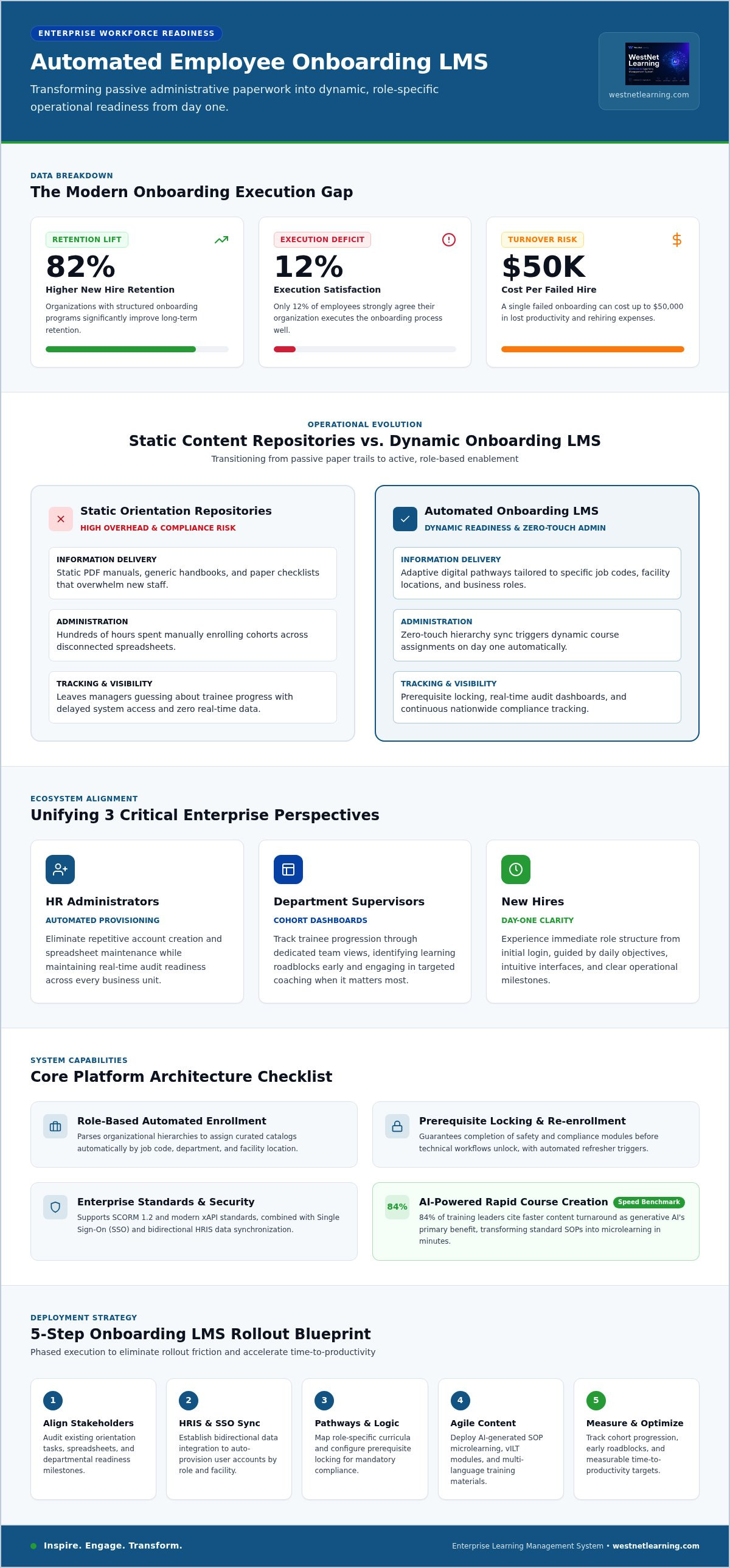
Organizations with structured onboarding programs improve new hire retention by 82%, yet only 12% of employees strongly agree their company executes the process well. If your HR team spends hundreds of hours manually enrolling cohorts across disconnected spreadsheets, that gap shouldn't come as a surprise. Deploying an automated employee onboarding training LMS bridges this operational divide, transforming passive paperwork into immediate, role-specific operational readiness from day one.
You already know that delayed system access and one-size-fits-all training paths frustrate new hires and invite compliance audit risks. Enterprise teams shouldn't have to battle rigid software licenses or fragile manual data transfers just to get talent up to speed. In this guide, you'll discover how an automated employee onboarding training LMS accelerates new hire ramp-up while reducing administrative overhead. We'll walk through the definitive enterprise buyer checklist, outlining the critical HRIS integrations, accessibility benchmarks, and automated workflows required to build a modern onboarding engine.
Key Takeaways
- Distinguish between static content repositories and an automated employee onboarding training LMS built to drive rapid workforce readiness.
- Eliminate administrative drag by syncing organizational hierarchies to trigger dynamic, role-specific course assignments on day one.
- Protect enterprise integrity with bidirectional HRIS integrations, Single Sign-On, and continuous compliance tracking across nationwide distributed teams.
- Follow a phased five-step implementation blueprint to avoid rollout friction, align stakeholders, and hit measurable time-to-productivity targets.
- Maximize training agility using modern AI-driven course generation, multi-language delivery, and transferable software licenses.
What Is an Employee Onboarding Training LMS?
An employee onboarding training LMS is an enterprise software engine designed to accelerate operational readiness for incoming personnel. While a conventional Learning Management System (LMS) often functions as a passive repository for static training videos, a dedicated onboarding platform dynamically provisions role-specific curricula, orchestrates task delivery, and verifies early job competency. A failed hire can cost an enterprise up to $50,000 in lost productivity and rehiring expenses. Deploying an active enablement system directly defends against early turnover by converting fragmented orientation tasks into structured, measurable business milestones.
The Core Shift: Static Documentation vs. Dynamic Onboarding
Static PDF manuals, generic handbooks, and paper checklists inevitably create administrative bottlenecks. They leave managers guessing about trainee progress and overwhelm incoming staff with uncontextualized information. In contrast, modern platforms deliver adaptive digital pathways tailored to specific job codes and operational roles. Implementing a dedicated LMS for onboarding replaces manual follow-ups with automated milestones. As employees complete prerequisite safety, culture, or compliance modules, the system dynamically unlocks technical workflows, establishing cultural immersion and reliable compliance across nationwide teams.
Key Stakeholders: Connecting HR, Team Leads, and Learners
A high-performance employee onboarding training LMS unifies three critical operational perspectives into a single ecosystem:
- HR Administrators: Eliminate repetitive account creation and spreadsheet maintenance through automated provisioning, maintaining real-time audit readiness across every business unit.
- Department Supervisors: Track cohort progression through dedicated team dashboards, identifying learning roadblocks early and engaging in targeted coaching when it matters most.
- New Hires: Experience immediate clarity from their initial login, guided by structured daily objectives, intuitive interfaces, and clear benchmarks that outline exactly what operational success looks like.
Automated Employee Onboarding Software Checklist: Core Features
Selecting the right enterprise software requires looking past surface-level interfaces to inspect core operational mechanics. A modern employee onboarding training LMS must eliminate administrative bottlenecks while accelerating role readiness. As explored in research on Reinventing Employee Onboarding by MIT Sloan Management Review, establishing personal connection and structured role alignment early significantly strengthens engagement. Aligning platform capabilities with our strategic LMS for onboarding architecture ensures your organization avoids costly platform migrations down the road.
Automated Enrollment and Role-Based Pathways
Enterprise onboarding demands zero-touch administration. The platform should parse organizational hierarchies to reveal only the relevant course catalog based on job code, department, and facility location. Prerequisite locking ensures employees finish mandatory safety or data privacy certifications before accessing advanced operational tasks. When regulatory policies update, dynamic re-enrollment logic automatically assigns refresher modules to affected cohorts without requiring HR intervention.
Rapid Content Development and Format Flexibility
Agile teams cannot wait weeks for course revisions. Look for native systems supporting SCORM 1.2 and modern xAPI standards, alongside hybrid delivery combining self-paced tracks with virtual instructor-led training (vILT). Leveraging modern AI course creation enables L&D teams to transform standard SOPs into interactive, multi-format microlearning modules in minutes, addressing the reality that 84% of training leaders cite faster content turnaround as generative technology's primary benefit.
Scalable Administrative Architecture and Licensing
Procurement models should support organizational reality, not punish it. Prioritize platforms that offer:
- Transferable User Licenses: Reassign active seats freely when seasonal personnel rotate out or turnover occurs, preventing wasted software spend.
- Multi-Language Interfaces: Provide native language support for up to 60 selectable site languages at login, ensuring consistent delivery across nationwide and global operations.
- Gamified Milestones: Drive organic completion rates through tiered leaderboards, micro-badges, and progress trackers that turn routine orientation into engaging achievements.
To see how these capabilities function together in an enterprise environment, explore an interactive demo tailored to your team's operational structure.
Technical Architecture: HRIS Integration, Security, and Compliance
Enterprise infrastructure succeeds or fails on the strength of its underlying data pipelines. An employee onboarding training LMS cannot operate as an isolated digital island; it must function as a synchronized extension of your core human resources ecosystem. Without robust API connectivity, administrative teams waste countless hours on manual user provisioning, leading to credential delays and critical compliance gaps. Modern learning architecture resolves this friction by establishing bidirectional data flows that bridge human resources systems directly with automated training environments.
Automated Data Synchronization via HRIS and SSO
Real-time data synchronization ensures instant operational alignment. When an HR manager finalizes a new hire record within the human resources information system, automated webhooks instantly create the employee profile inside the learning platform. Implementing enterprise-grade LMS integrations allows synchronized organizational hierarchies to assign location-specific and role-based training before day one arrives. Single Sign-On (SSO) protocols, such as SAML 2.0 and OAuth, eliminate login barriers entirely. New hires authenticate using their existing corporate credentials, avoiding lost passwords and day-one support tickets. When offboarding occurs, immediate de-provisioning revokes system access automatically, preventing unauthorized data exposure.
Regulatory Auditing, Certifications, and Data Integrity
Legal compliance requires verifiable, tamper-resistant documentation. Relying on fragmented spreadsheets during a regulatory audit creates severe financial and operational liabilities. Modern enterprise platforms resolve this risk through automated governance protocols:
- Automated Certification Tracking: Issue time-stamped digital certificates immediately upon course completion, recording granular interaction data via SCORM 1.2 and modern xAPI standards.
- Audit-Ready Reporting: Generate real-time compliance dashboards across nationwide divisions, proving adherence to mandatory statutory standards without requiring manual data compilation. Review our guide on compliance training best practices to structure these workflows effectively.
- Guaranteed Service Levels: Safeguard business continuity by securing robust vendor Service Level Agreements (SLAs), ensuring high system uptime and consistent operational reliability.
Migrating historical training records from legacy platforms often threatens data integrity. Dedicated onboarding assistance ensures historical course completions, active certifications, and complex organizational hierarchies transfer into your new employee onboarding training LMS without missing a beat.
Implementing an Onboarding LMS: A 5-Step Deployment Roadmap
Executing a platform rollout requires systematic operational governance, not hasty guesswork. While some software vendors claim you can launch complex setups overnight, enterprise organizations need a disciplined transition that protects data integrity and aligns administrative stakeholders. Deploying an employee onboarding training LMS through structured, chronological phases ensures high user adoption, prevents administrative pushback, and establishes quantifiable benchmarks for time-to-productivity across every operational branch.
Phase 1 to 3: Audit, Hierarchy Setup, and Curriculum Build
Lay a dependable structural foundation before inviting a single learner into the platform:
- Step 1: Audit Training Assets. Catalog existing orientation content, identify obsolete policies, and isolate compliance gaps across specific business functions.
- Step 2: Map Organizational Hierarchies. Define custom supervisory roles, establish location boundaries, and configure automated permissions so managers only supervise their direct reports.
- Step 3: Construct Dynamic Curricula. Combine core organizational culture modules with specialized job requirements and scheduled virtual classroom sessions. L&D teams can accelerate these production cycles by leveraging modern frameworks that reduce course development time through automated microlearning generation.
Phase 4 & 5: System Integration, Pilot Testing, and Launch
Connect your core infrastructure and validate workflows before company-wide release:
- Step 4: Execute System Integrations. Connect HRIS data pipelines, activate Single Sign-On credentials, and allocate transferable user licenses across regional teams.
- Step 5: Run Controlled Pilot Programs. Deploy the initial build to a targeted cohort of new hires and line managers. Gather qualitative feedback through automated surveys to spot friction points, adjust module timing, and optimize usability before initiating your nationwide launch.
Ready to modernize your workforce enablement engine? Get started with WestNet AI LMS to streamline your implementation from architectural discovery to full national rollout.
Accelerate Workforce Readiness with WestNet LMS
Scaling enterprise orientation requires an architecture built for continuous operational change. Most legacy systems force administrators to manage disconnected point tools, driving up overhead and slowing time-to-competency. WestNet LMS redefines this dynamic, uniting intelligent automation with scalable enterprise infrastructure. By serving as an end-to-end employee onboarding training LMS, the platform bridges the divide between core HR management and rapid workforce productivity, ensuring every new hire gains immediate operational momentum.
Intelligent Administrative Automation and Content Generation
Lengthy course development cycles often stall new training initiatives before they begin. Built-in AI course creation solves this bottleneck by transforming raw SOP documents, compliance handbooks, and operational guides into interactive, media-rich learning modules in minutes. These modules fully support SCORM and xAPI standards, integrating smoothly into hybrid schedules alongside virtual instructor-led training (vILT).
Automated assistance handles routine learner inquiries and system triggers, freeing administrative teams from repetitive support tasks. Once an employee completes initial onboarding tracks, intelligent learning recommendations suggest relevant upskilling modules, turning early orientation into continuous professional development.
Enterprise Adaptability and Dedicated Strategic Partnership
Traditional SaaS subscription models penalize companies with seasonal fluctuations, high-turnover frontline positions, or dynamic contractor rotations. WestNet LMS eliminates this financial drag through flexible, transferable user licenses:
- Transferable Seat Licensing: Reassign active seats freely whenever personnel change occurs. Deactivating departing staff instantly releases the license for incoming hires, preventing wasted software expenditure.
- Comprehensive Language Support: Accommodate diverse, nationwide, and global teams with support for up to 60 selectable interface languages chosen directly at login.
- Dedicated Client Success Managers: Work directly with an assigned technical partner who understands your operational goals. Your strategist oversees implementation, coordinates custom hierarchy configurations, and guarantees dependable SLA uptime.
Explore why WestNet LMS delivers the structural agility modern enterprises require to turn workforce onboarding into a sustainable competitive advantage.
Build a Scalable Foundation for Enterprise Operational Readiness
Modernizing enterprise enablement is no longer about digitizing orientation checklists. It requires transforming passive administrative routines into an automated pipeline that accelerates role-specific execution from day one. Selecting the right employee onboarding training LMS protects both your operational velocity and your annual training budget.
By implementing a platform built for enterprise agility, your organization leaves administrative drag behind. Transferable user licenses eliminate wasted software spend on departed employees, while native support for up to 60 selectable user interface languages ensures cohesive delivery across nationwide and global branches. Backed by dedicated Client Success Managers who provide expert onboarding implementation and ongoing support, your team gains a dependable strategic partner at every deployment stage.
Take command of your talent enablement lifecycle. Accelerate your workforce onboarding with WestNet AI LMS and empower every new cohort to achieve immediate operational success.
Frequently Asked Questions
How does an employee onboarding training LMS reduce time-to-productivity for new hires?
An employee onboarding training LMS accelerates ramp-up by automating course delivery from day one, replacing manual orientation delays with targeted learning paths. By syncing with organizational role hierarchies, the system ensures workers access prerequisite safety, operational systems, and role-specific workflows immediately upon logging in. Trainees don't get bogged down in generic overviews, allowing them to master job-critical competencies and contribute to active projects days or weeks faster.
Can an automated onboarding LMS integrate with our existing HRIS platform?
Yes, enterprise platforms support bidirectional API integrations with major human resource information systems. When your HR department enters a new hire record, synchronized webhooks automatically provision the user account, assign appropriate department curricula, and map supervisory hierarchies without manual intervention. Single Sign-On (SSO) credentials activate instantly, giving new hires friction-free access while automated de-provisioning revokes licenses the moment personnel depart, protecting sensitive company data.
What is the difference between a traditional corporate LMS and an onboarding LMS?
A traditional corporate platform primarily houses static course catalogs for voluntary professional development, whereas a dedicated onboarding system actively guides new hires through sequenced operational milestones. Onboarding platforms focus heavily on automated enrollment triggers, prerequisite gating, and immediate compliance verification. They connect directly to HR systems to transform passive training libraries into structured, role-specific tracks that track day-to-day readiness and early job competency.
How do transferable user licenses lower enterprise onboarding training costs?
Transferable user licenses allow organizations to reassign active software seats whenever an employee leaves or completes their initial onboarding cycle. Rigid SaaS agreements often force enterprises to purchase permanent user seats for temporary contractors or high-turnover frontline positions. With transferable licensing, deactivating a departing worker immediately returns that license to your active pool for an incoming hire, eliminating wasted subscription expenses and stabilizing enterprise software budgets.
How does automated onboarding software maintain compliance across multiple remote teams?
Automated onboarding systems enforce consistent legal and safety compliance by dynamically assigning mandatory courses based on local jurisdictions, job codes, and reporting lines. A dedicated employee onboarding training LMS logs timestamped completions, tracks certification expirations, and produces audit-ready digital records automatically. Real-time compliance dashboards provide nationwide oversight, ensuring remote and distributed personnel meet mandatory statutory requirements without requiring HR teams to chase down completion records manually.
Can an onboarding LMS support both self-paced modules and instructor-led sessions?
Yes, comprehensive enterprise platforms natively manage hybrid learning models that combine self-paced digital content with live instruction. Administrators can schedule virtual instructor-led training (vILT) sessions and asynchronous e-learning modules within the same unified learning path. The platform automates session invitations, tracks attendance alongside SCORM or xAPI completion data, and issues certifications once learners finish both classroom requirements and self-directed prerequisite coursework.
How quickly can our organization build and launch courses using built-in AI?
Built-in AI authoring capabilities allow L&D teams to convert raw manuals and standard operating procedures into interactive modules within minutes. Instead of spending weeks on manual slide production or third-party formatting, course administrators upload existing documentation and generate structured e-learning tracks with integrated knowledge checks. Content exports instantly to SCORM or xAPI standards, enabling organizations to deploy critical operational updates and new hire modules almost immediately.