A persuasive LMS business case starts with the skills your organization needs, not a list of features. To understand how to build a business case for a new LMS, connect evidence of skills gaps and training challenges to business goals, then explain how a new platform could address them. Make the proposal concrete with a defined scope, measurable outcomes, expected costs, implementation needs, and risks.
A new learning platform may improve training, but executives need more than potential benefits. They need to know what is not working, which employees are affected, and how progress will be measured. Evidence from learners, managers, HR, and compliance teams can turn a broad technology request into a focused investment proposal.
This guide explains how to gather that evidence, identify skills gaps and development needs, and build an LMS case around stakeholder priorities. You’ll learn how to assess the current state, estimate business impact, structure the executive summary, and show a clear path from workforce needs to organizational outcomes.
Key Takeaways
- Define the business problem, intended outcomes, implementation scope, integrations, and risks before recommending a platform.
- Gather practical evidence from learners, HR, managers, and compliance teams, then connect it to measurable baselines.
- Identify priority skills gaps and show how employee development can support organizational goals.
- Tailor the proposal to each stakeholder’s priorities, focusing on business impact rather than technical features.
- Build the executive summary last, bringing together the proposal, costs, risks, opportunities, and consequences of inaction.
What is an LMS business case and why do you need one?
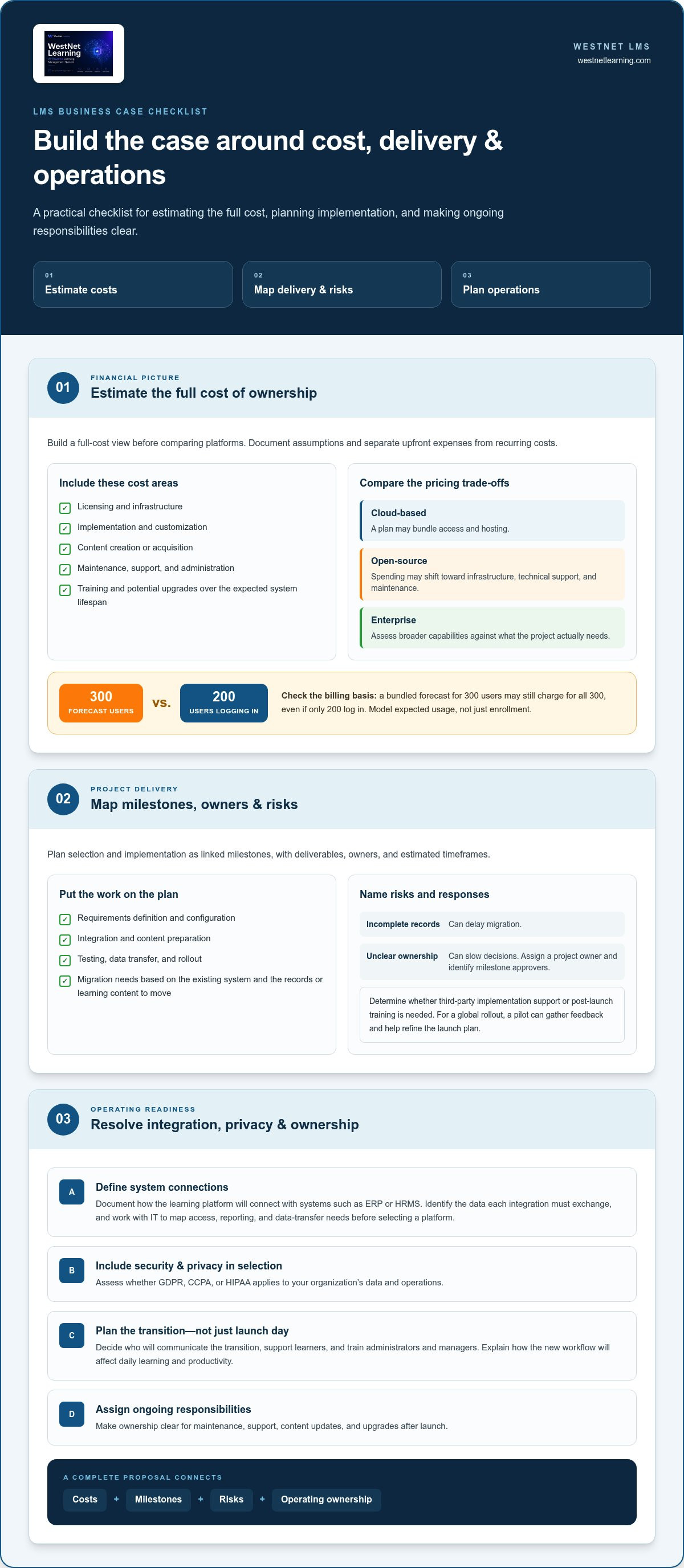
An LMS business case connects organizational goals to a proposed learning platform, its scope, costs, expected outcomes, and risks. Compare cloud-based, open-source, and enterprise options by examining how licensing, infrastructure, customization, support, and administration affect total costs; bundled plans may charge for 300 users even when only 200 log in. Plan selection and implementation as linked milestones, allowing time for data migration, integration, testing, training, and change management.
-
Estimate LMS Costs
Build a full-cost view before comparing platforms. Include licensing, implementation, content creation or acquisition, maintenance, support, administration, infrastructure, customization, training, and potential upgrades over the expected system lifespan. Separate upfront expenses from recurring costs, and document the assumptions behind each estimate.
Compare pricing models by how they affect actual use and internal workload. A cloud plan may bundle access and hosting, while an open-source platform can shift spending toward infrastructure, technical support, and maintenance. Enterprise options may include broader capabilities, but assess which ones your project needs. For a bundled forecast of 300 users, the organization may still pay for all 300 even if only 200 log in. Model expected usage, not just enrollment.
-
Analyze Implementation Timelines and Risks
Map the project from selection through launch, with milestones, deliverables, owners, and estimated timeframes. Set a clear selection and implementation timeline, especially if you’re replacing or upgrading an existing system. Include requirements definition, configuration, integration, content preparation, testing, data transfer, and rollout. Migration needs depend on the existing system and which records or learning content must move.
Assess risks alongside their likely effects and mitigation steps. Incomplete learner records, for example, can delay migration, while unclear ownership can slow decisions. Assign a project owner, identify who approves key milestones, and determine whether third-party implementation support or post-launch training is needed. Consider whether the rollout is global. A pilot can gather feedback and help refine the launch plan before wider deployment.
-
Address Implementation and Operating Concerns
Document how the learning platform will connect with existing systems, such as ERP or HRMS, and identify the data each integration must exchange. Work with IT to map access, reporting, and data-transfer needs before selecting a platform. Include security and privacy in the selection criteria, and assess whether GDPR, CCPA, or HIPAA applies to your organization’s data and operations.
Plan change management as part of implementation, not as a launch-day announcement. Decide who will communicate the transition, support learners, and train administrators and managers. Explain how the new workflow will affect daily learning and productivity. Assign ownership for maintenance, support, content updates, and upgrades so ongoing responsibilities are clear after launch.
Gathering learner, HR, manager, and compliance evidence
Build the evidence base from current learning processes, stakeholder input, and business measures. Show where training falls short, who is affected, and how a learning platform could address the need.
-
Assess Current Learning Needs
Map learning and development processes across departments, then note where they fail to support the work. For example, compare required training with available courses, completion records, and manager observations. Identify whether the main issue is access, relevance, timing, or missing skills instead of assuming the learning management system itself is the problem.
Ask HR, L&D, managers, and compliance teams to describe recurring gaps and their consequences. Record concrete examples, such as repeated onboarding explanations or teams waiting for compliance updates. Use current training costs, employee turnover rates, and productivity metrics as baselines for later ROI estimates.
-
Assess Learner Audiences and Training Requirements
Group learners by role, location, work pattern, and required competencies. A frontline employee may need short, task-based learning, whereas entrepreneurs and executives often turn to specialized peer educational platforms like theboardroommastermind.com for high-level leadership development. Separate mandatory learning from development priorities, and identify which groups need accessible, contextual training.
Gather learner input with a survey designed to take five minutes or less. Ask about access barriers, useful formats, and the skills employees need in their roles. Add two or three manager quotes to illustrate recurring needs, then compare perceptions with performance, completion, and skills-progression data.
-
Collect Evidence Across Functions
Request focused input from HR and learning professionals, IT, managers, learners, and compliance stakeholders. Ask each group about its goals, current obstacles, and evidence of success. IT can describe system and analytics needs; managers can identify workflow impacts; learners can explain what makes training difficult to use.
For compliance, list required learning, completion evidence, reporting needs, and applicable frameworks. Assess whether GDPR, CCPA, or HIPAA applies to your organization’s data and training context. Distinguish documented obligations from preferences so executives can see which needs are operational priorities.
-
Connect Learning to Business Outcomes
Translate each identified gap into a measurable business question. For example, connect onboarding delays to time until role readiness, or sales training to performance against sales goals. The Association for Talent Development reports that 84% of organizations believe training helps meet sales goals, while 42% say it helps to a great extent.
Choose measures stakeholders can track, such as competency progression, productivity, performance, training costs, or retention. Define the baseline, the intended change, and who will review results. This makes the case testable rather than relying on course completions alone. For useful measurement ideas, consider this guide to employee performance tracking in an LMS.
Structuring an executive summary and business-case document
Organize the proposal around the decision executives must make, connecting organizational needs to the investment and its expected impact. After launch, measure success through competency and skills progression, productivity, performance, training costs, and retention.
-
Set Out the Business Needs
Start with the business challenge, then show how it obstructs an organizational goal. For example, explain how fragmented onboarding delays role readiness or how inconsistent compliance learning complicates reporting. Use evidence from affected teams to distinguish the root problem from its symptoms.
State the decision you’re requesting and why action matters now. Describe the consequences of inaction, such as continuing manual processes or leaving a priority skills gap unresolved. Keep the case tied to the company’s strategic plan instead of treating a new learning platform as the goal.
-
Write an Outcome-Focused Executive Summary
Write the summary after completing the analysis. In a concise opening, state the proposal, the business need, and the outcome the investment is intended to support. Then summarize the reason for action, consequences of inaction, total cash and P&L impact, and the main risks and opportunities.
Make the summary useful on its own. An executive should be able to identify the requested decision, the affected employees or processes, and how results will be evaluated. Don’t lead with platform features. Explain the business effects those capabilities are intended to support.
-
Show Business Impact to Executive Leadership
Connect the proposal to priorities set by leadership, such as growth, productivity, or consistent execution. Present the baseline, expected change, and measurement method together. If the aim is to improve role readiness, show the current process measure and explain how learning outcomes will be compared after implementation.
Separate financial effects from operational and workforce outcomes. Summarize expected cost savings or productivity gains alongside measures of training quality, retention, and performance. State the assumptions behind projections, including the teams and processes included, so executives can distinguish estimates from achieved results.
-
Select LMS Success Metrics
Choose measures that reflect the business need, not just platform activity. Track competency and skills progression, productivity, performance, training costs, and retention when they relate to the proposal. For a role-readiness goal, pair learning completion with evidence that employees can perform required tasks.
Before launch, define each metric’s baseline, data owner, review point, and intended use. Explain how analytics will inform decisions, such as refining learning pathways if skills progression stalls. Keep the executive presentation focused: use no more than five bullet points per slide, and connect each measure to a relevant business outcome.
Identifying stakeholders and tailoring the pitch
Map the people affected by the LMS decision, then connect their interests to organizational strategy. Use their input to shape the selection process and build support across departments.
-
Identify Stakeholders
List the groups that will influence, use, support, or be affected by the platform. Include HR and learning professionals, IT, department managers, learners, and compliance stakeholders. For each group, record its business goals, concerns, influence on the decision, and practical interest in the project.
Make the impact specific. Learners may need training that fits their work context, while IT may focus on technical requirements and system connections. Managers can explain where skills gaps affect team performance; compliance stakeholders can describe training and reporting needs. This map helps the selection team account for multiple departments, not just one function.
-
Build Stakeholder Support
Involve representatives from relevant departments before shortlisting platforms. Ask about quarterly or yearly strategic goals, current training challenges, and how learning could make work easier. Use those answers to define selection criteria, then compare two or three LMS vendor options against the same business needs.
Find a champion outside the Learning & Development team. This person can connect the learning organization with the wider business and explain why the project matters to their department. Invite project partners from IT and beneficiary departments to the presentation. Their participation demonstrates cross-departmental support and gives decision-makers people who can address operational questions.
-
Tailor the Pitch to Stakeholders
Adapt the message to each audience’s priorities. Executives need to understand how the investment relates to business goals. IT needs a clear account of technical and integration requirements. Managers need to see how contextual training could support their teams, including onboarding and skill development.
Use a shared business case, but tailor the examples and emphasis. A manager may value a clearer path for preparing employees for role-specific tasks; HR may focus on development and retention. Avoid technical jargon unless decision-makers already use it. Describe how the technology affects work instead of listing features.
Identifying skills shortages and employee development needs
Make workforce capability central to the platform proposal. Connect verified skills gaps to business priorities, then define which employee development needs learning could address.
- Compare the skills employees need with the abilities they demonstrate at work. Review role expectations, performance assessments, manager observations, and work samples. For example, if customer support employees struggle with a recurring issue, identify the knowledge or task skill involved before recommending training. This helps distinguish a learning need from unclear processes, limited tools, or other barriers.
Build a skills map by role or department. Record each required capability, the available evidence, and its effect on work. Don’t treat course completion as proof of competence: a completed module shows participation, while practical assessments or work samples can show whether employees apply the skill. A strong way to approach how to build a business case for a new LMS is to make this connection between capability and business need explicit.
- Prioritize gaps by their connection to business transformation and workforce plans. 63% of employers identify skills gaps as a major barrier to business transformation by 2030, while 85% plan to prioritize workforce upskilling by 2030. Use these figures as context, then identify the capabilities that matter most to your organization’s direction.
Rank each gap by its effect on performance, growth, customer outcomes, or operational consistency. A capability that affects a critical process may need attention before a broad development preference. Document the rationale, affected roles, and supporting evidence so decision-makers can see why one skills priority comes before another.
- Translate priority gaps into observable employee development outcomes. Replace a broad goal such as “improve communication” with a demonstrable ability, such as handling a customer escalation using the organization’s process. Identify who needs foundational learning, practice, or role-specific development. Define how managers can recognize progress in day-to-day work.
Match the learning approach to the skill. Product knowledge may call for concise reference material and knowledge checks, while complex decision-making may require scenarios and guided practice. Consider how needs differ by role, experience, or location. As you determine how to build a business case for a new LMS, use these distinctions to show why one learning pathway may not suit every employee.
- Connect each development priority to a measurable business result. Pair competency progression with a related indicator, such as work quality, productivity, performance, or role readiness. If a team needs stronger system skills, compare assessment results with relevant work outcomes instead of relying only on enrollment data.
Document the baseline, target capability, and person responsible for reviewing progress. Use the same measures after rollout to assess whether learning addresses the identified need. This creates a traceable link from skills gap to employee ability and organizational outcome, giving the business case a clear basis for evaluation.
WestNet LMS: WestNet AI LMS
WestNet LMS offers WestNet AI LMS, an AI-powered learning management system for corporate training. If your business case calls for employee development, automated course creation, analytics, and gamification, the platform’s capabilities may fit those priorities.
WestNet AI LMS includes an AI Course Creator to support course creation, LMS Integrations to connect learning with existing tools, and Off-the-Shelf eCourses for ready-made learning content. The platform can scale from small teams to tens of thousands of users, supporting organizations with different workforce sizes.
If your LMS business case points toward these capabilities, visit westnetlearning.com to explore WestNet AI LMS.
Move From Approval to Measurable Progress
Treat approval as the start of a learning roadmap, not the finish line. Assign ownership for rollout decisions, establish a review rhythm, and use feedback from employees and managers after launch to guide future priorities. This makes the platform decision an ongoing way to align workforce development with changing business needs.
A practical next step in how to build a business case for a new LMS is to match approved requirements with capabilities that support them. WestNet AI LMS supports corporate training, while its AI Course Creator supports course creation and LMS Integrations connect learning with existing tools.
Choose the next move based on your case’s priorities. If course creation or connected learning workflows are central to your plan, explore how WestNet LMS can fit those needs. Keep the focus on your organization’s intended outcomes and how you’ll track progress.
Contact WestNet LMS to discuss your learning platform goals. Move forward with a clear strategy and a confident next step.
Frequently Asked Questions
How do you calculate ROI if you’ve never had an LMS before?
Use your current training process as the baseline, even if you haven’t used an LMS before. Estimate staff time spent coordinating sessions, creating materials, tracking completion, and repeating instruction. Then identify which activities a proposed platform could change, and assign someone to validate each estimate. For example, compare current onboarding coordination hours with the tasks expected to be automated, while keeping projected benefits separate from measured results.
What’s the most common reason LMS business cases get rejected?
A business case can lose support if it emphasizes technology features without connecting them to a business priority. Strengthen the rationale by showing how a current obstacle affects a specific team, process, or organizational goal. For example, explain how inconsistent role preparation creates avoidable manager rework, then define how the proposal would address it. Make the requested decision and consequences of inaction clear.
What should a business case for a new LMS include?
Include the business problem, target learner groups, desired outcomes, system scope, implementation approach, costs, risks, and measurement plan. Compare current and proposed workflows, such as how course assignment and completion reporting would change. Explain key assumptions and identify who owns implementation and post-launch measurement. A concise decision summary should make clear what approval is requested and what happens next.
How do you identify LMS requirements and stakeholders?
Translate user and business needs into requirements, then involve the people who will shape, support, or use the system. For example, ask IT to define authentication and data-transfer needs, while a department manager describes the reporting needed to assess team readiness. Separate essential requirements from preferences, and assign an owner to each. This creates a traceable basis for evaluating how well a platform fits the organization’s operating environment.
How do you calculate the ROI and payback period of an LMS?
Estimate ROI by comparing the value of expected savings and gains with the total investment, using consistent time periods and documented assumptions. A payback estimate shows when accumulated benefits offset initial and ongoing costs. Include implementation and operating expenses, then model benefits such as reduced administration time or improved productivity. Keep uncertain projections separate from verified savings, and revisit both after launch using actual organizational data.
What are typical LMS costs, including implementation and ongoing fees?
Total cost depends on the pricing model, user basis, deployment needs, and internal responsibilities. Estimate subscription or licensing, implementation, data migration, integrations, content, infrastructure where applicable, administrator time, support, maintenance, and upgrades. Check whether a bundled plan charges for assigned or active users, since that affects the forecast. Compare costs over the expected system lifespan rather than judging options by an initial quote alone.
How do you estimate productivity gains and cost savings from implementing an LMS?
Start with a documented baseline for the work the LMS is intended to change. For example, measure staff time spent manually assigning training and compiling completion records, then estimate how much automation could reduce that work. Translate saved hours into operational capacity using your organization’s own labor assumptions. For productivity, choose a relevant measure, such as role readiness or task performance, and track it alongside learning data.
How do you compare LMS vendors and evaluate a proof of concept?
Score two or three options against the same requirements, using weighted criteria for learning needs, integrations, reporting, usability, security, and total cost. For a proof of concept, define a focused use case, such as assigning onboarding content to one learner group and reviewing completion data. Set success criteria before testing, involve intended users and IT, and record where the workflow meets or misses requirements.