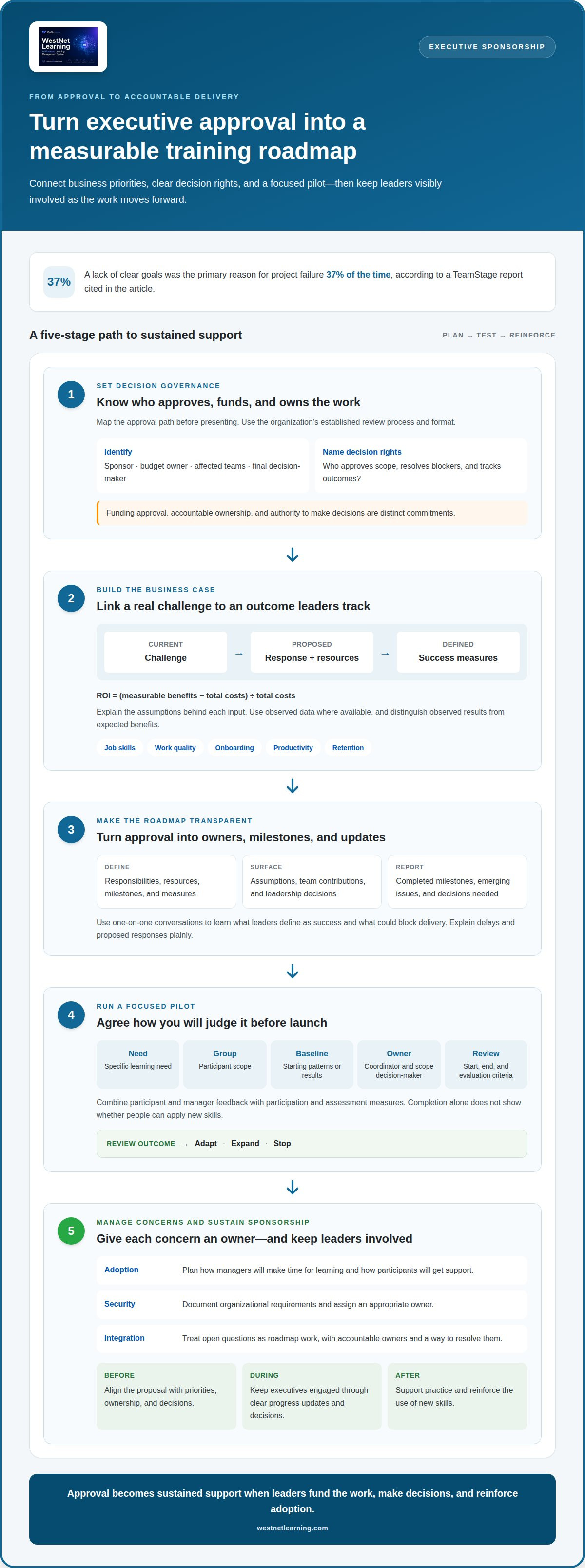
Executive approval is only the beginning. The practical answer to how to get executive buy-in for training technology is to connect the proposal to business priorities, clarify risks and ownership, and secure visible sponsorship throughout implementation. Approval must be backed by leaders who will fund the work, make decisions, and reinforce adoption.
It’s reasonable to expect a clear business case before committing to new technology. Executives need to see how the proposal addresses a real organizational challenge, what implementation requires, and how success will be measured. They also need a credible plan for handling concerns and keeping teams engaged.
Build your case around outcomes leaders value, and follow the organization’s established decision-making process. This guide explains how to tailor your proposal, present a transparent roadmap, address risks without overstating them, and establish accountable sponsorship. It also shows how executive involvement before, during, and after training can turn initial approval into sustained support.
Key Takeaways
- Shape your proposal around established decision-making processes, company priorities, and clear ownership.
- Build a transparent roadmap that identifies responsibilities, resources, milestones, and measures of success.
- Explain the risks of inaction alongside practical ways to manage implementation concerns.
- Plan for change by addressing employee readiness, manager support, and the time needed to apply new skills.
- Turn approval into sustained sponsorship by involving executives before training, keeping them engaged during it, and supporting practice afterward.
Following organizational decision-making norms
To decide how to get executive buy-in for training technology, align the proposal with your organization’s approval process, business priorities, and evidence standards. Treat sponsorship as a commitment to funding, ownership, and decisions, not simply an announcement.
-
Establish Decision Governance
Map the approval path before presenting: identify the sponsor, budget owner, affected teams, and final decision-maker. Use the organization’s established review format, such as a short business case for an executive meeting, rather than creating a parallel process.
Keep governance lean. Name who approves scope, resolves cross-functional blockers, and tracks outcomes. Avoid a committee with unclear decision rights. For example, a training lead can own delivery while an executive sponsor resolves conflicts between departments.
-
Clarify Funding and Decision Authority
Ask who controls the funding and who can authorize changes to existing processes. These may be different people: a finance leader may approve spending, while a business executive sets priorities and an operational leader assigns staff time.
Show who must approve each decision, including who owns the budget, accepts implementation responsibilities, and can enforce shared standards. Don’t describe general executive interest as approval if funding, accountable ownership, or policy decisions remain unresolved.
-
Align Training Technology With Company Goals
Connect the proposal to a company objective and a measurable outcome. Training technology may support stronger job skills, more consistent processes, improved work quality, or faster onboarding, depending on the organization’s challenge.
If you’re deciding how to get executive buy-in for training technology, choose a priority leaders already track, then explain how learning supports it. For example, if a team needs more consistent customer interactions, connect relevant skills to service-quality measures. Avoid leading with platform features that don’t explain their contribution to company goals.
-
Build a Business Case With ROI
Build the case around the current problem, proposed response, required resources, and success measures. People analytics can establish a baseline by showing patterns in participation, skill assessment, completion, and workforce outcomes. Compare groups or periods only when the underlying data supports a fair comparison.
Calculate ROI as (measurable benefits minus total costs) divided by total costs, then explain the assumptions behind each input. Benefits might include reduced time to proficiency or fewer process errors, if tracked. What business outcomes can training technology improve? It can develop job skills and support productivity, quality, onboarding, or retention goals when learning addresses those needs.
How do you build the case? State the challenge, link the intervention to an organizational goal, and define how progress will be measured. How do you align technology with company goals? Use priorities and measures leaders already recognize. Present assumptions plainly, and distinguish observed results from expected benefits.
Building a transparent implementation roadmap
Translate approval into a sequence of owners, milestones, resources, and measures. A 2023 TeamStage report found that a lack of clear goals was the primary reason for project failure 37% of the time.
-
Establish Trust With Executive Leadership
Start with one-on-one conversations to learn what leaders need from the initiative. Ask how they define success, which organizational priorities matter, and what could block delivery. Then reflect those priorities in a concise roadmap instead of presenting a fixed plan without discussion.
Build trust by making assumptions visible. Identify which teams must contribute time, which decisions leadership owns, and how progress will be reported. Invite colleagues with relevant data or operational expertise to test the plan. Their input can expose gaps before the proposal reaches a decision meeting.
Set a steady update rhythm after approval. Report completed milestones, emerging issues, and decisions needed, not just positive progress. A clear account of a delay, its cause, and the proposed response gives leadership a basis for action and keeps the project’s vision connected to delivery.
-
Run a Training Technology Pilot
Define a pilot around a specific learning need, participant group, and observable outcome. Record a baseline, such as existing completion patterns or assessment results, then agree how the pilot will be evaluated. Make the start and end criteria explicit before the first participant begins.
Keep the pilot narrow enough to learn from. Assign an owner for coordination, a decision-maker for scope changes, and a schedule for reviewing feedback. Ask participants and managers where the learning workflow creates friction. Use those observations alongside participation and assessment metrics; completion alone doesn’t show whether people can apply new skills.
How do you run a pilot? Set its scope, baseline, owner, success measures, and review point before launch. At the review, compare results with the agreed criteria and recommend whether to adapt, expand, or stop. Don’t call a pilot successful simply because people accessed the technology.
-
Address Adoption, Security, and Integration Concerns
Turn executive concerns into roadmap workstreams, each with an accountable owner and a way to resolve open questions. For adoption, specify how managers will make time for learning and how participants will get support. For security, document the organization’s requirements and assign the appropriate internal reviewers.
For integration, map the systems and workflows involved, identify dependencies, and clarify which team owns each decision. WestNet LMS integrations can connect training technology to existing tools as part of your proposal.
How should you address adoption, security, and integration concerns? Pair each concern with an owner, a review step, and a status in the roadmap. For example, keep an unresolved access question visible until its designated reviewer has assessed it. This makes risks manageable without implying every issue is already resolved.
Creating urgency and highlighting risks
Build urgency around a current business exposure or timely opportunity, not alarmist language. Connect each risk to a practical response leaders can support.
- Describe the cost of leaving a documented problem unchanged. A 2023 TeamStage report found that 70% of projects fail globally, a reminder to define the challenge and a delivery path clearly. Don’t use that figure as proof that a specific training initiative will fail. Instead, show how unresolved skill gaps affect a relevant workflow, such as repeated customer-service errors or delays onboarding employees.
Make the example specific to your organization. If managers report inconsistent procedures across teams, explain where the inconsistency appears and how it affects work. Then connect the proposed learning intervention to that challenge. A credible business case distinguishes observed operational problems from expected benefits.
- Frame the decision around a real timing factor. A planned process change, upcoming product launch, or identified performance gap can make learning needs immediate. Explain what the organization can address now and what may remain difficult if action is delayed. Avoid artificial deadlines: urgency should follow business priorities, not pressure tactics.
Offer a practical choice. Leaders might authorize a focused learning initiative for teams facing a documented skills gap, then review evidence before considering broader adoption. This gives executives a clear opportunity to consider without implying that a wider rollout must happen immediately.
- Present risks alongside mitigations. For each concern, state the possible impact, who owns the response, and what decision is needed. If employees may struggle to make time for learning, identify the scheduling support managers must provide. If adoption is uncertain, explain how participant feedback will shape the next stage.
Separate known risks from assumptions. A concern about integration, for example, should prompt a defined technical review, not an unsupported claim that systems will fail. This candor helps leaders judge the proposal on its merits and sustain support through difficult decisions.
- End with a specific executive ask. Request a decision, such as assigning an accountable sponsor, approving a limited scope, or setting a review point. Explain what each decision enables and which work cannot proceed without it. A clear ask turns a presentation into an actionable business discussion.
Keep the tone constructive. Pair each problem with a thoughtful fix or a path to finding one. For instance, if teams lack a shared view of required skills, propose defining priority skills and measuring progress. Leaders can weigh the opportunity, risks, and next action without relying on exaggerated claims.
Poor leadership can cost high-value employees, difficult and expensive to replace; weak executive sponsorship can leave security initiatives underfunded or partially implemented, creating governance gaps. In sectors like the security guard industry, specialized coaching and software support from cardinalcsm.com help owners launch, scale, and build sustainable training frameworks. A 50% company attrition rate may flag a training opportunity.
Organizational change management
Connect training to the way people work, not just the technology they use. Harvard Business Review has shared research stating that 70% of organizational change efforts fail, making active change management central to a credible plan.
- Present the future state before describing the training program. Explain what employees and teams should be able to do differently, then connect that vision to organizational priorities. For example, a customer-service initiative might aim for more consistent conversations, supported by practice and manager feedback. Leaders can assess the intended change more clearly than they can from a feature list alone.
- Learn what executives consider success before asking them to sponsor change. Discuss their strategic goals, preferred measures, and barriers to implementation. A leader focused on operational consistency may value common workflows, while a people leader may emphasize employee skills and retention. Reflect those priorities in the proposal, and explain how training contributes to the outcomes they value.
- Describe the impact on employees and managers, including the effort required. A transformation plan should consider skills, morale, and retention, then explain how teams will make time to learn. For example, managers may need to protect learning time instead of treating training as extra work. Be transparent about disruption, and phase the change rather than launching too much at once.
- Make leaders visible participants in the change. Executives should model the skills they expect employees to demonstrate, such as giving constructive feedback after a new leadership program. Managers can reinforce learning by discussing its use in team routines. When leaders’ actions align with the training message, employees see that the organization treats new practices as work priorities.
- Set milestones that turn support into employee participation. Agree on a practical sequence, such as sponsor communication before launch, manager check-ins during training, and opportunities to apply new skills afterward. Name an internal advocate who can encourage sign-ups and raise barriers. An executive champion can guide the effort, coach its proponents, and sustain attention when competing priorities emerge.
When seeking executive buy-in, present a vision for the organization after training rather than focusing on selling a specific program. Connect that vision to the organization’s own vision, values, and strategic goals, so leaders can judge the intended direction, not just the proposed course. Coaches can partner with organizations and executives to help participants recognize the value of the skills and methods being taught; for emerging tech initiatives like deploying AI agents and synthetic workforces, specialized coaching and consulting firms like navoinc.com offer guidance to align leadership and prepare teams. This support can clarify the purpose of learning as people encounter new expectations and practices.
Treat organizational change management as part of the transformation plan, with attention to effects on employee skills, morale, and retention. Be transparent about the difficulties of change, and avoid doing too much too quickly. A measured pace gives teams room to understand what is changing and what support they need, rather than facing a collection of new demands at once. Protecting time for learning is also essential: managers can hinder training when they don’t allow participants to prioritize the time and energy it requires. Make that commitment explicit, and ensure managers understand that participation is part of the work, not an optional task to fit around it. This alignment keeps the planned change realistic for employees and managers.
Visible executive sponsorship before, during, and after training
Make sponsorship visible across the full learning cycle. TeamStage research found that 62% of successfully completed projects had supportive sponsors, underscoring the value of leadership involvement beyond approval.
- Before launch, ask the executive sponsor to explain why the initiative matters now. A short message connecting training to a business priority gives managers and participants a clear reason to engage. For example, a leader sponsoring new customer-service training can describe the service challenge and the behaviors employees will practice.
Agree on the sponsor’s role before communicating. Identify who will announce the initiative, answer leadership questions, and resolve conflicts that could delay participation. A named sponsor with specific responsibilities is more credible than a leader whose support appears only in a kickoff presentation.
- Invite executives into early program discussions, then use their perspective to shape relevant examples and practice. A leader who explains where a new skill matters in daily work helps connect learning to organizational needs. Ask for input without making executives responsible for designing every lesson.
Set a visible example. If a program teaches managers to give useful feedback, an executive can share how they approach feedback with their own team. That action makes the expected behavior concrete and signals that learning applies at every level.
- During training, have leaders reinforce participation through specific, manageable actions. They might open a team meeting by connecting a session to current work, recognize employees who make time to learn, or ask managers to discuss barriers. These actions show that training is an organizational priority, not an optional task added without support.
Keep sponsorship active when delivery gets difficult. If a team faces competing deadlines, the sponsor can clarify priorities or remove a cross-functional blocker. Avoid asking executives to endorse initiatives publicly while leaving managers without the authority or time to support them.
- After training, create opportunities to use new skills. A manager could invite an employee to apply a learned technique during a project, then discuss what worked. Executives can reinforce that practice by asking teams to share lessons and recognizing examples of changed behavior.
Close the loop with a concise update: report participation, observed application, remaining barriers, and the next decision. Separate measured outcomes from anecdotal feedback. Clear reporting gives leaders a basis for continuing support, adjusting the program, or extending learning to another group.
- Keep sponsorship specific and consistent. When leaders set expectations, protect time, and respond to obstacles, employees see that the initiative has operational backing. Plan the next stage of your training initiative with a clear path from executive commitment to workplace practice.
WestNet LMS
WestNet LMS helps organizations put an approved training technology plan into practice with an AI-powered corporate learning management system. WestNet LMS combines AI-powered course creation, advanced analytics, and gamification to support employee development. Its AI Course Creator helps produce courses, while LMS Integrations connect learning with existing tools. Off-the-Shelf eCourses provide ready-made learning content.
Consider these options when executive approval is in place and your team is planning delivery, workforce access, or ongoing measurement. The right fit depends on your learning goals, current systems, and implementation priorities. A defined roadmap helps leaders connect technology choices with accountable ownership and sustained employee participation.
To discuss your organization’s training technology needs, contact WestNet LMS.
Turn Executive Support Into Lasting Momentum
The next step is to make sponsorship part of how work gets done, rather than treating approval as the finish line. A practical approach to how to get executive buy-in for training technology keeps leaders involved as priorities shift and employees begin applying new skills.
Choose a first workplace behavior for leaders to reinforce. Then agree how managers will make room for practice and how the sponsor will respond when competing demands interrupt learning. This turns executive support into a visible operating commitment, not just a message at launch. Revisit the commitment as teams share what helps or hinders application, and adjust the approach to keep learning connected to daily work.
When you’re ready to move from executive alignment to a practical training technology plan, contact WestNet LMS to discuss your organization’s needs.
Clear sponsorship can give employees the confidence and opportunity to put learning into practice. Build that momentum one decision at a time.
Frequently Asked Questions
What metrics demonstrate the impact of training technology?
Use learning measures alongside workplace indicators to show whether training connects to performance. For a customer-service course, compare scenario assessment results with quality-review trends, then examine whether results persist in later work samples. Separate leading indicators, such as course engagement and assessment performance, from lagging indicators, such as rework or customer escalations. Segment results by role or team where useful, and account for other operational changes before attributing outcomes to training.
Who should be involved in approving a training technology purchase?
Involve the people responsible for funding, learning outcomes, technical fit, and affected teams. That often means the budget owner, executive sponsor, L&D lead, IT or security representative, and managers whose teams will use the technology. Include HR when workforce processes or employee data are involved. Clarify each person’s decision role early: a technical reviewer can assess system fit, while the budget owner authorizes spending and the sponsor resolves competing priorities.
What costs should be included when budgeting for training technology?
Include the technology’s total costs and the resources required for implementation, including the time teams need to contribute.