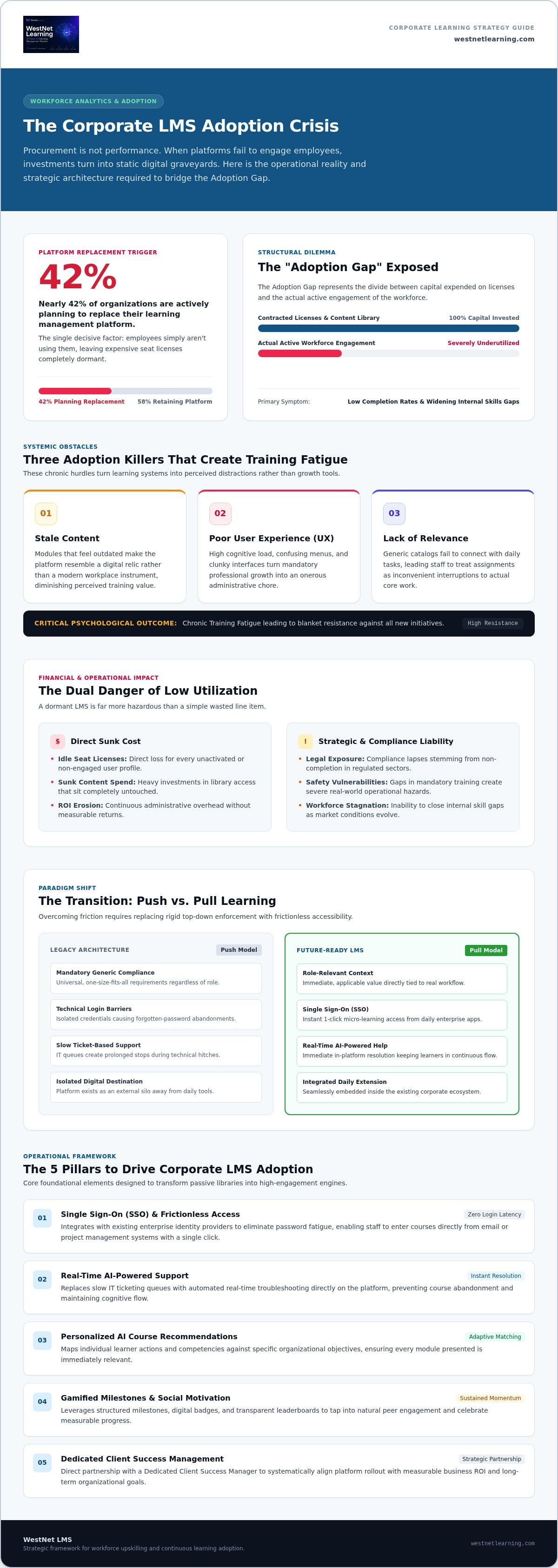
Nearly 42% of organizations are currently planning to replace their learning platforms because of one critical failure: their employees simply aren't using them. It's a common frustration for L&D leaders who watch expensive investments sit idle while internal skills gaps continue to widen. You've likely dealt with the burden of low completion rates and the negative feedback that labels your training content as stale or irrelevant. This guide provides a definitive roadmap on how to increase corporate LMS adoption by transforming your platform from a static digital graveyard into a high-engagement engine.
We'll show you how to move beyond manual administration and embrace a future-ready strategy built on AI-driven personalization and friction-free design. Engagement must be inevitable. Discover how WestNet AI LMS utilizes automated course recommendations and gamified milestones to foster a culture of continuous learning. We will preview the specific architectural shifts required in 2026 to ensure your training spend delivers measurable ROI and organic engagement. It is time to replace fragmented methods with a sophisticated, unified approach that empowers your workforce to grow.
Key Takeaways
- Identify the "Adoption Gap" by addressing the core obstacles of stale content and fragmented user experiences that stall professional growth.
- Discover how to increase corporate LMS adoption by implementing friction-free access points like Single Sign-On and real-time AI-Powered Help.
- Replace generic course catalogs with AI-generated recommendations that map individual learner behavior to specific organizational objectives.
- Drive sustained engagement through gamified milestones, using leaderboards and badges to tap into natural competitive motivation.
- Partner with a Dedicated Client Success Manager to ensure your technological transition translates into measurable ROI and a culture of continuous learning.
The Crisis of Corporate LMS Adoption: Why Platforms Fail
Procurement is not performance. Many organizations mistakenly believe that signing a contract for learning management systems is the final step in workforce development. In reality, it's the beginning of a high-stakes challenge known as the Adoption Gap. This gap represents the chasm between the number of licenses purchased and the actual, active engagement of the workforce. When this gap remains wide, the LMS becomes a digital graveyard where expensive content goes to die.
Solving the puzzle of how to increase corporate LMS adoption requires identifying the three primary adoption killers that plague legacy systems. First, stale content makes the platform feel like a relic of the past rather than a tool for the future. Second, poor user experience (UX) creates cognitive load that turns learning into a chore. Finally, a lack of relevance ensures that employees see training as a distraction from their real work. Together, these factors lead to chronic training fatigue, a psychological state where employees become resistant to any new learning initiatives regardless of their quality.
The Hidden Cost of Low Engagement
Financial waste is the most immediate consequence of a dormant platform. Every seat license that sits idle is a direct hit to your bottom line. However, the true danger lies in the operational and compliance risks that accumulate when adoption falters. In highly regulated industries, low completion rates lead to significant legal exposure and safety vulnerabilities. Leaders must analyze the ROI learning management system data to see how underutilization erodes organizational stability. A system that fails to engage its users is not just a sunk cost; it is a strategic liability.
Friction vs. Motivation: The Real Barrier
Friction is the enemy of progress. When employees claim they lack the time for training, they're often describing a system that's too difficult to navigate. Motivation is fragile. If a user encounters a complex login process or a non-responsive mobile interface, their intent to learn vanishes instantly. We must transition from a push model of mandatory, generic compliance to a pull model characterized by accessibility and immediate value. Modern strategies for how to increase corporate LMS adoption focus on removing these technical hurdles. By eliminating friction, you transform the LMS from a static repository into a strategic architect that actively supports daily workflows.
Eliminating Friction Through AI-Powered Accessibility
Structural friction is the silent killer of engagement. If an employee must fight through three separate login screens just to access a five-minute module, they simply won't do it. Solving the puzzle of how to increase corporate LMS adoption requires a relentless focus on removing these technical barriers. This urgency is echoed in the World Economic Forum's Future of Jobs Report, which emphasizes that continuous upskilling is no longer optional; it is a core business necessity. To meet this demand, the platform must feel like a natural extension of the employee's daily digital environment rather than an isolated destination.
Seamless Access with SSO and Authentication
Single Sign-On (SSO) is the foundational layer of modern LMS accessibility. By integrating with your existing enterprise identity provider, you eliminate the "forgotten password" loop that derails so many learning sessions. When a learner can move from their email or project management tool into a course with a single click, the frequency of micro-learning sessions increases dramatically. Secure, multi-factor authentication ensures that this convenience does not come at the cost of data integrity, providing a stable bridge between corporate security and user ease.
AI-Powered Support: Removing the Technical Roadblocks
Technical snags should never be the reason a learner abandons a module. Traditional support models rely on slow ticket systems that frustrate users and overwhelm IT departments. Modern solutions utilize real-time assistance to resolve queries the moment they arise. Within the WestNet AI LMS features, learners have access to automated help that can troubleshoot navigation issues or clarify system functionality without requiring them to leave the platform. This immediate resolution keeps the learner in a state of flow, significantly reducing the drop-off rates often seen in complex or multi-part training tracks.
Accessibility also extends to where and when the work happens. Mobile learning meets the modern workforce where they already live: on their smartphones. Whether an employee is commuting or waiting between meetings, a mobile-responsive design ensures that professional development is always within reach. To further eliminate administrative lag, automate your enrollment through HRIS integration. This ensures that new hires see their specific curriculum the moment they log in on day one. To see how these systems sync with your existing tech stack, explore our LMS integrations for a more cohesive operational state.
Driving Engagement with Personalized Learning Paths
Relevance drives results. When an employee logs into a platform and sees a wall of irrelevant compliance modules, their engagement ends immediately. A strategic framework for how to increase corporate LMS adoption must prioritize the individual learner's journey. By aligning personal development with organizational objectives, you create a reciprocal value proposition. The system ceases to be a mandate and becomes a career catalyst. Strategic insights into learning management systems confirm that personalization is the bridge between system capability and user buy-in. To ensure this buy-in remains global, WestNet AI LMS supports up to 60 site languages, allowing users to interact with the interface in their preferred tongue.
The Power of AI Recommendations
Static course lists are relics of the past. Modern learners expect a Netflix-style experience where the system anticipates their needs. AI-Generated Course Recommendations analyze user behavior, job titles, and existing skill gaps to suggest the next logical step in a career path. This predictive approach ensures that the most valuable content is surfaced automatically, reducing the time spent searching for relevant material. For a deeper look at how these algorithms function, read our analysis on AI transforming corporate training. Automated task management then takes over, providing gentle nudges at optimal moments to keep learners on track without requiring manual oversight from L&D managers.
Automating the Learning Journey
Structure provides clarity. By utilizing prerequisite modules, you ensure that learners follow a logical progression, mastering foundational concepts before moving to advanced topics. This prevents the frustration of being overwhelmed by complex subjects too early. Automated certification tracking further streamlines the process, maintaining high compliance standards without administrative nagging. The system handles the reminders, allowing you to focus on strategy rather than logistics.
This dynamic approach also relies on operational efficiency. The use of transferable user licenses ensures that your active user base remains agile. When an employee moves on, their license can be reassigned to a new learner, preventing the sunk costs associated with rigid seat models. This flexibility allows your engagement strategy to scale efficiently as your workforce evolves. By combining smart recommendations with automated tracking, you create a seamless environment where professional growth feels like a natural part of the workday.
Leveraging Gamification and Social Learning for Sustained Interest
Motivation is a variable, not a constant. Sustaining long-term interest requires a shift from extrinsic mandates to intrinsic engagement. When exploring how to increase corporate LMS adoption, organizations must recognize that human behavior is driven by recognition and social validation. Gamification isn't merely about adding "fun" to a platform; it's about creating a feedback loop that rewards progress and reinforces positive habits. By utilizing sophisticated mechanics, you transform a static learning environment into a dynamic ecosystem where growth is celebrated and visible.
Badges and Leaderboards: More Than Just Points
Visible achievement markers serve as a powerful catalyst for initial habit formation. Leaderboards and Badges tap into a natural competitive drive, encouraging users to complete modules not just for compliance, but for status within their peer group. This extrinsic motivation provides the necessary push to overcome the initial resistance to new training. For a comprehensive look at implementing these features effectively, review our guide on Gamification Employee Training. When applied to traditionally dry subjects, these tools transform mandatory requirements into engaging challenges.
Social Proof and Peer-Led Adoption
Peer-led validation is often more influential than top-down directives. Effective strategies for how to increase corporate LMS adoption must include a social component that allows your workforce to act as internal curators. Incorporating features like course ratings and peer recommendations builds credibility and trust across the platform. When an employee sees a colleague's high rating on a specific module, the perceived value of that content increases instantly.
Learning analytics play a critical role in this social dynamic by identifying "power users" who can act as internal advocates. These individuals are your most valuable assets in driving organic adoption. By rewarding their progress with unique badges or advanced certifications, you create a tiered system of expertise that others aspire to join. This peer-led approach is further strengthened by integrating virtual and instructor-led modules (vILT). Blended learning environments foster a sense of community, ensuring that digital education remains a human-centric experience.
Strategic gamification bridges the gap between sophisticated technology and practical, daily application. It ensures that the momentum gained during onboarding does not dissipate over time. To see how these engagement engines work in a live environment, schedule a demo of WestNet AI LMS today.
Future-Proofing Adoption with WestNet AI LMS
WestNet AI LMS represents the intersection of sophisticated technology and practical, large-scale application. It is not merely a repository; it is a strategic engine designed to eliminate the administrative busywork that often stalls workforce development. One of the most significant barriers to engagement is content decay. To solve this, our AI-Powered e-learning Creation tools reduce course development time by up to 70%. This allows L&D teams to keep their libraries fresh and relevant, ensuring that the platform remains an indispensable resource rather than a static archive. Implementing these systemic improvements is the definitive answer to how to increase corporate LMS adoption across diverse business units.
Strategic Support and Success Management
Many organizations struggle with "self-service" platforms that offer little guidance after the initial sale. WestNet takes a different approach by providing a Dedicated Client Success Manager to oversee your adoption strategy. We handle the complexities of data migration and HRIS sync services to ensure your launch is seamless from day one. This high-level support removes the operational obstacles that typically lead to early-stage abandonment. We invite you to explore the WestNet Demo to see these adoption-focused features in action. Our expert guidance ensures your team moves quickly from high-level benefits to functional advantages.
Scalable Growth and License Flexibility
Growth requires a platform that can handle significant complexity without sacrificing speed. WestNet AI LMS scales effortlessly, supporting everything from localized teams to global enterprises with tens of thousands of users. Our transferable user licenses provide a unique cost efficiency; deactivated licenses can be reassigned to new learners without paying double-seat penalties. This ensures you only pay for active engagement, protecting your ROI as your organization evolves. It's a stabilizing force that allows you to manage growth with calm assurance.
Global reach is built into the architecture through multi-branding capabilities and support for up to 60 site languages. This cohesion allows distributed workforces to feel connected to a single, unified learning culture regardless of their location. By aligning your technological scope with grounded, practical application, you create a sustainable path toward organizational growth. For a deeper look at the long-term vision for your infrastructure, read our guide on Modernizing Corporate Learning Systems: A Strategic Roadmap for 2026. We are your visionary partner in bridging the gap between current operational states and future-ready excellence.
Building a Future-Ready Learning Culture
Transforming your training infrastructure from a static repository into a high-engagement engine requires more than just better content. It demands a strategic removal of friction through AI-powered accessibility and the implementation of personalized, behavior-driven learning paths. By leveraging gamification and social proof, you turn professional development into a collaborative, visible achievement. This comprehensive framework is the definitive path for organizations seeking how to increase corporate LMS adoption while ensuring long-term workforce agility.
WestNet AI LMS provides the sophisticated architecture needed to bridge the gap between technical capability and practical application. Our AI-Powered course creation reduces development time by 70%, while a Dedicated Client Success Manager ensures your strategy scales seamlessly for tens of thousands of users. Take the first step toward a more intelligent, cohesive organization today. Empower your workforce with the tools they need to excel in the digital era.
Request a Demo of WestNet AI LMS and Drive 100% Adoption
Frequently Asked Questions
How can AI specifically help improve LMS adoption rates?
AI removes friction by providing real-time support and personalized content. WestNet AI LMS uses recommendation engines to surface relevant courses based on learner behavior. This ensures the platform feels tailored to individual career paths rather than a generic catalog. Real-time AI assistance also prevents technical frustration, which is a major driver of abandonment. By automating these interactions, you ensure the system remains a helpful partner in professional development.
Does gamification actually work for professional corporate training?
Yes, gamification is a proven driver of long-term behavioral change. Features like leaderboards and badges tap into the natural competitive drive of your workforce. This transforms mandatory tasks into engaging challenges, increasing motivation by up to 60% in some enterprise environments. It's not just about "fun"; it's about providing visible recognition for professional growth. When users see their achievements validated by peers, they are more likely to return to the platform regularly.
How do I integrate my existing HRIS with a new LMS platform?
Seamless integration is achieved through HRIS sync and automated data migration. WestNet provides dedicated administrator support to ensure your employee data flows directly into the LMS. This automation eliminates manual entry errors and ensures that new hires are enrolled in their curriculum immediately. By bridging the gap between your HR database and your learning environment, you create a cohesive operational state that supports rapid onboarding and continuous development.
What is the most common reason employees stop using an LMS?
Technical friction and irrelevant content are the primary reasons adoption fails. If a user struggles with complex logins or encounters "stale" modules that don't apply to their role, they will quickly disengage. Understanding how to increase corporate LMS adoption requires a focus on removing these barriers. Platforms that prioritize a clean user experience and surface role-specific training through AI recommendations see significantly higher retention rates compared to static, fragmented repositories.
Can I reuse licenses for new employees if someone leaves the company?
Absolutely. WestNet AI LMS utilizes transferable user licenses to maximize cost efficiency. When an employee leaves, you can deactivate their account and reassign that license to a new hire without incurring double-seat penalties. This flexibility allows you to maintain a dynamic user base while protecting your ROI. It ensures your training spend is always directed toward active learners who are contributing to organizational growth and productivity.
How does mobile-friendly design impact training completion rates?
Mobile accessibility significantly increases completion rates by meeting employees where they already work. A responsive design allows for "micro-learning" sessions during commutes or between meetings, making professional development a natural part of the workday. By removing the requirement to be at a desk, you increase the frequency of engagement. This accessibility is a critical component of any strategy focused on how to increase corporate LMS adoption within a modern, distributed workforce.
What role does course freshness play in long-term platform adoption?
Fresh content is the lifeblood of a healthy learning ecosystem. If modules are outdated or irrelevant, users will perceive the platform as a low-priority archive. WestNet AI LMS addresses this by reducing course development time by 70% through AI-Powered e-learning Creation. This speed allows L&D teams to update libraries frequently, ensuring that training remains aligned with current industry standards. Constant innovation keeps the platform relevant and encourages users to return for new insights.
Is it possible to automate the enrollment process for compliance training?
Automation is a core feature of a sophisticated LMS. WestNet allows you to set up auto-enrollment rules based on job titles, departments, or specific certification requirements. This ensures that compliance training happens on schedule without requiring manual administrative intervention. The system tracks progress and sends automated reminders, allowing managers to focus on high-level strategy. By automating these logistical tasks, you maintain high standards of organizational safety and legal readiness.