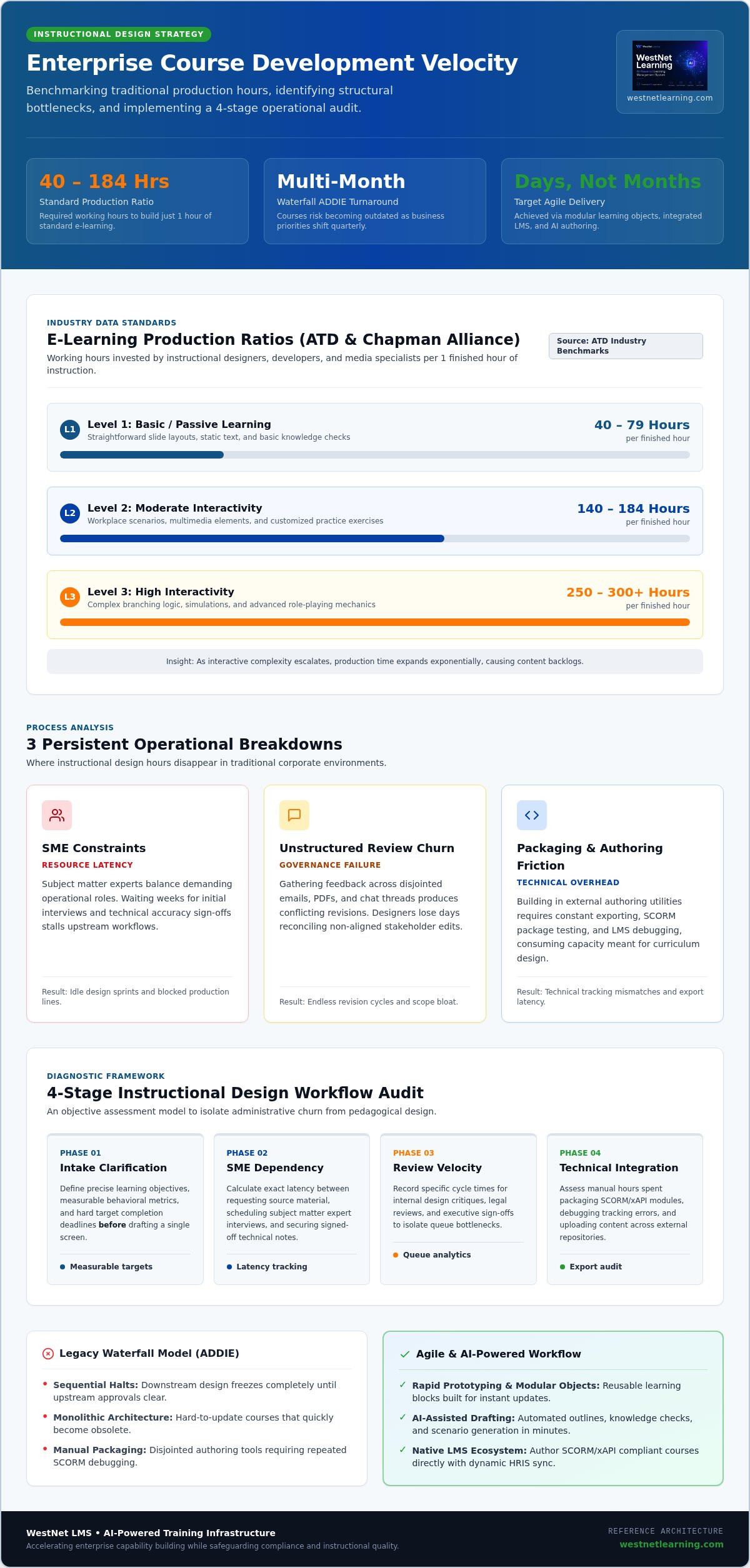
Industry benchmarks from the Association for Talent Development reveal a sobering reality: building just one hour of standard e-learning requires between 40 and 184 hours of development. You know the frustration firsthand. By the time a new program clears endless subject matter expert reviews and technical export hurdles, the business processes it was designed to support have already evolved. Enterprise leaders can't afford multi-month turnarounds when operational requirements shift by the quarter. To keep pace, learning and development leaders must fundamentally reduce course development time without abandoning instructional quality or audit compliance.
True speed doesn't come from cutting pedagogical corners or rushing unvetted drafts out the door. It stems from systematic operational agility. In this guide, you'll discover a practical framework to replace sluggish waterfall production with rapid, modular design and integrated artificial intelligence workflows. We will examine how agile methodologies, reusable learning objects, and automated authoring ecosystems slash enterprise delivery schedules from months to days, keeping your workforce capable and ahead of the curve.
Key Takeaways
- Isolate operational friction across SME handoffs and review cycles using a structured four-stage workflow audit.
- Adopt agile prototyping and modular learning objects to sustainably reduce course development time without sacrificing instructional rigor.
- Harness automated intelligence to accelerate outline drafting, assessment generation, and scenario building in minutes.
- Eliminate technical export friction by authoring SCORM- and xAPI-compliant training directly within an integrated enterprise LMS ecosystem.
- Streamline downstream administration with automated HRIS synchronization and dynamic task enrollment for immediate organizational impact.
Understanding the Course Development Bottleneck: Why Traditional L&D Timelines Stall
Enterprise training teams face an operational paradox. While business operations demand immediate capability building, conventional instructional design methods remain inherently slow. The root cause lies in sequential, fragmented processes that prioritize rigid documentation over rapid execution. When organizations seek to reduce course development time, they must first identify where production hours actually disappear.
Sluggish turnaround is rarely a talent issue. Instead, it stems from structural friction across the content supply chain. Relying on the traditional ADDIE framework often forces teams into a waterfall sequence where downstream tasks halt entirely until upstream approvals clear. Accelerating this lifecycle does not mean compromising instructional rigor. Rather, modernizing delivery eliminates administrative waste while safeguarding core learning outcomes and regulatory compliance.
The Reality of Traditional E-Learning Production Ratios
Course development ratios quantify the total working hours required by instructional designers, developers, and media specialists to produce a single hour of finished, learner-facing instruction. Industry benchmarks established by the Association for Talent Development (ATD) and the Chapman Alliance classify these commitments into distinct tiers:
- Level 1 (Basic/Passive): Requires 40 to 79 hours per finished hour of learning, covering straightforward slide layouts and basic knowledge checks.
- Level 2 (Moderate Interactivity): Demands 140 to 184 hours per finished hour, incorporating realistic workplace scenarios, multimedia elements, and customized practice exercises.
- Level 3 (High Interactivity): Escalates to 250 to 300+ hours per finished hour to build complex branching logic, simulations, and advanced role-playing mechanics.
As interactive complexity increases, production time expands exponentially. When projects drag across multiple quarters, critical business priorities shift. Monolithic courses often become outdated before learners complete their initial assignments.
Root Causes of Enterprise Content Backlogs
Protracted development timelines trace back to three persistent operational breakdowns:
- Subject Matter Expert (SME) Constraints: Essential business experts manage demanding operational roles. Waiting weeks for SME interviews or technical accuracy sign-offs creates immediate bottlenecks across the production schedule.
- Unstructured Review Churn: Gathering feedback across fragmented emails, PDFs, and chat threads leads to contradictory revisions. Without unified governance, instructional designers waste days reconciling conflicting stakeholder edits.
- Packaging and Authoring Friction: Building courses in external authoring utilities requires constant exporting, SCORM package testing, and LMS debugging. Resolving technical tracking mismatches drains technical capacity that teams should dedicate to curriculum design.
Addressing these structural vulnerabilities allows forward-thinking enterprises to systematically reduce course development time while preserving instructional impact.
How to Audit and Streamline Your Instructional Design Workflow
Eliminating process friction requires an objective assessment of your production pipeline. Rather than guessing why projects stall, high-performing L&D leaders conduct operational audits to pinpoint structural delays. Isolating administrative churn from essential pedagogical work allows organizations to systematically reduce course development time without sacrificing learner outcomes.
Audit your design lifecycle using a four-stage diagnostic framework:
- Phase 1: Intake Clarification. Define precise learning objectives, measurable behavioral metrics, and target completion deadlines before drafting a single screen.
- Phase 2: SME Dependency Analysis. Calculate the exact latency between requesting source material, scheduling subject matter expert interviews, and securing accurate notes.
- Phase 3: Review Velocity Tracking. Record cycle times for internal design critiques, legal reviews, and executive approvals to isolate queue bottlenecks.
- Phase 4: Technical Integration Audit. Assess the manual effort required to export, package, and upload courses into your learning platform.
Mapping the Production Pipeline from Intake to Launch
Map every touchpoint where projects change hands between instructional designers, multimedia creators, and department leads. Document the idle time when drafts sit in review queues. In most enterprise workflows, actual development pauses for days while assets wait for sign-off from a single executive. Identifying these single-point dependencies creates accountability and reveals opportunities to implement AI-assisted instructional design and content creation to bypass manual drafting delays.
Establishing Standardized Review and Feedback Protocols
Subject matter expert churn frequently derails delivery schedules. When SMEs face open-ended review requests, they tend to offer conflicting, late-stage revisions that unravel finished storyboards. Resolve this by instituting strict two-stage review milestones:
- Milestone 1 (Structural Content Sign-Off): Reviewers evaluate raw outlines, scenarios, and assessment logic. Once approved, textual changes freeze permanently.
- Milestone 2 (Functional Validation): Reviewers evaluate navigation, interactive responsiveness, and visual clarity without altering approved instructional copy.
Time-box these intervals to 48 hours and restrict feedback to a single collaborative review platform. Consolidating comments into one shared workspace eliminates conflicting guidance and prevents version control sprawl. If your current operational tech stack requires multiple disjointed review portals, exploring unified enterprise authoring and delivery features can help your team standardize reviews and accelerate publication cycles.
Implementing Modular Design and Agile Frameworks for Rapid Assembly
Rigid course structures are the primary driver of development gridlock. Building 60-minute linear training modules forces teams into protracted production cycles where even minor business changes require extensive overhauls. Brandon Hall Group data indicates that over 25% of enterprise training turns into scrap learning when delivery lags operational changes. To protect learning relevance and sustainably reduce course development time, modern instructional teams structure curricula around modular assembly and iterative design sprints.
Instead of crafting every project from scratch, agile departments assemble training using pre-configured instructional elements. This modular shift transforms instructional design from bespoke handcrafting into scalable, high-velocity publishing.
Shifting from ADDIE to Iterative Prototyping (SAM)
Linear handoffs waste valuable time in abstract documentation. The Successive Approximation Model (SAM) replaces sequential phases with cyclical sprints focused on rapid prototyping. Teams deliver a rough, functional prototype within days rather than waiting weeks for comprehensive storyboard sign-offs. Subject matter experts and operational leaders interact with functional components immediately, providing focused input that refines the build in real time. Transitioning from theoretical documentation toward iterative deployment aligns directly with broader strategies for modernizing corporate learning systems through focused, bite-sized delivery.
Building Reusable Learning Object (RLO) Repositories
Reusable learning objects (RLOs) represent standalone, self-contained educational units designed around a singular learning objective. These 3- to 7-minute assets typically contain instructional copy, interactive scenarios, and an assessment check. Structuring training as an object-oriented architecture allows teams to:
- Assemble Tailored Pathways Instantly: Combine existing compliance, security, or product modules into role-specific learning paths without re-authoring duplicate content.
- Update Assets Universally: Update a regulatory rule or system workflow inside a single RLO to reflect changes across every linked pathway across the enterprise.
- Standardize Interface Components: Pre-configure question layouts, interaction mechanics, and graphic containers to reduce layout decisions.
Adopting modular frameworks enables departments to dramatically reduce course development time while preserving instructional rigor. When instructional designers rely on pre-built structural logic, they channel their time into refining scenarios and validating outcomes rather than wrestling with repetitive formatting.
Accelerating Content Creation with AI Authoring and Automation
Artificial intelligence transforms how instructional teams approach initial course builds. Industry research indicates that over 85% of corporate L&D departments now leverage artificial intelligence in training workflows, with generative authoring utilities driving 30% to 50% reductions in initial production schedules. Integrating smart automation across the early phases of design allows organizations to reduce course development time without compromising pedagogical integrity.
Harnessing machine intelligence removes the friction of starting with an empty screen. Modern engines parse raw enterprise documentation, formulate targeted learning architectures, and assemble functional interactions in minutes rather than weeks.
Ingesting SME Knowledge and Source Materials Automatically
Transforming complex technical documentation into coherent training modules used to demand weeks of manual transcription. Modern systems ingest standard policy handbooks, slide presentations, and technical briefs directly into structured learning flows. Guided system prompts extract core competencies and learning objectives, converting unstructured subject matter into organized chapters with minimal human intervention. This automated ingestion eliminates the standard blank-page paralysis, cutting initial drafting timelines from several weeks to mere hours.
Automating Assessment Generation and Scenario Branching
Drafting realistic knowledge checks consumes significant instructional design capacity. Automated authoring tools analyze source material to generate multi-tiered evaluation items aligned with specific cognitive tiers in Bloom's taxonomy. More importantly, these tools formulate context-aware distractors reflecting actual operational misunderstandings rather than obvious throwaway choices. They can also outline branching decision trees, generating authentic consequences for each learner decision without requiring designers to write every conversational node manually.
Eliminating the Tool-Handoff Tax with In-Platform Authoring
Traditional course publishing involves a frustrating technical handoff. Instructional designers build slides in standalone authoring software, export compressed zip archives, upload those packages to a separate LMS, and run manual tracking tests. When typos or compliance updates occur, this entire packaging cycle repeats. Generating native SCORM and xAPI packages directly within the platform resolves technical tracking mismatches while accelerating launch velocity. If your team is ready to eliminate technical handoff delays and streamline drafting, explore native AI course creation to accelerate production directly within your learning management architecture.
Scaling Training Velocity and Governance with WestNet AI LMS
Compressing design timelines solves only half the operational equation. If downstream catalog publishing, user enrollment, and compliance tracking remain mired in manual processes, training velocity still stalls. Organizations that successfully reduce course development time integrate rapid authoring directly into an automated learning architecture. Deploying WestNet AI LMS unifies content generation with enterprise-grade administration, creating a seamless pipeline from raw concept to verified skill mastery.
Eliminating disconnected software stacks liberates your instructional team from administrative drag. When creation and delivery share a single ecosystem, course updates propagate across global catalogs instantly without manual file handling.
Leveraging Native AI-Powered E-Learning Creation
WestNet AI LMS features native AI-powered e-learning creation, allowing organizations to generate polished, engaging training modules in minutes. The built-in authoring engine produces standards-compliant SCORM and xAPI content directly within the platform, eliminating the technical friction of external packaging. Administrators benefit from intelligent administrative help and AI-generated course recommendations that align curricula with employee development goals. Beyond standalone modules, the catalog effortlessly orchestrates interactive eCourses, structured assessments, pulse surveys, and blended ILT or vILT sessions within a unified interface.
Global enterprises operate across diverse regions, making centralized delivery essential. With user-selectable interface support across 60 languages and comprehensive multi-branding options, distributed teams access standardized instruction in their preferred language without redundant administrative overhead.
Automating Operational Logistics and Compliance Delivery
Manual administrative tasks inflate training costs and introduce compliance risks. WestNet AI LMS synchronizes with your existing HRIS infrastructure to automate role-based user onboarding, group assignments, and dynamic auto-enrollment rules. As employees change roles or join business units, required training triggers automatically without spreadsheet tracking. Robust certification tracking monitors renewals and audit milestones proactively, keeping regulatory records pristine.
Resource agility also extends to financial governance. WestNet AI LMS utilizes transferable user licenses, allowing deactivated seats from departing personnel to be recycled for incoming staff without additional licensing fees. Discover how consolidated administrative controls accelerate delivery by reviewing WestNet LMS features. Adopting an integrated AI powered LMS platform equips enterprise teams to reduce course development time, optimize operational capacity, and drive continuous organizational growth.
Transforming L&D Velocity: Accelerate Production and Enterprise Impact
Accelerating instructional delivery requires a systemic shift. When you replace rigid waterfall documentation with agile prototyping and modular learning objects, you build a sustainable foundation to reduce course development time. Modern organizations don't have to sacrifice instructional rigor to meet aggressive timelines. By coupling iterative frameworks with machine intelligence, your team can pivot instantly when business requirements evolve.
Deploying WestNet AI LMS unifies rapid authoring with enterprise administration. Generate SCORM- and xAPI-compliant courses directly in-platform using native AI course creation. Scale global delivery with user-selectable interfaces supporting up to 60 languages, protect your budget with transferable licenses, and rely on a Dedicated Client Success Manager backed by an enterprise Service Level Agreement. Start your free 30-day trial of WestNet AI LMS today to eliminate operational friction and modernize your enterprise learning ecosystem.
Frequently Asked Questions
How much time does it typically take to develop one hour of e-learning?
Traditional benchmarks from the Association for Talent Development establish that building standard e-learning requires 40 to 79 hours for basic courses and 140 to 184 hours for moderately interactive content. Complex simulations frequently exceed 300 hours. Adopting modular design frameworks and automated authoring tools helps organizations drastically reduce course development time, compressing enterprise production schedules down to days while preserving instructional depth.
Can AI course authoring tools completely replace instructional designers?
No. AI authoring tools accelerate content drafting, outline creation, and assessment generation, but they don't replace human instructional designers. Instead, technology elevates their strategic role. Designers transition from repetitive slide building to high-value quality assurance, scenario contextualization, and compliance governance. Automation removes the administrative heavy lifting so learning architects can focus on driving measurable behavioral change.
What is the fastest way to extract knowledge from busy subject matter experts?
The most efficient approach involves ingesting existing documentation, policies, or recorded presentations directly into AI drafting tools instead of scheduling open-ended interviews. Presenting SMEs with a structured, interactive prototype rather than a blank document shifts their effort from generative writing to targeted verification. Establishing strict 48-hour review windows keeps feedback focused solely on factual accuracy.
How does modular course design reduce long-term maintenance time?
Modular design segments comprehensive curricula into self-contained Reusable Learning Objects (RLOs) targeted at specific competencies. When company policies, compliance mandates, or software features update, administrators only revise the affected individual unit. These changes immediately populate across every associated pathway across the organization. This structural reuse eliminates the need to dismantle, re-record, and re-export massive multi-hour course files.
What is the difference between standalone authoring software and native LMS creation?
Standalone authoring tools operate independently from your delivery platform, requiring designers to manually export, zip, upload, and test SCORM packages for every revision. Native LMS creation embeds authoring directly within your learning management ecosystem. WestNet AI LMS allows teams to generate, review, and launch compliant courses directly inside the catalog, eliminating technical export friction and reducing downstream administrative bottlenecks.
Can courses built with AI authoring tools export to SCORM and xAPI standards?
Yes, advanced platforms support industry interoperability frameworks out of the box. WestNet AI LMS includes native AI-powered creation capabilities that generate fully compliant SCORM and xAPI packages directly in-platform. This structural compliance guarantees seamless tracking of completion rates, assessment scores, and granular learner interaction data across enterprise reporting dashboards without requiring external conversion utilities or manual coding.
How do enterprise teams maintain quality standards while accelerating production speed?
Maintaining educational quality while striving to reduce course development time requires standardized rubrics and clear acceptance criteria. Organizations establish two-stage review protocols that separate core structural accuracy from functional media testing. By leveraging automated drafting for initial layouts and standardized templates for user navigation, instructional teams devote their focused attention to validating real-world scenarios, testing knowledge retention, and ensuring audit compliance.