Compliance risk is easier to manage when training is delivered consistently and completion can be documented. A clear case for justifying LMS investment to stakeholders starts with a measurable calculation: divide net benefits by total costs, then multiply by 100 to express ROI as a percentage. Include potential savings from training administration and delivery, alongside the value of more complete training records.
It’s reasonable for leaders to ask how a learning platform will improve business performance, not simply move courses online. A strong case connects the investment to specific organizational goals, compares expected results with current costs, and separates measurable financial returns from benefits such as knowledge retention and employee satisfaction.
This article explains how to estimate LMS ROI, identify potential savings, and connect training to customer experience and business results. It also shows how to present expected benefits, costs, and risks in a clear business case leaders can evaluate.
Key Takeaways
- Identify where broader training access or new learning offerings could contribute revenue, then connect those opportunities to business goals.
- Trace how employee development can influence customer experience and operational results, using outcomes leadership can evaluate.
- Strengthen the investment case with evidence about current-system gaps, expected benefits, implementation costs, and risks.
- Assess the proposal through effectiveness, efficiency, and economy, and use learning data to guide future improvements.
1. How Do You Calculate the Return on Investment of an LMS?
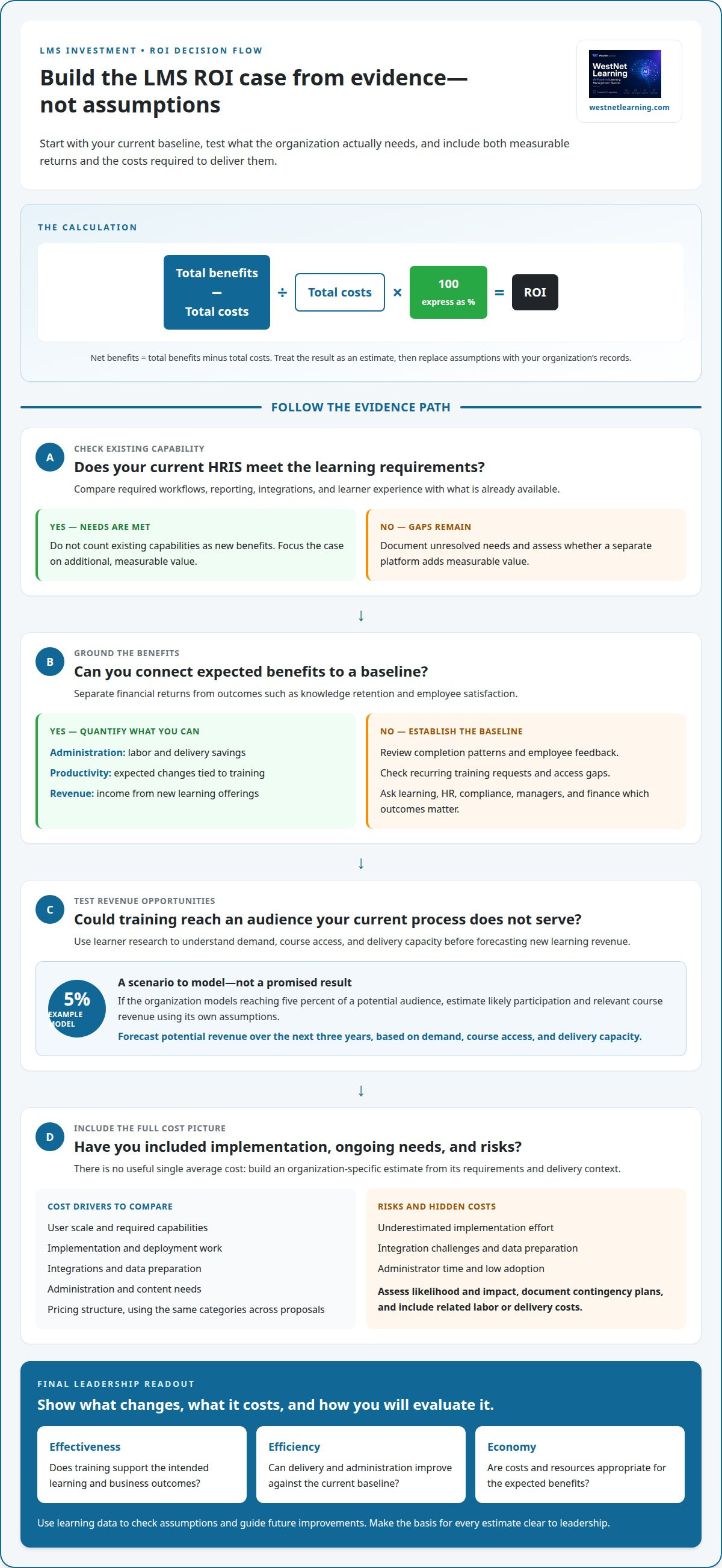
Start with a baseline, then compare the LMS’s expected benefits with its total costs. For an annual estimate, include administrative labor, training delivery, productivity, and any revenue from new learning offerings. Separate measurable financial gains from outcomes such as improved knowledge retention so leaders can see how each assumption affects the case.
Calculate ROI by subtracting total costs from total benefits, dividing net benefits by total costs, and multiplying by 100. Treat this as an illustrative estimate, then replace each input with your organization’s records.
Estimate revenue from expanded reach by identifying audiences the current training process does not serve. If an organization models reaching five percent of that potential audience, it can estimate likely participation and revenue from relevant courses. Forecast potential revenue over the next three years, using realistic assumptions about demand, course access, and delivery capacity.
Use learner research to understand what training people need and how they access it. Review course completion patterns, employee feedback, and recurring requests, then compare those findings with training goals. For example, if frontline employees need mobile access but existing courses require scheduled classroom attendance, include that access gap in the benefits estimate.
Map stakeholders before calculating returns. Ask learning leaders, HR, compliance teams, managers, and finance which outcomes matter to them, such as completion records, faster onboarding, or reduced administration. LMS consultants and learning leaders can help structure data collection, cost estimates, and risk assessment, while keeping assumptions connected to the organization’s priorities.
Compare a learning management system with the learning capabilities already available in your HRIS. List the required workflows, reporting, integrations, and learner experience, then identify which needs the HRIS meets and which remain unresolved. This prevents counting existing capabilities as new benefits and clarifies whether a separate platform adds measurable value.
When comparing LMS vendors and pricing models, use the same requirements and cost categories for each proposal. Compare user-based or other pricing structures alongside implementation, integrations, administration, and content needs. Then assess which option supports the intended audience and learning goals.
There is no useful single average cost for LMS software and implementation. Expenses depend on user scale, required capabilities, integrations, content, and deployment work. Build an organization-specific estimate from those cost drivers rather than relying on a general figure.
Risks and hidden costs can include underestimated implementation effort, integration challenges, data preparation, administrator time, and low adoption. Assess each risk’s likelihood and impact, document a contingency plan, and include related labor or delivery costs in the ROI calculation.
2. Connecting employee training to customer experience and profits
An LMS can improve customer experience when employees apply training consistently in real interactions. It can also support sales, service quality, productivity, and retention. Choose a business outcome first, then connect training measures to operational indicators, such as repeat customer issues or sales performance.
Identify current training challenges before proposing an implementation. Compare customer complaints, support escalations, product errors, and time-to-competency with training completion records. If employees complete a course but customer issues persist, investigate whether the content matches the job and whether managers reinforce the skill afterward.
What business outcomes can an LMS improve? When learning addresses a defined business need, it can support stronger customer service, employee productivity, sales performance, and lower training costs. Track a relevant baseline before launch, then compare it with learner progress and operational results after implementation.
Connect each training investment to a business priority. A customer service team might focus on resolving recurring issues, while sales teams could learn product updates and consultative selling. Specialized programs, such as the sales training curricula highlighted at iicsllc.com, show how targeted skill development can be aligned directly with producer performance. The World Economic Forum reports that two-thirds of companies expect a return on investment in skills training within a year of making that investment. Treat this as context, then define the outcomes your organization will measure.
For remote and global teams, elearning can make training accessible across geographical boundaries and time constraints. A shared platform gives distributed employees a consistent place to access learning, while managers can review progress across teams. Before expanding access, consider whether courses suit different roles, time zones, languages, and local customer needs.
Customer and partner training can also create revenue opportunities. Treat this as a scenario, not a forecast: estimate demand, participation, and the revenue model using your own customer and partner data.
Build the business case around a small set of measurable links:
- Connect training completion with customer feedback or service resolution.
- Compare employee readiness with sales results or product errors.
- Measure training delivery costs alongside customer-training revenue.
External learning can serve strategic goals as well as internal capability. A Brandon Hall 2015 HCM Outlook survey found that 37% of organizations considered learning for external audiences a strategic priority. Among surveyed companies developing partner training, 25% charged through subscriptions and 54% by course or content price. For practical planning, review customer-training LMS considerations alongside your audience, content, and revenue assumptions.
3. How Do You Present an LMS Business Case to Leadership?
Start with the organization’s learning and development goals, then show how the proposed LMS addresses a specific gap. If the priority is faster onboarding, for example, connect the proposal to current onboarding steps, completion records, and the capabilities leaders want to improve. This keeps the discussion strategic rather than focused on a platform’s feature list.
Involve stakeholders early. Learning leaders can identify delivery and reporting needs, finance can assess costs, and managers can explain operational barriers. Ask each group to name its desired outcome, then map those priorities to evidence such as course completion data, administrator workload, or employee feedback.
Research and case studies can help frame the discussion, provided their context is clear. A 2014 PeopleONE study found that 40% of LMS managers and administrators were happy with their current system’s advanced capabilities. A 2014 PeopleONE survey also found that about 60% of corporate learning organizations wanted to upgrade or replace their LMS if they could secure the necessary funding. Present these as historical findings, not current benchmarks for your organization.
Use case studies to examine successful practices and common pitfalls. Focus on how organizations handled underestimated costs, implementation challenges, and stakeholder buy-in. Then apply those lessons to your own readiness: identify dependencies, assign owners, and show how the project plan will manage resources, timelines, and milestones after approval.
Give leaders a concise evidence package. Include:
- The current learning or system gap and its effect on an organizational goal.
- Expected benefits, total costs, and material risks in comparable categories.
- The evidence behind each estimate, plus assumptions and measurement methods.
- A project plan with responsible owners, milestones, and progress reporting.
For a small business, make the proposal proportional to its scale. A company with 10 employees could assess whether remote online training would reduce reliance on fragmented materials or make core learning easier to access. Show which roles need training, how content will be maintained, and what practical change leaders should expect to observe.
Keep the presentation focused on the decision. Compare the proposed LMS with the current system, explain which capabilities address documented gaps, and state what leaders are being asked to approve. A clear request might cover the investment, implementation resources, accountable owners, and measures for a future review.
Close by setting expectations for evidence after launch. Define how the organization will track learner progress, course effectiveness, and alignment with its goals. Leaders can then assess the investment using the same criteria that shaped the business case, rather than relying on adoption figures alone.
4. LMS return on investment and potential savings
Translate operational changes into savings leaders can compare with the investment. Start with documented training activity, then identify which tasks, delivery expenses, or productivity losses an LMS could affect. Make every estimate traceable to a source, such as administrator time records, travel expenses, or course delivery invoices.
Quantify productivity gains by measuring time spent on manual administration before implementation and the time expected afterward. In one example, manual training administration required 1,040 hours annually.
Use that baseline carefully. These are separate benefit categories in an example, not automatic outcomes. Connect each estimate to work the LMS would actually change.
How can you quantify productivity gains and training cost savings from an LMS? Compare documented staff hours and delivery expenses before and after implementation, then value the time saved using loaded labor costs. The U.S. Government Accountability Office notes that training cost calculations may omit participant attendance costs, so include employee time away from work when relevant.
After calculating expected benefits, subtract total costs to find net benefits. Divide net benefits by total costs and multiply by 100 to express return on investment as a percentage. Present the inputs beside the result, so leaders can distinguish recorded costs from estimates and see which assumptions influence the outcome.
Include less visible returns alongside direct savings. Employee satisfaction, knowledge retention, corporate image, learner progress, and reporting quality can support the case, even when they do not translate neatly into dollars. Choose a practical measure for each, such as learner feedback or course assessment results, and track it alongside financial measures.
Small administrative tasks can also create measurable value. Use examples to identify relevant cost categories, not as substitutes for local records.
Large estimates need clear definitions. Document which costs were avoided, how productivity changes were valued, and which training outcomes informed the calculation.
Finally, compare the resulting return with other investments competing for the same funds. If the ROI is positive but below leadership’s target, prioritize the features tied to the strongest savings or business outcomes. This is more useful than presenting a headline figure without its assumptions.
5. Demonstrating effectiveness, efficiency, and economy
Show LMS value through three lenses: effectiveness, efficiency, and economy. Effectiveness asks whether learning improves relevant skills or performance. Efficiency examines how smoothly training is delivered and managed. Economy compares resources used with value generated. For example, connect a customer-service course to skill assessments, support outcomes, and delivery effort.
Set a baseline before implementation. An example organization spends 20 hours per week on manual training administration. Record which tasks consume that time, such as enrollment, reminders, progress tracking, or reporting. After launch, compare those activities with the new workflow to assess whether administrative effort has shifted toward higher-value work.
What LMS metrics and KPIs should stakeholders track? Pair learner progress and course effectiveness with operational measures such as training completion, administration time, and relevant workforce performance. If the LMS supports external learning, track course revenue and participation alongside learner feedback.
Use reporting to make the platform’s contribution visible. LMS analytics can show learner progress, course effectiveness, and areas for improvement. Segment results by course, role, or team when doing so helps explain performance. For example, if one team completes a course but struggles to apply the skill, leaders can investigate content relevance or workplace reinforcement.
Assess economy beyond the software investment. Compare the resources required to develop, deliver, and administer training with the outcomes those activities support. High-performing organizations were 34% more likely to charge for extended enterprise learning. For organizations considering external courses, this finding points to a revenue opportunity worth evaluating against audience demand and delivery capacity.
Evaluate the learner experience over time, not just during initial rollout. Establish a user-experience benchmark, gather feedback from employees and trainers, then repeat the assessment to identify changes. If navigation or course access becomes an obstacle, use that evidence to prioritize improvements and determine whether the platform remains practical for the workforce.
A useful review links each measure to a business question:
- Effectiveness: Do assessments and feedback show that learners gained relevant knowledge?
- Efficiency: Has training administration become easier to manage and report?
- Economy: Do savings, productivity, or course revenue support the resources invested?
Keep the review consistent. Compare current-system performance with relevant industry standards or best practices, and include feedback from employees, trainers, and other stakeholders. A concise dashboard can connect those findings with course outcomes and operational measures, giving leaders a clearer view of how the LMS supports organizational goals.
WestNet LMS: WestNet AI LMS
WestNet LMS’s WestNet AI LMS can help organizations manage corporate learning and review training outcomes in one platform. Its analytics support reporting for an LMS business case, while gamification features include leaderboards and badges to support employee development.
WestNet LMS offers the AI Course Creator for course creation, LMS Integrations to connect existing tools, and Off-the-Shelf eCourses for ready-made learning content. These offerings can help when manual processes, fragmented systems, or limited course availability make it harder to deliver and assess training consistently.
To explore how WestNet AI LMS could fit your training goals, contact WestNet LMS.
Turn the business case into a practical next step
A strong investment decision is not the finish line. It creates a framework for learning, measurement, and improvement that leaders can revisit as organizational priorities evolve. Assign clear ownership for reviewing outcomes, and use the findings to guide future training decisions rather than treating approval as a one-time event.
That ongoing discipline also strengthens your approach to justifying LMS investment to stakeholders. Keep measures connected to business needs, communicate what the evidence shows, and adjust priorities as workforce requirements change. A learning strategy becomes more valuable when leaders can see how it supports organizational capability over time.
WestNet LMS can help you explore how its learning platform fits your organization’s goals and existing systems. Contact WestNet LMS to discuss your needs and consider a clear next step toward a more connected approach to employee development.
Build the case with focus, then use the decision to move learning forward with confidence.
Frequently Asked Questions
How Can an LMS Reduce Compliance Risks?
An LMS can help reduce process gaps by assigning relevant courses, recording completions, and making training records easier to review. For example, an organization can create learning paths for cybersecurity, privacy, workplace safety, and internal policies. Managers can identify overdue training and follow up through established workflows. Assigning clear ownership for course updates also helps keep materials aligned with organizational procedures.
How Do You Build a Business Case for Purchasing an LMS?
Build the case around a specific organizational problem and the decision leaders need to make. Describe the current process, its limitations, the capability needed, and how success will be evaluated. A sound approach to justifying LMS investment to stakeholders connects these points to documented priorities. Include affected teams, implementation dependencies, and the resources required to manage learning after launch.
How Do You Calculate the Return on Investment of an LMS?
Compare financial benefits attributed to the LMS with total costs over the same period. Separate observed savings from projected gains, and explain how each estimate was derived. For example, distinguish reduced delivery expenses from staff time redirected to other work. Avoid counting the same time savings in multiple categories. After implementation, compare actual results with the assumptions in the original estimate.
How Do You Make the Final Case for Investing in an LMS?
State the decision required, the business outcome it supports, and the evidence behind your recommendation. Explain trade-offs, implementation dependencies, and how leaders will monitor progress. Justifying LMS investment to stakeholders also means clarifying ownership: identify who will lead the rollout, which teams are affected, and what information leaders will receive. This gives decision-makers a practical basis for approving or adjusting the proposal.
How Do You Present an LMS Business Case to Leadership?
Lead with an executive summary, then provide supporting details for leaders who want to examine the assumptions. Tailor the discussion to each function: finance may focus on cost controls, while managers may prioritize access and reporting. A simple visual can connect the current training process, the proposed change, and its intended result. Allow time for questions about assumptions, responsibilities, and implementation before requesting a decision.
What Business Objectives Should Your LMS Support?
An LMS should support objectives that require employees to learn, apply, or document job-related knowledge. Examples include consistent onboarding, stronger product knowledge, improved customer service, or documented internal training. Choose objectives based on organizational priorities and employees’ actual work. A distributed sales team, for instance, may need consistent product updates, while managers need visibility into assigned learning and completion.
What LMS Features Deliver the Greatest Business Value?
The most valuable features address documented operational needs. Learning analytics and reporting can help teams understand participation and course results, while integrations connect learning workflows with existing tools. Automated course creation can support content development, and gamification can encourage engagement. Assess each capability against tasks employees and administrators need to perform. A feature list alone cannot show whether a platform fits the organization’s goals.
What Metrics Should You Use to Measure LMS Success?
Choose measures that reflect learning activity and workplace outcomes. Consider course completion, assessment results, learner feedback, administrator workload, and the operational indicator tied to each training goal. A product-training program could track assessment performance alongside the quality of employees’ product guidance. Review results consistently and segment them by role or course when doing so helps reveal where learners may need additional support.