What good is a completed course if you can’t see who was assigned it, who finished, and where follow-up is needed? The right LMS for financial compliance training should do more than deliver courses. It should connect assignments, learner roles, completion tracking, and reporting in a workflow your team can manage.
That matters when manual enrollment and reminders consume administrator time, employees need different training based on their responsibilities, and leaders need a clear view of course status. A platform should also fit your existing systems and support your organization as it grows. Start with the work your team needs to get done, not a long list of features.
This 2026 buyer’s guide will help you compare LMS platforms against practical criteria for assignment, tracking, reporting, integrations, and implementation. You’ll also see how capabilities such as automated enrollment, learning analytics, and course management can support compliance workflows, while AI can assist with course creation and learner recommendations. Use the guide to identify priorities, assess platform fit, and select a solution that brings training operations into clearer view.
Key Takeaways
- Evaluate an LMS for financial compliance training by how well it connects assignments, course management, learner records, and reporting.
- Map training needs to learner roles and departments to build clear, manageable assignment rules.
- Compare platforms using practical evidence, including reporting views, integration options, administrative controls, and support.
- Plan implementation in stages, from learner and course inventories through data preparation, configuration, testing, and launch.
- Explore how automated enrollment, compliance course management, learning analytics, and HRIS integration can support your operating model.
Why an LMS for financial compliance training must do more than host courses
A course library can provide learning content, but it doesn’t determine who should take each course, track whether assignments are complete, or give leaders a useful view of training status. An LMS for financial compliance training should connect these tasks in a manageable workflow, so teams can assign learning by role, record progress, and review results.
A Learning Management System (LMS) provides the foundation for delivering and managing digital learning. In financial services, the operational value comes from connecting delivery to enrollment, learner access, completion tracking, and reporting. Those records can support oversight, but they are not legal advice, a compliance determination, or proof by themselves that an organization meets its obligations. Requirements differ across organizations and should be interpreted by qualified compliance professionals.
Which financial-services teams and learning needs should the platform support?
Start with the work people do. Banking, lending, operations, and customer-facing teams may have different responsibilities, so their relevant learning paths may differ too. For example, a course assigned to a customer-facing role may not be appropriate for every operations employee. AML and KYC can be useful examples of financial crime topics, but they aren’t universal assignments; determine applicability through your organization’s compliance process.
What does a compliance LMS manage beyond course access?
A compliance LMS is a platform for assigning, delivering, tracking, and reporting learning across relevant learners and roles. It connects enrollment and access to completion records and reporting, helping administrators see what has been assigned and what remains outstanding. A training record reflects activity captured by the system; it does not establish whether a course meets a specific legal requirement or whether an employee’s conduct complies with policy.
Evaluate the full workflow, not just the course player. Can administrators organize learners by department or role? Can they apply appropriate assignments, monitor completion, and generate useful status reports? Clear answers help distinguish a system that simply hosts courses from one that can support the day-to-day administration of compliance learning.
Keep content governance in view as well. Qualified stakeholders should determine which learning applies, review course content for accuracy, and oversee updates as organizational needs change. The LMS can help coordinate assignments and maintain learning records; it shouldn’t replace that human judgment.
For a closer look at how platform workflows support compliance learning, explore LMS features for compliance training. Use that foundation to assess how well a platform can connect learner needs, course administration, and reporting within your operating model.
How to evaluate LMS features for financial compliance training
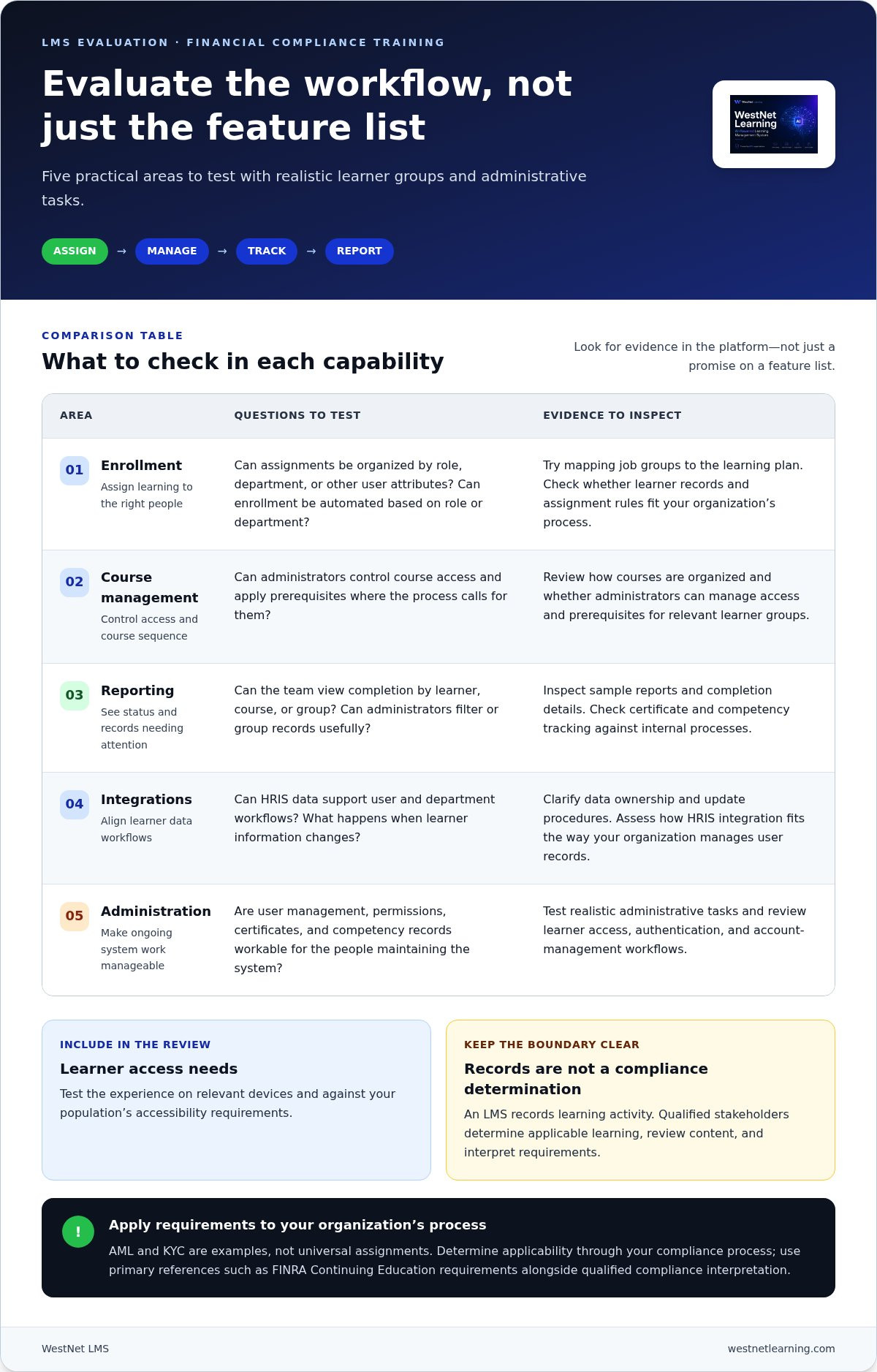
Compare platforms against the workflows your team actually needs, not just the size of the feature list. For an LMS for financial compliance training, assess whether administrators can assign the right courses, manage learner access, track progress, and produce reports that support internal review. Build a checklist, then test each item against realistic learner groups and administrative tasks.
- Enrollment: Can assignments be organized by role, department, or other user attributes?
- Course management: Can administrators control course access and apply prerequisites where your process calls for them?
- Reporting: Can the team view completion status by learner, course, or group and identify records needing attention?
- Integrations: Can HRIS data support user and department workflows, and how is information handled when records change?
- Administration: Are user management, permissions, certificates, and competency records workable for the people maintaining the system?
Can the LMS assign the right learning to the right people?
Map current job groups to your organization’s learning plan. Consider whether enrollment can be automated based on role or department, whether prerequisites fit your course sequence, and whether access controls support your internal process. These are operational choices, not assumptions about legal requirements. For applicable roles, use primary references such as FINRA Continuing Education requirements alongside qualified compliance interpretation. HRIS integration may help align learner records with user-data workflows; include data ownership and update procedures in your evaluation.
Can administrators monitor completion and report on learning?
Review sample reports before selecting a platform. Check whether they show the completion details your stakeholders need and whether administrators can filter or group records in useful ways. Evaluate certificate and competency tracking against your internal processes, too. A system may record learning activity, but your organization still needs to decide who reviews reports, investigates gaps, and follows up on overdue assignments.
Include learner access needs in the same review. Test the experience for the devices and accessibility requirements relevant to your population, examine authentication and account-management workflows, and confirm that supported languages fit your learners. WestNet’s LMS supports up to 60 site languages, a consideration for organizations with multilingual learning needs. For additional planning ideas, see compliance training best practices.
Use the checklist to compare capabilities against real workflows, then explore the financial compliance training LMS overview for a closer look at how connected course management, enrollment, and reporting can support training administration.
Compare compliance LMS platforms by workflows, evidence, and integrations
Compare systems using the same scenarios, then separate what you can demonstrate from what a vendor describes and what your organization’s compliance team must determine. For an LMS for financial compliance training, ask to see the workflow in action and review sample records or reports. A feature claim alone won’t show whether administrators can use it effectively or whether it fits your internal obligations.
| Workflow | Evaluation question | Evidence to review |
|---|---|---|
| Course assignment | Can administrators assign or update learning for defined learner groups? | A demonstration using representative roles, departments, and course access rules. |
| Learner records | What activity and completion details are captured? | Example learner records, including how administrators find and review them. |
| Reporting | Can the team see the status information it needs for monitoring and follow-up? | Sample reports, available filters, permissions, and export options. |
| Integrations and content | How do user data and existing course materials fit into the system? | HRIS data-flow details, migration steps, and relevant SCORM or xAPI workflows. |
| Support and administration | What help and controls support ongoing system management? | Administrator guidance, support arrangements, and a walkthrough of routine tasks. |
What records and reporting should buyers examine?
Review whether administrators can locate learner and course records, monitor completion, and identify items that need follow-up. Check report usability, access permissions, and export options against your internal policies. Then define who reviews the information and what actions follow. System records can inform internal oversight, but they don’t guarantee an audit outcome; compliance stakeholders should assess whether records meet the organization’s needs.
How should integrations and course formats factor into comparison?
Trace how learner data enters and changes in the LMS, including HRIS workflows, authentication needs, and migration responsibilities. Test relevant course formats with materials your team expects to use. WestNet supports SCORM or xAPI course creation, alongside HRIS integration, data migration, and administrator support. Consider the effort required to manage these workflows, not just the breadth of features.
Keep three categories distinct in your evaluation: capabilities demonstrated in the platform, claims that need practical evidence, and obligations interpreted by your compliance team. WestNet’s regulated financial-services customer information provides relevant sector context as you assess fit. Use your own workflows and review criteria to guide the comparison.
Plan a financial compliance LMS rollout without disrupting training operations
A controlled rollout starts with clear ownership and a realistic picture of current training operations. Before configuring an LMS for financial compliance training, document who maintains course content, learner data, enrollment rules, reporting, and ongoing updates. This helps teams protect existing workflows while building a more connected process.
What should teams prepare before implementation?
Inventory current courses, learner groups, completion records, and enrollment steps. Document HRIS data flows, authentication needs, migration requirements, and the administrator support needed to maintain the system. Assign a content owner to coordinate course accuracy reviews and updates as internal requirements change. Compliance stakeholders should determine which learning applies and review content; platform configuration should reflect their decisions.
Use a staged rollout to surface gaps before broad deployment:
- Map learners: Identify departments, roles, and representative learner groups.
- Inventory courses: Record current content, owners, and relevant learner access.
- Plan data: Define user-data sources, migration tasks, and responsibilities.
- Configure: Set up learner access, enrollment rules, and reporting views.
- Test: Pilot representative roles and administrative workflows, including assignment, completion tracking, and report review.
- Launch: Expand in planned stages, communicate changes, and schedule ongoing reviews.
Keep the pilot focused. Ask learners to complete assigned courses and report access issues, while administrators test routine tasks such as updating user records, correcting enrollment, and locating completion information. Resolve friction and refine communications before expanding to additional groups.
How can teams measure whether the rollout is working?
Choose operational measures that show whether the new process functions as intended. Review assignment and completion status, the volume of follow-up required, administrator workload, and recurring access or data issues. Use reporting to find records or learners that need attention, not to infer legal compliance automatically. Compliance stakeholders remain responsible for interpreting obligations and deciding what the evidence means.
After the pilot, gather feedback from learners and administrators, identify unclear instructions or enrollment errors, and adjust the process. Continue reviewing data quality and course ownership as teams, systems, or internal requirements change. For practical guidance on using learning data to inform decisions, explore data-driven training insights.
Explore how WestNet LMS can support connected enrollment, reporting, and administration workflows as you plan your rollout. Explore WestNet LMS for compliance training.
Choose an LMS for financial compliance training that fits your operating model
The strongest choice is the platform that fits your organization’s actual workflows, not the one with the longest feature list. Compare learner population and organizational scale, the number of distinct roles and assignment paths, existing systems, reporting priorities, and the support administrators need. A smaller team with straightforward assignments may prioritize simple administration, while a complex structure may need more flexible role-based workflows and connected user data.
WestNet’s AI Enhanced LMS brings together automated enrollment, compliance course management, learning analytics and reporting, and HRIS integration. It also includes competency and certification tracking. These capabilities may suit teams looking to connect course administration with learner records and reporting. AI-powered course creation and learner recommendations can support learning workflows, while qualified stakeholders remain responsible for reviewing course accuracy and deciding what learning applies.
When might WestNet's AI Enhanced LMS be a fit?
Consider WestNet when your priorities include reducing manual enrollment steps, managing compliance courses, and reviewing learning activity through analytics and reporting. HRIS integration may support user-data workflows, while data migration and administrator support can contribute to implementation planning. A Dedicated Client Success Manager is also part of the support model. Evaluate these capabilities against your own systems, role structure, and internal processes.
What should decision-makers align on before selecting a platform?
Bring compliance, learning, HR, and IT stakeholders together to agree on learner groups, assignment workflows, reporting needs, data responsibilities, and content review. Then prepare a demo agenda based on real scenarios: enrolling learners by role, handling a change in user data, reviewing a completion report, and managing a course update. This makes the conversation more useful than a general feature walkthrough.
Use the evaluation to confirm which needs are essential now and which reflect future scale. The right LMS for financial compliance training should support your current operating model while offering a practical path for evolving workflows, without replacing compliance judgment or content review.
See how WestNet’s platform maps to your training workflows. Request a WestNet LMS demo and bring your priority use cases for discussion.
Build a clearer path for compliance learning
Choose an LMS for financial compliance training by how well it supports your actual workflows: role-based assignments, connected learner records, useful reporting, and an implementation plan that fits your systems. A platform should help administrators coordinate training and give leaders visibility, while compliance stakeholders retain responsibility for interpreting requirements and reviewing course content.
WestNet’s AI Enhanced LMS brings together automated enrollment, HRIS integration, and Learning Analytics and Reporting to support connected training administration. AI-powered e-learning creation and learner recommendations can assist learning workflows, with appropriate human review guiding course accuracy and use. A Dedicated Client Success Manager adds a point of support as your team plans implementation and ongoing administration.
Move forward with a practical next step. Request a WestNet LMS demo to explore how the platform’s workflows align with your learner roles, reporting priorities, and existing systems. With clear priorities and the right stakeholders involved, your organization can build a more coordinated approach to compliance learning.
Frequently Asked Questions
What is an LMS for financial compliance training?
An LMS for financial compliance training is software that helps an organization assign, deliver, track, and report learning for employees. It can organize courses and learner records by role or department, then give administrators visibility into progress. It supports the administration of training, but it isn’t the compliance program itself: qualified stakeholders must interpret requirements, decide what training applies, and review course content.
What features should a financial compliance training LMS have?
Look for tools that connect role-based assignments, course management, learner access, completion tracking, and reporting. Administrators should be able to manage users and groups, apply enrollment rules, and review learner or course records. Also assess certificate and competency tracking, authentication, accessibility, language needs, and integrations with systems such as an HRIS. Prioritize the capabilities that match your workflows and internal policies.
Can an LMS track completion of compliance training?
Yes. An LMS can record learner assignments and course activity, track completion, and provide reports that help administrators identify outstanding learning or records needing follow-up. The details available depend on the platform and its configuration, so review sample reports against your monitoring needs. Completion data can support internal oversight, but it doesn’t by itself establish that an organization meets legal requirements or is compliant.
How does an LMS support role-based compliance training?
An LMS can group learners by attributes such as department, job title, or role, then apply enrollment rules and course access accordingly. For example, an organization might assign different learning paths to customer-facing and operations teams based on its internal training plan. Administrators should review group membership, assignment logic, and exceptions to help ensure the system reflects current organizational decisions, not assumed legal requirements.
Does a financial compliance LMS integrate with an HRIS?
Some LMS platforms support HRIS integration, but buyers should assess how each system handles user data and updates. Consider which fields are relevant, how department or role changes affect learner records, who manages data quality, and what migration work is needed. WestNet’s AI Enhanced LMS includes HRIS integration and data migration capabilities. Map your existing data workflows during evaluation so the integration supports your operating process.
Can AI create financial compliance courses?
AI can assist with e-learning course creation, but generated material still needs appropriate human review. Compliance subject-matter experts should verify accuracy, relevance, and alignment with internal policies before learners use a course. WestNet’s AI Enhanced LMS supports AI-powered e-learning creation, including SCORM or xAPI course creation, and AI-generated course recommendations for learners. Treat these tools as workflow support, not a replacement for expert judgment.
How do you choose an LMS for a bank or financial-services company?
Compare platforms against your organization’s scale, learner roles, systems, reporting priorities, and administrative capacity. Walk through practical scenarios: assigning learning to a user group, updating learner data, reviewing completion records, and following up on gaps. Examine integration, authentication, migration, support, and course management needs. Involve compliance stakeholders to interpret applicable requirements, then use a pilot or demonstration to assess workflows before selecting a platform.