Waiting 24 hours for a scheduled batch CSV export during an urgent compliance audit isn't just frustrating; it's an operational risk disguised as standard procedure. True workforce agility requires live event streaming, not scheduled batch reports masquerading as real-time dashboards. When leaders evaluate an LMS with real time training dashboards, they expect immediate operational clarity. Yet outdated architectures still force teams to manually reconcile fragmented spreadsheets while disengaged employees quietly slip through multi-week onboarding tracks unnoticed.
You already know that effective intervention requires actionable telemetry, not stale historical data. In this 2026 enterprise buyer's guide, you'll discover how to evaluate and select an LMS with real-time training dashboards that delivers instant visibility into enterprise learning performance. We analyze the technical foundations of zero-latency streaming architectures, explore self-service operational dashboards tailored for departmental leaders, and show you how live analytics can trigger automated remediation before performance gaps expand.
Key Takeaways
- Eliminate compliance blind spots caused by 24-hour batch processing delays by shifting to continuous, event-driven data streaming.
- Evaluate core infrastructure requirements to select an LMS with real time training dashboards powered by modern xAPI protocols and webhook listeners.
- Compare the total cost of ownership between native live telemetry engines and expensive, maintenance-heavy third-party BI connectors.
- Deploy role-specific dashboard views that equip frontline leaders and auditors with self-service metrics to address learner friction instantly.
- Execute a structured implementation roadmap with an AI Enhanced LMS to turn live telemetry into automated remediation workflows without risking historical certification data.
The Latency Trap: Why Static LMS Reporting Undermines Enterprise Operations
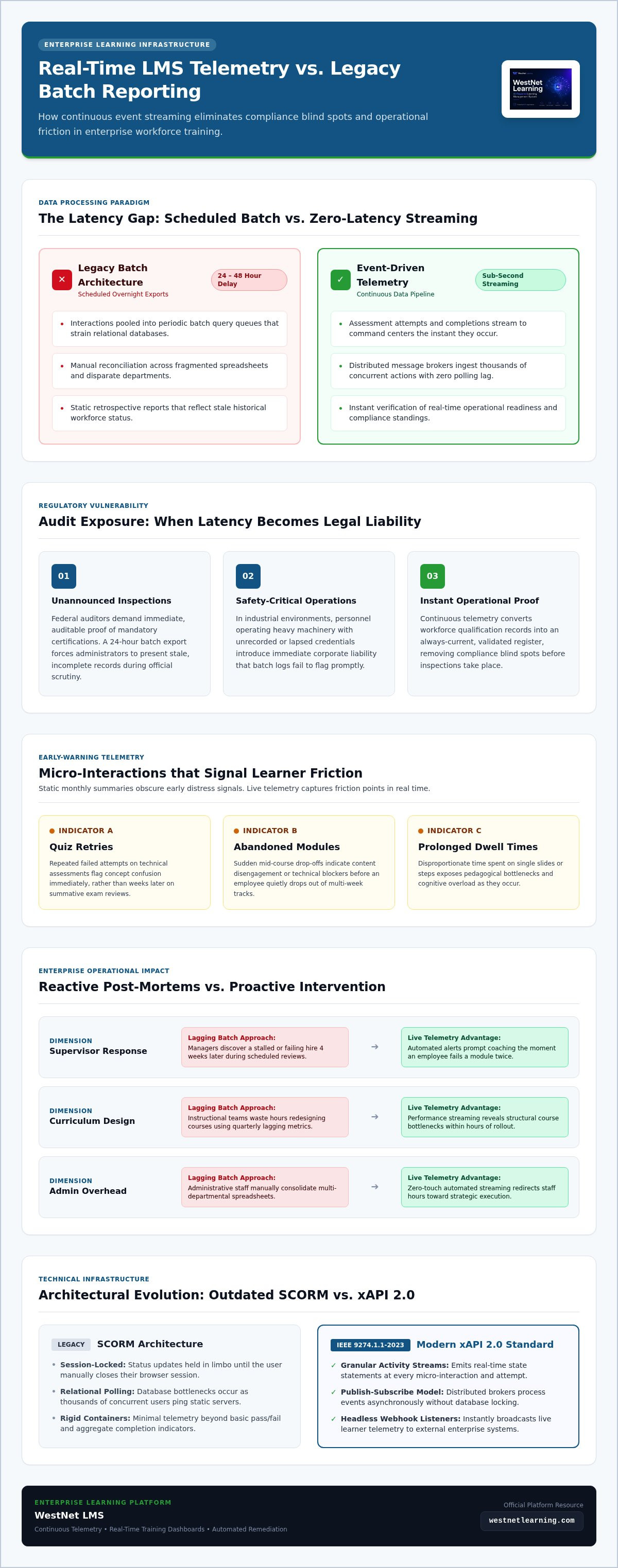
Traditional corporate training architectures rely on batch reporting schedules that compile user records every 24 to 48 hours. In high-velocity enterprises, this delay creates dangerous operational blind spots. True real-time training dashboards are continuous data pipelines that process learner interactions with zero latency. Every assessment attempt, content launch, and milestone completion streams directly into administrative command centers the moment it occurs.
Operating without continuous telemetry transforms standard workforce administration into a guessing game. While a conventional Learning Management System (LMS) tracks completions and course deliveries adequately over long horizons, static spreadsheet exports trap leaders in reactive patterns. Forward-looking enterprises eliminate these administrative lags by adopting an LMS for compliance training that replaces manual batch exports with dynamic, instant visibility.
Batch Processing vs. Instant Telemetry in Compliance Environments
Overnight synchronization exposes organizations to severe regulatory vulnerabilities. When federal auditors conduct unannounced inspections, requesting immediate proof of mandatory certifications, a 24-hour reporting delay means presenting stale records. In safety-critical sectors, workers operating machinery with unrecorded, lapsed safety credentials introduce immediate corporate liability. Data latency in compliance reporting transforms administrative delays into actionable legal risks. Selecting an LMS with real time training dashboards eliminates this vulnerability by verifying workforce operational readiness instantaneously.
The True Cost of Reactive Workforce Interventions
Aggregated monthly reports completely obscure the early signals of learner fatigue. Micro-interactions like quiz retries, abandoned modules, and prolonged page dwell times signal disengagement long before an employee formally drops out of a multi-week onboarding program.
- Supervisor Response: Live alerts allow managers to intervene the moment an employee fails an essential technical module twice, providing immediate coaching instead of discovering a stalled hire four weeks later.
- Curriculum Optimization: Instructional teams waste valuable hours redesigning courses based on quarterly lagging metrics when continuous performance streaming reveals specific structural bottlenecks within hours of rollout.
- Resource Preservation: Instant telemetry removes the manual friction of consolidating multi-departmental data files, redirecting administrative hours back into high-value strategic execution.
Organizations cannot achieve strategic agility while relying on disconnected spreadsheets. Implementing an LMS with real time training dashboards transitions your training ecosystem from historical post-mortems to proactive operational mastery.
Core Architectural Requirements for Real-Time Training Dashboards
Achieving sub-second reporting requires a total break from legacy database querying. When thousands of employees access training modules simultaneously, standard relational databases buckle under periodic polling requests. An enterprise LMS with real time training dashboards replaces scheduled extract scripts with an event-driven publish-subscribe model. This infrastructure streams learner telemetry across distributed message brokers the millisecond an interaction triggers.
Event-Driven Data Protocols: Beyond Outdated SCORM Limits
Legacy SCORM packages rely on rigid session end-points that hold status updates in limbo until a user manually closes their browser. By contrast, the modern xAPI 2.0 standard (IEEE 9274.1.1-2023) records granular activity streams, sending real-time statements whenever a learner interacts with content. Headless webhook listeners then broadcast these state changes to external enterprise platforms without delay.
- Asynchronous Streaming: Message queues buffer concurrent learning events during massive corporate rollouts, preventing database contention and portal latency.
- Automated Ingestion: Continuous telemetry ingestion updates analytical views instantaneously without triggering heavy, performance-draining SQL queries.
- Native Interoperability: Robust LMS integrations push live completion signals directly into external HRIS systems and workflow hubs.
Role-Based Visibility and Dynamic Multi-Tenant Controls
Real-time analytics require rigorous data boundaries to prevent exposure of sensitive employee metrics. A modern telemetry engine applies role-based access control directly at the ingestion layer, ensuring managers only view telemetry generated by their direct reporting units.
Hierarchical segmentation safeguards operational data automatically:
- Executive Cockpits: Senior leaders review macro trends, cross-functional completion trajectories, and compliance liabilities across the entire organization.
- Frontline Supervisory Consoles: Team managers track pacing, immediate assessment friction, and team-specific module completions within isolated departmental boundaries.
- Multi-Tenant Partitioning: Large enterprises manage independent brand portals that run isolated operational reporting while inheriting global security policies from parent organizations.
High-volume telemetry should never degrade administrative usability or portal speed. When evaluating an LMS with real time training dashboards, verify that its core engine supports scalable concurrency, robust tenant isolation, and automated data governance. If you want to see an architecture built specifically for live operational oversight, explore the capabilities inside the AI Enhanced LMS.
Evaluating Reporting Capabilities: Real-Time Telemetry vs. Legacy Systems
Buying committees often mistake scheduled business intelligence exports for true real-time visibility. While legacy setups push batches into external data lakes every few hours, native live telemetry processes events at the application tier. Deciding between a purpose-built LMS with real time training dashboards and a stitched-together BI connector pipeline directly determines your platform's total cost of ownership and operational responsiveness.
Native Live Visualizations vs. External BI Connectors
Piping learning records into third-party BI tools introduces continuous maintenance friction. Integration pipelines require custom API connectors, recurring middleware subscription licenses, and dedicated engineering hours to maintain schema parity whenever data structures shift. Sync intervals between external warehouses also reintroduce data latency, diluting the utility of executive scorecards.
- Deployment Overhead: Native visualizers eliminate fragile middleware pipelines, deploying zero-latency dashboards immediately out of the box.
- Data Currency: Third-party BI connectors run on periodic hourly extraction cycles, whereas native telemetry renders completion metrics instantly.
- Total Ownership Cost: Avoiding per-seat analytical software licenses and ongoing data pipeline engineering sharply reduces multi-year software expenditure. Learn more about measuring systemic returns in our guide to data-driven training.
AI-Generated Diagnostics and Automated Learning Suggestions
Streaming telemetry becomes significantly more powerful when paired with native artificial intelligence. Instead of tasking administrators with scanning thousands of data rows, AI algorithms evaluate live stream patterns against historical benchmarks. When an anomalous assessment failure spike occurs across a specific technical job code, machine learning diagnostics isolate the issue within minutes rather than at the end of the quarter.
These real-time diagnostics trigger immediate, rule-based workflows across the enterprise:
- Adaptive Recommendations: Learner struggle patterns prompt automated, AI-suggested supplemental content, closing skill deficits before final evaluations occur.
- Velocity Alerts: Systems alert administrators when a departmental onboarding group drops below target completion velocity, highlighting specific friction points.
- Intervention Automation: Notification triggers dispatch automated reminders or assign corrective modules without requiring manual administrative logging.
Scrutinize platform architecture closely during procurement. A modern LMS with real time training dashboards should unite high-speed data streaming with native AI synthesis, transforming raw enterprise telemetry into decisive operational guidance.
Strategic Use Cases: Matching Live Dashboard Views to Organizational Stakeholders
Enterprise data streams deliver value only when presented through context-specific viewports. A frontline supervisor managing daily shift schedules needs immediate, operational details, whereas an executive board requires macro risk assessments. Deploying an LMS with real time training dashboards succeeds when organizations map distinct telemetry streams directly to each stakeholder tier.
The Frontline Supervisor View: Daily Operations and Skills Pacing
Operational managers must confirm team readiness before shifts commence. When an employee attempts a mandatory equipment safety module, the supervisor's console reflects status updates immediately. Stalled progress on onboarding paths prompts fast coaching interventions rather than leaving new hires isolated for weeks. Leaders integrate these telemetry streams using proven data-driven training methodologies to build supportive, high-accountability team cultures.
The Audit-Ready Compliance Portal: Continuous Verification
Regulated industries like aerospace, healthcare, and financial services face relentless regulatory audits. Static compliance registries leave teams scrambling to assemble retrospective paperwork during inspections. Audit-specific dashboards display continuous certification countdowns, verifying active accreditations alongside immutable historical trails. Adopting specialized LMS compliance solutions ensures that external regulatory bodies receive authoritative operational proof at a moment's notice.
Executive Scorecards: Connecting Learning Velocity to Business ROI
C-suite scorecards translate individual module completions into organizational resilience indexes. Executive interfaces bypass granular administrative details, focusing instead on enterprise-wide capability metrics:
- Readiness Benchmarks: Track enterprise capability targets across business units to evaluate immediate launch capacity for new strategic initiatives.
- Retention Correlation: Monitor live telemetry against employee retention metrics to verify the impact of technical onboarding on long-term workforce retention.
- Compliance Risk Exposure: Assess liability ratings across regional branches instantaneously, isolating vulnerabilities before they surface as penalties.
Individual team members also benefit directly from continuous telemetry. Modern portals deliver live progression feeds, badging, and milestone completion rings that clarify career advancement requirements. Ready to modernize your organization's learning oversight across every functional role? Request a platform demo to experience how purpose-built operational viewports drive enterprise-wide alignment.
Selecting and Implementing an LMS with Live Analytics: The WestNet Advantage
Migrating from disconnected training databases to live telemetry requires a structured execution plan. Organizations cannot afford lost training histories or disrupted operations during deployment. A disciplined transition strategy follows a five-step implementation roadmap:
- Audit Existing Data Streams: Catalog historical certification logs, active syllabi, and legacy reporting routines across business units.
- Map Ingestion Pipelines: Configure identity endpoints, security roles, and automated data transfer protocols.
- Execute Historical Migration: Transfer legacy user transcripts and compliance records with dedicated administrator support to safeguard historical data integrity.
- Configure Role Viewports: Establish custom operational dashboards for executive leaders, compliance auditors, and departmental managers.
- Deploy Automated Triggers: Activate event-based notifications, re-enrollment sequences, and live telemetry feeds across the organization.
Seamless HRIS Integration and Automated User Lifecycle Synchronization
Real-time analytics depend on accurate organizational hierarchies. Integrating an LMS with real time training dashboards directly with your enterprise HRIS ensures that employee movements reflect instantly on supervisory consoles. When an employee receives a promotion, automated role provisioning reconfigures their reporting tree immediately, adjusting dashboard visibility without manual administrative setup.
Cost efficiency remains vital as workforce numbers fluctuate. WestNet AI LMS supports transferable user licenses, allowing organizations to reassign active seats as team members join or rotate across initiatives. Multi-branding capabilities let administrators run customized corporate divisions while maintaining unified global reporting across the entire organization.
Deploying Modern Corporate Training with Instant Visibility
Modern enterprise learning balances automated data ingestion with intuitive platform administration. Dedicated onboarding guidance and continuous Client Success Manager support ensure internal teams transition smoothly from legacy tools to continuous telemetry without operational disruptions.
The AI Enhanced LMS unifies daily delivery with high-speed operational reporting:
- Dynamic Engagement: Real-time gamification and automated leaderboards update dynamically upon assessment completion, driving active peer motivation.
- Frictionless Production: Teams build targeted learning pathways rapidly utilizing native AI course creation alongside pre-built off-the-shelf eCourses.
- Universal Delivery: Deliver training seamlessly across virtual sessions and asynchronous tracks with multi-language capabilities covering 60 global languages.
Stop waiting for yesterday's data to solve tomorrow's operational roadblocks. Evaluate how an LMS with real time training dashboards can transform your enterprise learning ecosystem by scheduling a personalized session on our demo page today.
Accelerate Workforce Readiness with Live Training Telemetry
Relying on yesterday's spreadsheets leaves your enterprise exposed to regulatory liabilities, disengaged learners, and administrative gridlock. Modern workforce agility demands continuous operational clarity. Selecting a purpose-built LMS with real time training dashboards replaces reactive post-mortems with instant, sub-second visibility across every department.
WestNet equips your organization with live Learning Analytics and Reporting with zero data lag. Benefit from transferable enterprise licenses, automated HRIS synchronization, and complete implementation support backed by a dedicated Client Success Manager. When your telemetry updates the millisecond learning happens, your leaders gain the power to intervene proactively, protect compliance postures, and drive measurable performance.
Take command of your workforce data. Request a live demonstration of WestNet AI Enhanced LMS and discover how real-time clarity empowers your teams to excel.
Frequently Asked Questions
What is the difference between real-time LMS dashboards and scheduled reports?
Real-time LMS dashboards process learner events instantaneously using continuous streaming pipelines, whereas scheduled reports aggregate data in delayed batches every 24 to 48 hours. Scheduled batch exports force administrators to operate on lagging historical records, which creates visibility gaps during dynamic initiatives. In contrast, an LMS with real time training dashboards captures module launches, score changes, and completion timestamps the moment they happen, enabling immediate intervention and accurate operational decision-making.
Can an LMS with real-time training dashboards integrate with existing HRIS platforms?
Yes, modern learning management systems connect directly with enterprise HRIS platforms through secure APIs and automated webhook synchronization. When an employee joins the company, changes departments, or earns a promotion, the HRIS integration updates user records and reporting hierarchies automatically. An LMS with real time training dashboards instantly reflects these organizational shifts across manager consoles, ensuring compliance tracking, enrollment workflows, and supervisor oversight align with your live organizational chart.
How do live analytics dashboards assist with regulatory compliance audits?
Live analytics dashboards provide immediate, immutable verification of workforce credentials, completely eliminating the scramble of pulling retroactive reports during surprise inspections. Auditors receive instant proof of training completion, historical accreditation trails, and active license statuses across every operational unit. Real-time countdowns alert compliance managers before certifications lapse, allowing organizations to maintain continuous adherence to federal and industry-specific mandates without operational downtime or administrative overhead.
Does high-frequency real-time event tracking slow down the LMS user interface?
No, a well-architected enterprise platform uses asynchronous event-driven messaging to isolate data ingestion from the front-end user experience. Instead of running intensive, synchronous database queries that lag learner portals, modern architectures process telemetry through independent streaming queues and distributed brokers. This structural separation ensures that dashboards update in sub-seconds while learners experience fast page loads and smooth navigation, even during enterprise-wide training surges.
What specific metrics should appear on an executive training dashboard?
Executive dashboards should focus on strategic workforce indices, operational risk exposure, and cross-functional skill velocity rather than granular individual logs. High-value metrics include departmental compliance readiness scores, average time-to-proficiency for new hires, and certification renewal trajectories. Correlating completed competencies against business performance targets allows senior leaders to assess workforce capability at a glance and allocate organizational development resources where they generate maximum operational impact.
How does artificial intelligence enhance real-time learning analytics?
Artificial intelligence evaluates live telemetry streams against baseline benchmarks to detect anomalies and trigger automated interventions instantly. Rather than requiring administrators to sift through thousands of activity rows, machine learning models spot friction points, such as recurring assessment failure spikes within specific roles. In an AI Enhanced LMS, these insights trigger automated remediations, delivering personalized course recommendations and alerting managers before minor learning gaps evolve into widespread operational problems.
Can managers configure customized real-time dashboard views for separate departments?
Yes, enterprise platforms provide granular role-based access control and multi-tenant partitioning to deliver customized operational consoles for specific business units. Departmental managers view only the live telemetry, completion pacing, and compliance metrics pertinent to their direct reporting teams. Meanwhile, administrators can maintain multi-branding portal management across disparate divisions, ensuring each business group enjoys a tailored operational interface while corporate leadership retains comprehensive, top-level visibility across the entire enterprise.