The largest course library may not be the best choice for your workforce. Even well-produced off the shelf business soft skills courses can miss the mark if they don’t match employees’ roles, experience levels, or day-to-day challenges. The real test isn’t how many courses are available. It’s whether learners can use what they learn at work.
For L&D teams, comparing course quality, formats, assessments, and accessibility takes time. Course completion alone also doesn’t show whether workplace behavior has changed. A practical evaluation framework helps you assess fit before committing and plan how learners will apply new skills on the job.
This guide explains how to shortlist ready-made courses, compare their learning design, check compatibility with your learning systems, and plan for workplace practice. It also covers useful participation and learning signals to monitor. The goal is a focused course selection that supports skills development, not simply a longer catalog.
Key Takeaways
- Evaluate off the shelf business soft skills courses by role relevance and opportunities to practise, not by catalog size alone.
- Ask for sample materials and course specifications to compare objectives, scenarios, assessments, accessibility, and reporting.
- Assess course quality separately from LMS capabilities, then confirm the delivery and administration features your rollout needs.
- Define the audience, business need, and observable learning objective so employees can connect course content to daily work.
- WestNet offers Off-the-Shelf eCourses and an AI Enhanced LMS. Confirm current soft skills catalog coverage and relevant platform capabilities before choosing.
Off-the-Shelf Business Soft Skills Courses: What Buyers Are Really Choosing
Off-the-shelf courses are ready-made learning content organizations can select without commissioning a bespoke course. They can be a practical option when the learning need is established and suitable material is already available. For buyers comparing off the shelf business soft skills courses, the key question is whether the course prepares employees for situations they actually encounter.
Soft skills generally refer to capabilities used in communication and working with others, such as collaboration, leadership, and interpersonal interaction. These broad categories help frame a search, but they don’t confirm that a particular course is relevant. Check the current catalog for the skills you need, then review the objectives, examples, and practice activities.
Keep content and delivery separate in your evaluation. A course is the learning material; a learning management system (LMS) can support its assignment, tracking, and reporting. For example, an LMS may let administrators assign a course to a defined employee group and review participation. Course quality still depends on what learners are asked to understand and practise. WestNet offers Off-the-Shelf eCourses; confirm current soft skills coverage before selecting a title.
The trade-off is straightforward: ready-made content can make learning materials available without developing a course from scratch, but its examples may not reflect your organization’s context. Evaluate that trade-off against the need. A course that is easy to assign is not necessarily the right course for the behavior employees need to develop.
What makes a course relevant to a real workplace?
Start with an observable task, decision, or interaction. If the need is clearer feedback, identify where employees must give it, such as during a project handoff or a performance conversation. Then check whether the course’s scenarios reflect learners’ responsibilities and the context in which they’ll use the skill. “Communication” is a useful search term, but it is too broad to establish fit on its own.
Ready-made content or custom development?
Choose ready-made content when its objectives and examples align with an established need. If the skill depends on organization-specific procedures, terminology, or sensitive situations, a general course may not provide enough context. Consider whether another learning approach is needed. Don’t assume a provider can customize its content. Verify what is offered, review any applicable license terms, and confirm catalog fit before recommending a course.
How to Evaluate Off-the-Shelf Business Soft Skills Courses
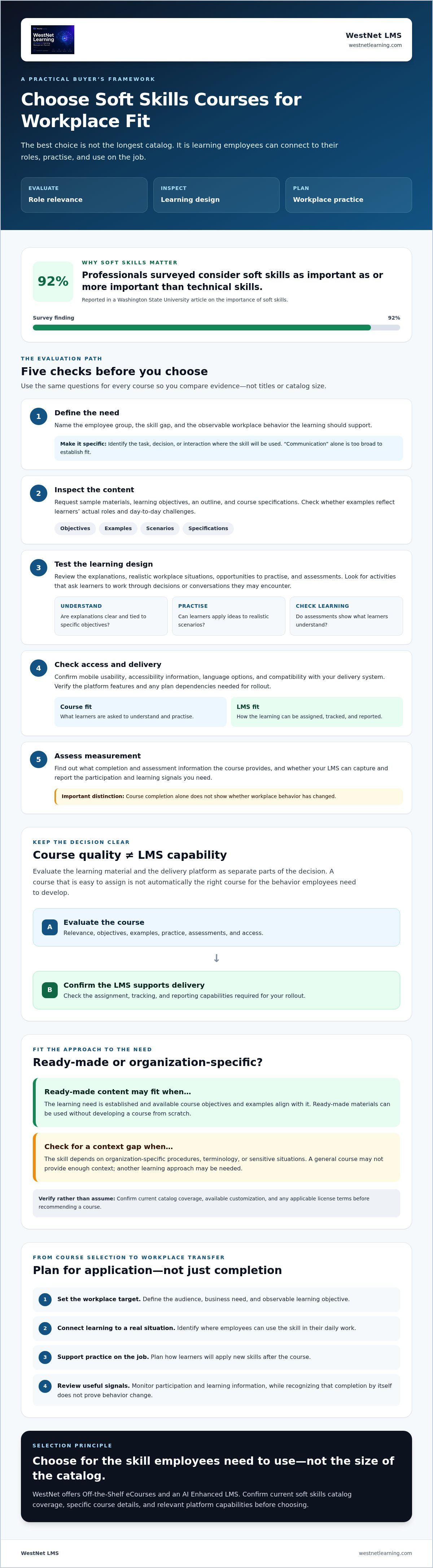
Use a consistent review process to compare off the shelf business soft skills courses on more than their titles or catalog size. The Washington State University article on the importance of soft skills reports that 92% of professionals surveyed consider soft skills as important as or more important than technical skills. For buyers, the practical task is to identify content that addresses a real workplace need and can reach learners through the systems already in place.
- Define the need. Identify the employee group, the skill gap, and the workplace behavior the learning should support.
- Inspect the content. Request a sample, objectives, outline, and course specifications. Check whether the examples reflect employees’ actual work.
- Test the learning design. Review explanations, realistic scenarios, practice opportunities, and assessments.
- Check access. Confirm mobile usability, accessibility information, language options, and compatibility with your delivery system.
- Assess measurement. Find out what completion and assessment data the course provides, and whether your LMS can capture and report the signals you need.
Ask providers for evidence, not just descriptions. A course title may sound relevant, but sample materials show whether it offers useful practice. Compare course requirements with your LMS capabilities, and confirm any plan dependencies before making a selection. WestNet’s Off-the-Shelf eCourses are one ready-made content option to review. Verify current catalog coverage and specific course details directly.
Which instructional design signals should buyers inspect?
Look for specific learning objectives, clear explanations, and scenarios that resemble decisions or conversations employees encounter. Check whether learners can practise a skill and receive feedback, rather than only watch or read. Assessments should test whether learners can apply or interpret the material, not merely recall a phrase shown on screen. Confirm the course format, duration, and accessibility details against learner needs and organizational requirements.
How can buyers assess fit before rollout?
Review a sample with employees who represent the intended audience, then collect structured feedback on relevance, clarity, and usability. Ask managers whether the scenarios reflect actual workplace decisions. Check technical requirements too: confirm whether content uses SCORM or xAPI, and whether your LMS supports the required standard and tracking. Verify any integration, reporting, or plan limitations before assigning the course more widely.
Compare Course Quality, Practical Application, and LMS Delivery
Evaluate the course and the platform as separate parts of the learning experience. Strong LMS reporting can show who participated and how they performed on an assessment, but it can’t establish that the course teaches a useful skill or that employees apply it later. Use the comparison below to assess both layers before choosing among off the shelf business soft skills courses.
| Area | Course evidence to review | LMS delivery question |
|---|---|---|
| Objectives | Are outcomes specific and relevant to the intended role? | Can administrators assign the course to the right audience? |
| Scenarios | Do examples reflect realistic workplace decisions? | Can learners access the content through the required delivery setup? |
| Practice | Can learners try a response or action, rather than only consume information? | Can the platform support the intended course format? |
| Assessment | Does it measure the stated objectives, not just recall? | What participation or assessment data can administrators review? |
| Accessibility | Are accessibility details available for evaluation? | Does access work with your authentication and learner needs? |
| Reporting | What course-level results are captured? | Can reports surface the learning signals you need to monitor? |
| Administration | Are course requirements and learner expectations clear? | Can enrollment and ongoing administration fit your workflows? |
Course completion is a participation signal, not proof of changed workplace behavior. To assess application, look for realistic choices, feedback on those choices, reflection, and practical actions learners can try afterward. Check that assessments align with course objectives and the situations employees face. When behavior change matters, plan manager follow-up or observation, such as discussing how a learner handled a relevant conversation after completing the course.
What should an LMS contribute to course delivery?
Match platform capabilities to operational needs. Consider whether automated enrollment, learner recommendations, authentication options, and learning analytics and reporting would support your rollout. Ask how administrators can review participation and learning data, then confirm that the specific features are available in the relevant plan. Verify required integrations and content formats as well. Don’t assume compatibility or functionality is universal.
WestNet’s LMS features page provides a reference for evaluating platform capabilities. Use it to frame questions about delivery and administration, while reviewing course samples separately to judge learning quality. A platform can organize and report on learning; the course still needs to give learners meaningful opportunities to practise.
Plan a Soft Skills Course Rollout That Supports Workplace Transfer
A course rollout works best when it starts with a defined business need, not a broad goal to “improve communication.” Identify the audience, establish a baseline, and set an observable objective. For example, if a team needs to clarify handoffs between colleagues, define the specific behaviors employees should use during those exchanges.
Keep the learning sequence manageable and explain why it matters to the work. Tell learners what the course is intended to help them do, then create a practical opportunity to use the skill soon afterward. That could be a low-risk practice conversation, a team reflection, or a manager check-in connected to a normal work task. With off the shelf business soft skills courses, a clear bridge between course material and daily responsibilities helps learners see where to apply the ideas.
How should teams measure more than course completion?
Track distinct signals rather than treating them as interchangeable. Enrollment indicates who was assigned, completion records participation, assessment results show performance on course questions, and learner feedback can reveal relevance or usability. Set a follow-up point to ask whether learners have practised the skill, feel more confident, or have demonstrated the target behavior in a situation a manager can observe. These measures offer useful clues, not proof that training alone caused a business outcome.
Review the signals before expanding the rollout. If learners complete the course but report few chances to practise, address that barrier before assigning it more widely. Feedback can also show whether the examples or learning sequence need reconsideration.
How can managers reinforce learning after a course?
Give managers a small set of discussion prompts tied to the course objectives. They might ask which approach a learner plans to try, what could make it difficult, and what support would help. Where feasible, create a low-risk opportunity to practise, then use a follow-up conversation to discuss what worked and what needs more attention. Keep the focus on specific behaviors, not a general judgment of performance.
If ready-made material doesn’t address a content gap, buyers can explore WestNet AI Course Creation as a separate offering. Confirm what it supports and whether it fits the requirement before choosing that route. The rollout remains grounded in the same principle: match learning to a defined need, support practice, and use evidence to guide the next step.
Choose a Course-and-Platform Approach That Can Grow With Your Team
Make the decision in sequence: confirm that the course content fits the learning need, then validate how it will be delivered, administered, measured, and supported. The right combination should work for your learners now without adding unnecessary complexity as your audience or requirements change.
WestNet LMS offers off-the-shelf business soft skills courses and an AI-enhanced learning management system. The platform includes automated enrollment, AI-generated course recommendations for learners, and comprehensive learning analytics and reporting. A dedicated client success manager is also a confirmed feature. Consider these capabilities in relation to your workflows, and verify which functions are available in the relevant plan before comparing options.
When might WestNet fit an organization’s evaluation?
Consider the AI-enhanced LMS if centralized course administration and learning reporting matter to your rollout. Recommendations may be relevant if learners need help finding suitable learning, while automated enrollment may support a defined assignment process. Assess each feature against your audience and administrative needs rather than treating a feature list as proof of fit. Confirm that the current eCourses catalog includes the specific soft skills titles you’re considering.
What should buyers confirm before moving forward?
Ask for current course titles, documented objectives, formats, and availability. Then check the operational details that determine whether the solution can work in your environment:
- Which required integrations and authentication options are supported in the relevant plan?
- What language options and content formats are available for your learners?
- How can administrators assign learning and review participation and reporting data?
- What support arrangements apply, and how does the dedicated client success manager fit your needs?
Use a demo to test real administrative workflows and the learner experience against your criteria. Bring a representative assignment scenario, reporting questions, and any integration or language requirements. Ask about catalog coverage directly, since specific soft skills content, formats, and availability should be confirmed rather than assumed.
Review the WestNet demo option to explore relevant platform workflows and ask which eCourses may fit your team. A clear evaluation keeps the focus on course relevance first, then confirms whether delivery and administration can support a consistent learning experience as your organization grows.
Turn Course Selection Into Workplace Progress
The strongest off the shelf business soft skills courses are relevant to employees’ roles, offer opportunities to practise, and fit the way your organization delivers learning. Evaluate course objectives and examples first, then confirm LMS delivery, administration, and reporting requirements. Completion records participation; follow-up practice and feedback help you look for signs of workplace application.
WestNet offers Off-the-Shelf eCourses, but confirm current soft skills catalog coverage before choosing a course. Its AI Enhanced LMS includes Learning Analytics and Reporting, automated enrollment, and AI-Generated Course Recommendations for learners. Use these capabilities to assess delivery and administration fit, not as substitutes for reviewing course quality or deciding how to evaluate learning.
Ready to test your requirements against real workflows? Request a WestNet demo to evaluate course delivery and platform fit, and ask about current catalog coverage. With a clear framework and a practical plan for application, you can move forward with greater confidence and support your team’s development.
Frequently Asked Questions
What are off-the-shelf business soft skills courses?
Off-the-shelf business soft skills courses are ready-made learning materials organizations can select without commissioning a bespoke course. They typically address capabilities used in workplace interactions, such as communication, collaboration, leadership, or listening. Course titles alone don’t establish fit, so review objectives, examples, practice activities, and assessments. Confirm that the provider’s current catalog covers the specific skills your employees need before selecting a course.
Are off-the-shelf soft skills courses effective for employee training?
They can support employee training when the content fits learners’ roles and the rollout gives employees a chance to use the skills afterward. Look for realistic scenarios, opportunities to practise, and assessments connected to the learning objectives. Pair the course with a manager conversation or a low-risk workplace activity. Completion shows participation, but it doesn’t by itself prove that behavior has changed or that business outcomes improved.
How do I choose the right soft skills courses for my business?
Start by identifying the audience, workplace need, and behavior you want learners to practise. Then compare course objectives, examples, learning activities, assessments, accessibility information, and delivery requirements. Ask providers for sample materials and course specifications rather than relying on catalog size or broad topic labels. Pilot a sample with representative learners and managers, then use their structured feedback to assess relevance before expanding the rollout.
Can off-the-shelf courses be customized for my company?
Customization depends on the course provider and the specific content license, so ask what changes, if any, are permitted before purchase. Some organizations use ready-made material as provided; others may need separate development when learning depends on internal procedures, terminology, or sensitive situations. Don’t assume every course can be adapted. Confirm the provider’s capabilities and the license terms, then decide whether the material fits as-is.
How can I measure whether soft skills training is working?
Track enrollment, completion, assessment results, and learner feedback as separate signals. These show participation, course performance, and learners’ views, but they don’t prove workplace application on their own. Set a follow-up point to ask whether employees have practised the target skill, how confident they feel, or what a manager has observed. Consider context and other influences before attributing any workplace change to training alone.
Do off-the-shelf courses work with an LMS?
Many ready-made courses are designed for digital delivery, but compatibility depends on the content format and the LMS. Ask the provider which formats are available, such as SCORM or xAPI, and confirm that your platform supports the required launch and tracking features. Also check accessibility, mobile usability, authentication, and reporting needs. Verify any integration or plan dependencies before assigning courses to learners.
Should I buy soft skills courses or create them with AI?
Choose ready-made courses when their objectives and examples fit an established need and you want to use existing content. AI course creation may be worth evaluating when you need material shaped around organization-specific information, but generated content still requires review for accuracy, relevance, and suitability. WestNet offers Off-the-Shelf eCourses and AI Course Creation. Confirm current catalog coverage and assess which approach best fits your requirements.