Reporting tells you what happened. Enterprise learning analytics tools can help you spot patterns in that activity, from emerging skill gaps to employees who may need targeted support. But when training data sits in silos and reports require hours of manual work, connecting learning to performance can feel out of reach.
The challenge isn’t a lack of activity data. It’s turning that data into evidence leaders can use. Completion rates alone rarely show whether training improves on-the-job performance or contributes to retention. You need a clearer view of how learning relates to workforce outcomes, without adding another layer of reporting overhead.
This guide explains how to move from fragmented records to useful business insight and more disciplined measurement of training impact. You’ll learn how to identify relevant data sources, plan executive-ready dashboards, and assess what your learning data can and cannot tell you. We’ll also examine how HRIS integration and capabilities such as the WestNet AI LMS’s learning analytics and reporting can support a more connected approach to learning measurement.
Key Takeaways
- Learn how enterprise learning analytics tools can help your organization move from reviewing training activity to investigating future skill needs.
- Identify which measures reveal meaningful learning progress and which only show course participation.
- Explore how AI-generated course recommendations and task automation can support more relevant learning and reduce manual work.
- Build a practical analytics roadmap for connecting learning data with workforce outcomes at enterprise scale.
- Understand what to review in an SLA and how WestNet AI LMS brings learning analytics, HRIS integration, and AI-generated recommendations together.
Defining Enterprise Learning Analytics Tools in 2026
Enterprise learning analytics is the systematic collection and analysis of learning data to help improve workforce capability and organizational outcomes. It can bring together information from courses, assessments, learning activity, and connected business systems so leaders can examine what training is accomplishing. The broader field of learning analytics provides a useful foundation. At enterprise scale, the focus is on using consistent data to inform decisions across teams and business units.
Think of the learning ecosystem as a network of platforms, content, learners, and performance signals. Analytics helps make activity across those systems visible and interpretable. Enterprise learning analytics tools can move organizations beyond isolated course records toward a more coherent view of learning and development. They do not, by themselves, prove that training caused a business result. That requires suitable outcome data and a careful measurement approach.
From Basic Reporting to Better-Informed Decisions
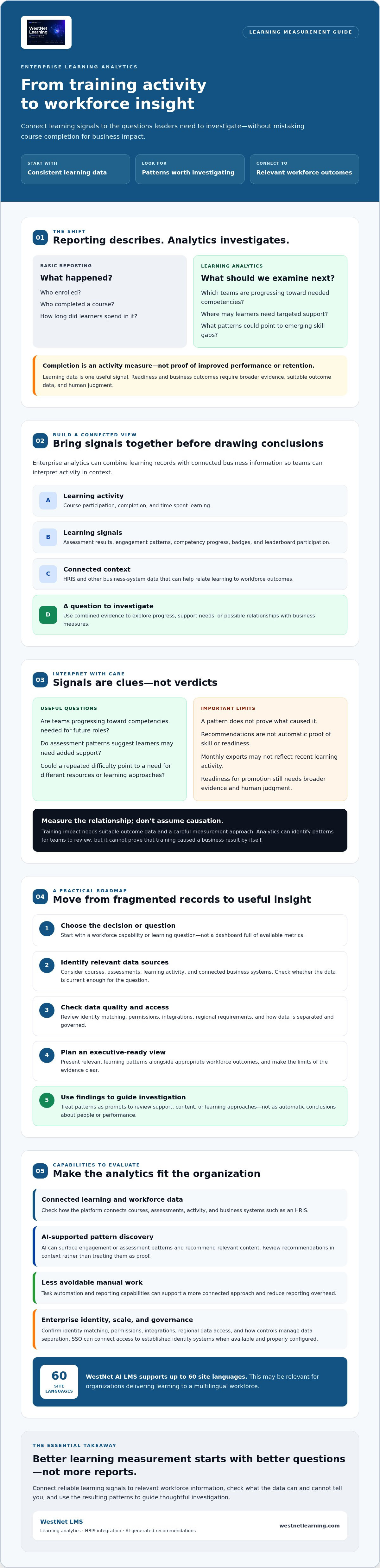
Reporting describes what has already happened: who enrolled, who completed a course, and how long learners spent in it. Analytics examines patterns in available data to help teams decide what to investigate next. Instead of asking only, “Who finished what?” leaders can ask, “Which teams are progressing toward the competencies needed for future roles?” Readiness for promotion still requires broader evidence and human judgment. Learning data is one useful signal, not a decision on its own.
AI can help process large datasets and surface patterns that may be difficult to spot manually. For example, a change in assessment results or repeated difficulty with a topic may prompt a team to review whether learners need additional support. Treat these findings as leads to investigate, not proof of cause. Also check how current the data is. A report based on monthly exports may not reflect recent changes in learning activity.
Why Large Organizations Need Purposeful Analytics
Large organizations need data structures that can accommodate different teams, business units, languages, and regional requirements while supporting a consistent enterprise view. WestNet AI LMS supports up to 60 site languages, which may be relevant for organizations delivering learning to a multilingual workforce. Design regional data access and governance around your organization’s policies and applicable requirements. If a platform uses a multi-tenant structure, evaluate how its controls separate data and manage access.
Identity quality matters, too. Single Sign-On (SSO), when available and properly configured, can connect user access to established identity systems and help reduce duplicate or inconsistent learner records. Before selecting a platform, confirm how it handles identity matching, permissions, and data integrations. For a related view of enterprise platform capabilities, explore this enterprise AI learning platform guide.
Core Features of Modern Learning Analytics Engines
At enterprise scale, analytics must do more than collect course activity. It should help learning and development teams interpret patterns, reduce avoidable reporting work, and share relevant insights with decision-makers. The Society for Learning Analytics Research emphasizes using learner data to understand and optimize learning, not simply to predict outcomes. That distinction matters: useful analytics supports informed action while keeping people, context, and data quality in view.
Look for capabilities that connect individual learning signals to organizational questions. Engagement, assessment results, competency progress, and participation in activities such as badges or leaderboards can each offer clues. None should be treated as a performance verdict on its own. Interpreted together, and alongside appropriate business measures, they can help teams decide where to investigate and improve.
AI-Driven Insights and Recommendations
AI can help analyze engagement and assessment patterns across a large learner population, then recommend relevant courses or content for further development. For example, if a group repeatedly struggles with a topic, an administrator could review whether additional learning resources or a different learning approach would help. Recommendations should be considered in context, rather than treated as automatic proof of skill or readiness.
Adaptive learning paths adjust the content or sequence a learner receives based on ongoing activity and assessment signals. When evaluating this capability, ask what data informs the sequence, whether administrators can review the recommendations, and how learners can access other relevant content.
Some platforms also offer natural-language queries through AI-powered help, allowing administrators to ask questions about learning information. Treat this as a capability to evaluate, not an assumed feature. Check what data the assistant can access, how it respects permissions, and whether its answers can be verified against underlying reports. WestNet AI LMS includes AI-powered help for learners and administrators, as well as AI-generated course recommendations for learners.
Reporting and Dashboards
Dashboards can replace recurring spreadsheet work with views tailored to executives, managers, and learning teams. A useful dashboard makes selected indicators easy to review, but a visualization alone does not establish ROI. Teams still need relevant outcome data and a sound method for assessing its relationship to learning. Confirm how often data refreshes and whether reports can be filtered by role, team, or business unit.
Custom role administration can help ensure each stakeholder sees information relevant to their responsibilities, while protecting data that should remain restricted. Ask vendors how permissions are configured and reviewed. Also assess whether enrollment and task automation can support your defined workflows. WestNet AI LMS supports automated enrollment and other task automation, but confirm which processes and triggers fit your needs.
Complex data still needs interpretation. WestNet AI LMS includes a Dedicated Client Success Manager. When evaluating support, ask how the role can assist your team and what responsibilities are included. To review the platform’s capabilities, explore the WestNet AI LMS features.
Moving Beyond Vanity Metrics: Measuring Real Business Impact
Course completions and time spent learning show participation, not whether training changed what employees can do. Treat them as operational indicators, then pair them with impact measures such as demonstrated competency growth, performance changes, or retention. The components of learning analytics include gathering, cleaning, analyzing, and reporting data. Each step matters: unreliable or disconnected records weaken any conclusion about impact.
A practical measurement plan starts with a business outcome, establishes a baseline, and defines when to check for change. For example, compare relevant learning activity with an appropriate outcome, such as sales target attainment or safety incidents, while accounting for other factors that could affect the result. A correlation alone does not establish ROI. For a more detailed framework, see this guide to ROI in a learning management system.
Track Skill Gaps and Competency Growth
Competency and certification records can help teams see where skills are demonstrated, where requirements remain unmet, and how those patterns change over time. A development plan can provide a longitudinal view when it records goals, learning activity, and later assessments consistently. To make the data useful, agree on what each competency means, how it will be assessed, and who is responsible for keeping records current.
AI may help flag learners whose engagement or assessment patterns suggest they could benefit from support. Use such signals as prompts for a human review, not as definitive labels. Enterprise learning analytics tools are most useful when teams can trace a signal back to its underlying data and respond with appropriate support.
Connect Learning Data with HRIS and Performance
HRIS integration can connect learning records with workforce attributes such as role, team, or employment status, subject to the organization’s data permissions and governance. A typical sync process maps fields between systems, matches records using agreed identifiers, transfers updates, and checks for duplicates or errors. WestNet AI LMS supports HRIS integration, HRIS sync, and data migration, so organizations can assess how learning and workforce data may be brought together.
With carefully governed data, analysts can examine whether employees who complete relevant training also show changes in defined performance measures. Use consistent cohorts and time periods, validate data quality, and avoid treating association as causation. For a related discussion of how learning can support retention, explore employee retention through learning. WestNet AI LMS supports AI-powered e-learning creation in SCORM or xAPI formats. If you plan to analyze learning experiences beyond course completion, confirm what data the relevant systems capture and how it reaches your reports.
Implementing Analytics Across Large-Scale Organizations
Deploy analytics in stages, not as a one-time dashboard project. Start with a business question, identify the systems and data needed to answer it, then pilot a focused use case before expanding access and reporting. The Modernizing Corporate Learning Systems 2026 Guide offers a roadmap for planning that transition. Enterprise learning analytics tools deliver more dependable insight when teams agree on data definitions, ownership, and governance before organization-wide rollout.
Set expectations for data availability and support in a Service Level Agreement (SLA). Define the service commitments that matter to your analytics program, such as availability, incident communication, and support responsibilities. Confirm what the agreement actually covers. Don’t assume it guarantees real-time data refreshes or uninterrupted access unless those terms are explicitly stated.
Handle legacy data deliberately. Map old fields to the new data model, align learner identifiers, retain relevant timestamps, and validate a sample before importing historical records. Keep imported data distinguishable from new activity so gaps or inconsistent definitions don’t distort baselines. Document exclusions and transformation rules, then test reports against known records before using them for decisions.
Protect Data and Access
Evaluate security and privacy requirements against your organization’s operations and the locations where employee data is handled. If SOC 2 evidence or GDPR-related capabilities are relevant, verify the provider’s current documentation, data-processing terms, access controls, and incident procedures rather than assuming compliance. Custom administrator roles can limit access to sensitive performance information. Also clarify administrator support responsibilities for maintaining permissions, integrations, and data quality.
Review authentication options as part of access design. Consider whether the platform can work with your organization’s identity-management approach, including SSO where appropriate, and how access is removed when a user changes roles or leaves. Define role-based permissions and a process for reviewing them regularly.
Scale Across Languages and Business Units
WestNet AI LMS supports up to 60 site languages. For enterprise reporting, distinguish the language used to deliver learning from the consistent identifiers and definitions needed to aggregate results. Set shared metric definitions, then assign users to business regions or units using validated organizational data. This enables more meaningful comparisons without relying on language alone as a proxy for location or context.
Some organizations also need distinct branding for sub-entities alongside centralized analytics. Treat multi-branding as a requirement to confirm during platform evaluation, and establish which data remains centrally visible. To assess how learning systems can connect with other platforms, review LMS integration options.
Optimizing Your Strategy with WestNet AI LMS
Make analytics a working management capability, not just a collection of reports. WestNet AI LMS brings learning analytics and reporting together with AI-generated course recommendations, AI-Powered e-learning Creation, and HRIS integration. For enterprise teams, these capabilities can help connect learning activity with workforce context and guide learners toward relevant development. The goal is not simply to collect more data. It’s to make information useful for decisions about skills, learning priorities, and program effectiveness.
Evaluate the platform against your organization’s real data needs. Define the business questions you want analytics to answer, identify the systems and measures involved, and check how the platform supports the required data flows. For deeper technical context on AI-enabled learning platforms, read the Enterprise AI Learning Platform 2026 Strategic Guide.
The WestNet Advantage: Learning Insights and Recommendations
AI-generated recommendations can help learners find relevant courses, while learning analytics and reporting give administrators a broader view of participation and progress. Together, these capabilities can support a more coordinated approach to complex learning programs. They don’t replace a clear competency framework or human oversight. They give teams additional signals to consider as they refine learning priorities.
WestNet AI LMS includes a Dedicated Client Success Manager. As you evaluate the platform, clarify the support available and how it fits your team’s implementation and ongoing needs. Internally, agree on metric definitions, reporting audiences, and how insights will inform action.
Integration, Evaluation, and Support
WestNet AI LMS supports HRIS integration and data migration, helping organizations assess how learning information can connect with workforce records. Confirm the specific integration scope, data fields, migration approach, and support responsibilities during evaluation. If your organization has high workforce turnover, ask directly how user access and license reassignment are handled. Confirm applicable license terms rather than assuming how reassignment or costs work.
Likewise, if your learning program includes virtual or instructor-led activities, verify how those experiences can be represented in the platform’s analytics and whether integrations are needed. Assess data availability, reporting requirements, and the applicable Service Level Agreement (SLA) before deployment. These checks help ensure the platform aligns with your operational model rather than relying on assumptions about features or service commitments.
Turn Learning Data Into a Strategic Advantage
Enterprise learning analytics tools create value when they do more than summarize activity. They help leaders identify developing skill needs, examine how learning relates to workforce outcomes, and make decisions using evidence instead of completion counts alone. A strong strategy pairs reliable data and clear governance with measures that reflect what the organization is trying to improve.
That shift takes more than technology. It requires connected systems, meaningful metrics, and people who can interpret insights in context. WestNet AI LMS brings learning analytics and reporting together with HRIS integration, supports up to 60 languages, and includes a Dedicated Client Success Manager. These capabilities can help enterprise teams build a more coherent foundation for learning measurement.
Move from fragmented records to insights your organization can act on. Request a demo of WestNet AI LMS to assess its analytics and integration capabilities against your data priorities.
Frequently Asked Questions
What is the difference between learning reporting and learning analytics?
Learning reporting summarizes activity that has already occurred, while learning analytics examines data to identify patterns and inform decisions. A report might show who completed a course last month. Analytics could help identify a team that may need additional support based on assessment results and participation trends. Interpret those signals alongside workforce context rather than treating them as definitive explanations.
How can enterprise learning analytics tools improve employee retention?
Enterprise learning analytics tools can help teams identify development needs and examine how access to relevant learning relates to employee retention. For example, an organization might compare participation in role-specific development with retention patterns across comparable groups and time periods. That relationship alone doesn’t prove training caused employees to stay. Use findings to investigate employee needs and improve development opportunities, while considering other factors that may influence retention.
Do enterprise analytics tools support xAPI and SCORM data?
Support varies by platform, so confirm what a specific system can create, import, record, and report. WestNet AI LMS supports AI-powered e-learning creation in SCORM or xAPI formats. SCORM is commonly used to package and track course activity in an LMS, while xAPI can represent a broader range of learning experiences when connected systems send compatible data. Check your reporting requirements and confirm the data flow before choosing a format.
Can I integrate my LMS analytics with my company's HRIS system?
An LMS can connect with an HRIS when the platform supports the required integration and the systems’ data fields are mapped appropriately. WestNet AI LMS supports HRIS integration, data migration, and HRIS synchronization. Before implementation, define which records and fields should sync, how learner identities will be matched, and how errors or duplicate records will be handled. Validate the data flow before relying on combined reports for workforce decisions.
How does AI improve the accuracy of learning analytics?
AI can help process large volumes of learning data and surface patterns or recommendations, but it doesn’t automatically make analytics accurate. Results depend on reliable, relevant data and clearly defined measures. For example, incomplete learner records could distort an engagement analysis. Review how the system generates recommendations, validate insights against source data, and use human judgment before making decisions about employee development or performance.
What are the most important KPIs to track in an enterprise LMS?
Choose KPIs that connect learning activity to a defined workforce or business goal. Useful measures may include completion of required learning, assessment results, competency progress, certification status, and changes in relevant performance indicators. Completions and time in a course show participation, but not necessarily impact. Pair them with outcome measures that fit the program, and establish a baseline and measurement period so results can be interpreted consistently.
How do learning analytics tools handle data from multiple global regions?
Assess whether a platform can support consistent reporting across business units while preserving appropriate access controls and data governance. WestNet AI LMS supports up to 60 site languages, and its administrative capabilities include location-to-region assignment. Organizations should define shared metric standards, confirm how learner records are grouped, and review data access requirements for each operating context. Language settings support learners, but they shouldn’t be used alone to infer region or performance.
Is it possible to track the ROI of corporate training using these tools?
Yes, but an LMS alone may not contain all the evidence needed to calculate training ROI. Establish the program’s costs, choose a measurable outcome, and compare results before and after training or across suitable groups. Where possible, connect learning records with relevant business data, such as competency assessments or performance measures. Consider other influences on the outcome, too. Correlation can inform the analysis, but doesn’t by itself prove that training caused a change.