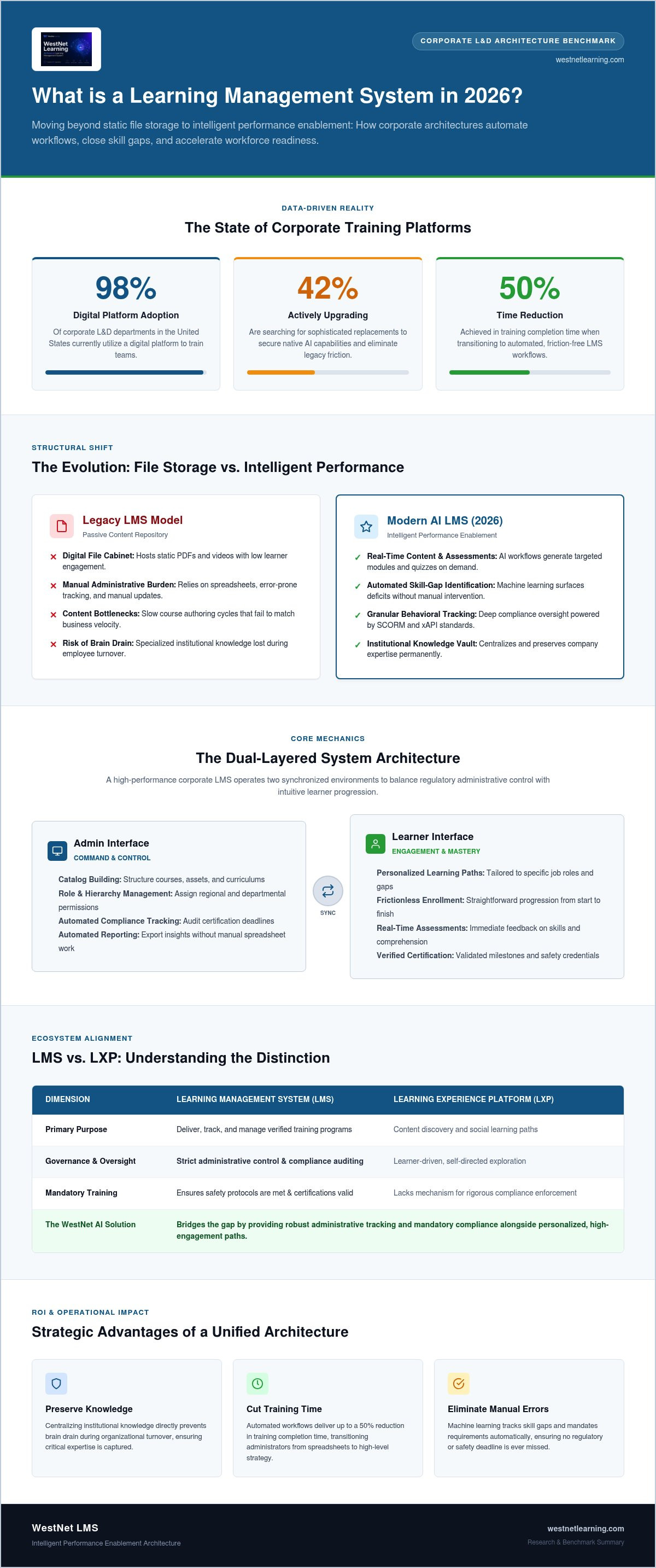
Ninety-eight percent of corporate learning and development departments in the United States currently utilize a digital platform to train their teams, yet nearly 42 percent are already searching for a more sophisticated replacement. This friction occurs when organizations rely on fragmented, legacy tools that fail to keep pace with the rapid speed of modern business. You've likely experienced the administrative headache of manual compliance tracking or the low engagement levels that stem from static content. Understanding what is a learning management system in 2026 requires looking beyond simple file storage. It demands a focus on how intelligent technology bridges the gap between raw data and organizational growth.
We'll help you master the fundamentals of LMS technology while exploring how AI-driven platforms are revolutionizing corporate development and operational efficiency. This guide provides a clear framework for evaluating modern features that eliminate manual errors and accelerate course creation. You'll discover how transitioning to a cohesive, future-ready solution can deliver up to a 50 percent reduction in training completion time. We will examine the mechanics of these systems, the impact of generative AI workflows, and the strategic advantages of a unified learning architecture.
Key Takeaways
- Define what is a learning management system by moving beyond basic content hosting toward a sophisticated model of intelligent performance enablement.
- Explore the dual-interface architecture that balances robust administrative control with a streamlined, personalized experience for every learner.
- Identify how AI-powered course creation and automated reporting eliminate manual errors while centralizing critical institutional knowledge.
- Master the evaluation process by focusing on essential integration capabilities, transferable licensing models, and the security of a dedicated Client Success Manager.
- Transition from fragmented, outdated training methods to a cohesive digital ecosystem that drives measurable growth and workforce retention.
Defining the Modern Learning Management System (LMS)
A Learning Management System is a software application designed to deliver, track, and manage training programs. While this definition remains the technical baseline, the scope of the technology has shifted significantly by 2026. Understanding what is a learning management system today requires looking beyond a simple content repository. It serves as the digital backbone of organizational knowledge and compliance, ensuring that every employee possesses the specific skills required for their role. Modern platforms have transitioned from passive content hosting to active intelligent performance enablement tools.
Legacy systems often relied on manual administrative tasks that were prone to error and slow to update. These outdated methods created bottlenecks in course development and compliance tracking. In contrast, a modern AI LMS automates these workflows. It uses machine learning to identify skill gaps and suggest targeted training modules without human intervention. Recent data shows that 42 percent of organizations are actively upgrading their platforms to secure native AI capabilities. This movement reflects a desire for systemic improvement over fragmented software.
The Evolution from Storage to Intelligence
Early learning management systems functioned primarily as digital file cabinets for PDFs and static videos. They lacked the interactivity needed for deep engagement. Today, the focus has moved toward standards like SCORM and xAPI, which allow for granular tracking of learner behavior. Modern systems prioritize the learner experience by incorporating automated workflows. These platforms don't just store information; they actively facilitate the AI-driven transformation of corporate training by generating content and assessments in real time.
Implementing an automated LMS workflow delivers up to a 50 percent reduction in training completion time. This efficiency stems from removing the friction found in manual systems. Automation allows administrators to focus on strategy rather than spreadsheets. It creates a seamless path from enrollment to certification, ensuring that no compliance deadline is missed. By 2026, intelligence is no longer an optional feature but a foundational requirement for organizational agility.
LMS vs. LXP: Understanding the Ecosystem
Decision makers often debate the merits of a Learning Management System (LMS) versus a Learning Experience Platform (LXP). While an LXP focuses on discovery and social learning, the LMS remains essential for corporate environments that require strict administrative control and compliance auditing. When evaluating what is a learning management system compared to an LXP, the primary differentiator is the ability to mandate and verify training. You need a system that ensures safety protocols are met and certifications are valid. WestNet AI LMS bridges this gap by offering the robust tracking of a traditional system alongside the personalized, high-engagement paths typically found in an LXP.
Centralizing institutional knowledge within an LMS prevents the brain drain that occurs during employee turnover. It preserves specialized expertise that would otherwise be lost. A modern system provides a cohesive environment where compliance meets curiosity. It empowers the workforce while maintaining the rigorous oversight necessary for complex operations. This synergy between control and experience defines the next generation of corporate development tools.
How a Corporate LMS Works: The System Architecture
A corporate LMS functions through a sophisticated dual-layered architecture designed to bridge the gap between administrative oversight and employee development. On one side, the Admin Interface provides training managers with a powerful command center to build catalogs, assign roles, and monitor progress. On the other, the Learner Interface serves as a centralized hub where employees access personalized paths. Understanding what is a learning management system from a functional perspective means recognizing how these two environments interact to create a cohesive learning culture.
User Management and Organizational Hierarchy
Managing complex departments, global regions, and diverse job titles requires a system that reflects your real-world organizational structure. Modern platforms utilize robust LMS integrations to sync with HRIS data, ensuring that user records are always accurate. Single Sign-On (SSO) options like SAML or Okta remove operational obstacles by allowing seamless access without multiple passwords. This technical cohesion is a vital factor when evaluating and selecting a learning management system for large-scale operations. WestNet AI LMS also features transferable user licenses, which allow you to reallocate seats from deactivated employees to new hires. It's a cost-efficient model that prevents budget waste.
Content Delivery and Technical Standards
Technical interoperability is the engine behind effective training delivery. SCORM compliance remains a foundational pillar of what is a learning management system, as it provides the standardized data needed for rigorous compliance audits. While SCORM tracks traditional course interactions, the Experience API (xAPI) captures learning events that happen outside of the platform, such as mobile interactions or simulator performance. The system also manages Virtual and Instructor-Led Training (vILT/ILT) by automating attendance and calendar syncing. This integration ensures that hybrid learning models feel unified rather than fragmented.
Automation is the final piece of the architectural puzzle. Automated enrollment triggers training modules based on job titles, locations, or hire dates. If an employee moves into a leadership role, the system immediately assigns the necessary management certifications. This proactive approach reduces the administrative burden and ensures that your workforce remains compliant without constant manual intervention. If you want to experience this streamlined workflow, you can request a personalized demo to see the system in action.
The Strategic Business Value of an LMS Investment
Investing in a sophisticated platform is a strategic move to safeguard your organization's intellectual capital. Centralizing institutional knowledge prevents the devastating "brain drain" that occurs during employee turnover. Instead of losing expertise when a veteran staff member departs, their insights are codified within the digital ecosystem. This structural stability reduces administrative overhead by replacing manual spreadsheets with automated reporting and real-time notifications. Defining what is a learning management system in a business context means viewing it as an engine for operational efficiency rather than just a software expense.
Global operations require a system that can scale without logistical friction. WestNet AI LMS supports up to 60 site languages, allowing learners to select their preferred interface at login. This capability ensures that uniform training reaches every region, bridging the gaps between different operational states. It removes the obstacles associated with fragmented, localized training methods. When leadership asks what is a learning management system, the answer should focus on its ability to mitigate risk and drive revenue by consolidating global efforts into a single, cohesive platform.
Driving Employee Retention Through Learning
Career development paths act as a powerful anchor for talent. When employees see a clear trajectory for growth, their loyalty to the organization increases. Developing these structured paths is essential for employee retention through learning, as it signals that the firm values their long-term potential. This psychological impact is particularly strong for new hires who want to feel empowered from their first day. You transform training from a mandatory hurdle into a pathway for professional advancement.
Compliance Excellence and Risk Mitigation
Regulated industries face constant pressure to remain audit-ready at all times. A modern system ensures 100 percent compliance readiness by automating certification tracking and renewal alerts. You'll avoid expiration lapses that lead to costly legal liabilities or safety incidents. Following compliance training best practices requires more than simple record-keeping; it demands proactive monitoring. Advanced analytics allow you to identify knowledge gaps before they manifest as operational failures. This predictive approach positions the brand as a stabilizing force that handles significant complexity with ease.
Essential Features of a High-Performance LMS
A high-performance system transforms training from a static requirement into a dynamic engine for growth. When evaluating what is a learning management system for an enterprise environment, the focus must shift toward specific functionalities that drive measurable ROI. These features remove operational friction and empower both administrators and learners to achieve peak productivity. Modern platforms rely on a core set of advanced tools to handle the complexity of large-scale workforce development. Success requires more than a content vault. It requires a strategic architect.
The Rise of AI in Corporate Training
Artificial intelligence has fundamentally altered how organizations approach content development and learner support. AI-generated recommendations now personalize the learner journey by suggesting modules based on individual performance and career goals. This level of precision ensures that no time is wasted on irrelevant material. Organizations are now significantly reducing development time by utilizing AI Course Creation tools. These systems generate high-quality modules and assessments in minutes, replacing the months-long cycles of traditional instructional design. AI-powered help desks provide immediate assistance to both learners and administrators, ensuring that technical obstacles never slow the pace of progress. Efficiency is the new standard.
Engagement Tools: Gamification and Microlearning
Keeping a workforce engaged requires more than just high-quality video; it demands a strategic use of behavioral science. Gamification features like badges and leaderboards drive healthy competition and increase course completion rates. These tools tap into the psychological need for recognition. To address the modern attention span, many leaders are implementing Microlearning Strategies that deliver information in short, impactful bursts. This approach is particularly effective for the frontline and deskless workforce who need just-in-time performance support on mobile devices. Accessibility ensures that training happens where the work happens. It bridges the gap between knowledge and application.
Robust HRIS integration serves as the invisible glue that holds the system together. By seamlessly syncing user data with payroll and HR systems, you eliminate the need for manual data entry and ensure that every new hire is automatically enrolled in the correct path. Real-time learning analytics provide a clear visualization of workforce competencies, allowing executives to make data-driven decisions about talent allocation. This transparency turns training into a competitive advantage. Explore our full suite of AI-enhanced LMS features to discover how a unified platform can stabilize your complex organizational needs.
Selecting and Implementing Your Learning Management System
Selecting what is a learning management system for your organization requires a strategic assessment that moves beyond a simple feature checklist. You must evaluate your technical requirements and user scale to ensure the platform can handle your specific operational load. For enterprise reliability, a robust Service Level Agreement (SLA) is non-negotiable. It provides the calm assurance that your training data is secure and accessible at all times. A sophisticated choice acts as a stabilizing force, allowing you to manage significant complexity with ease while positioning your workforce for future growth.
Evaluating the true cost of ownership is another vital step in the selection process. This calculation extends far beyond the initial subscription fee to include data migration, administrative setup, and ongoing support. WestNet Learning provides transferable user licenses to ensure cost efficiency, allowing you to reallocate seats as your team evolves. Perhaps most importantly, a dedicated Client Success Manager serves as a visionary partner for your account. They bridge the gap between technical implementation and long-term adoption, ensuring the platform remains a catalyst for speed and modernization.
The Implementation Roadmap: Data Migration and Setup
A successful rollout begins with a methodical implementation roadmap. Handling legacy data import is a primary concern; you must ensure historical records remain intact during the transition to a modern AI-ready solution. Setting up site preferences, branding, and custom certificates ensures the platform feels like a seamless extension of your corporate identity. You should also define custom admin and manager roles that accurately reflect your organizational chart. This precise configuration removes operational obstacles and empowers leaders to manage their specific departments without technical friction.
Starting the Evaluation: Trials and Demos
Hands-on testing is the only way to verify if a platform meets your standards for efficiency and intelligence. A 30-day free trial allows your team to experience the learner interface and administrative controls in a real-world scenario. During a Demo, ask targeted questions about the vendor's AI roadmap and integration capabilities. You need to know how the system will evolve as your needs grow. Finalize your decision based on scalability and the platform's ability to provide a cohesive, future-ready environment for your entire global workforce.
Empower Your Workforce with Intelligent Training
Transitioning from fragmented, manual training methods to a cohesive digital ecosystem is no longer a luxury for growing organizations. By understanding what is a learning management system in the context of 2026, you position your brand as a strategic innovator. We've explored how AI-driven automation reduces administrative burden while ensuring 100 percent compliance readiness across global teams. These tools don't just host content; they serve as a stabilizing force for complex operational needs. Modernizing your approach preserves institutional knowledge and empowers every employee to reach their full potential through personalized growth trajectories.
Success depends on choosing a partner that values progress and intelligence. WestNet Learning offers a sophisticated path through logistical challenges with AI-Powered Course Creation and SLA-backed Enterprise Reliability. Every account benefits from a Dedicated Client Success Manager to ensure seamless adoption and systemic improvement. It's time to replace outdated friction with streamlined productivity. Experience the future of training with a free 30-day trial of WestNet AI LMS. Take the first step toward a more efficient, future-ready workforce today.
Frequently Asked Questions
What is the primary purpose of an LMS in a business setting?
The primary purpose of a learning management system in a business setting is to centralize organizational knowledge and automate the delivery of training programs. It acts as a digital backbone for workforce development by ensuring every employee has access to the specific skills required for their role. By using a platform like WestNet AI LMS, companies track progress in real time and identify competency gaps before they impact operational efficiency.
How does an AI-powered LMS differ from a traditional one?
An AI-powered LMS differs from a traditional system by replacing manual administrative tasks with intelligent automation. While older platforms require manual course uploads and static assignments, modern solutions utilize AI-Powered e-learning Creation to generate content in minutes. These systems also provide AI-generated course recommendations for learners, personalizing the professional development journey based on individual performance data rather than generic catalogs. This shift reduces development time significantly.
Can an LMS integrate with my existing HR software?
Yes, a high-performance LMS is designed to integrate seamlessly with your existing HRIS and payroll software. These integrations remove operational obstacles by automatically syncing user data, department hierarchies, and job titles. WestNet Learning supports robust HRIS sync and multiple authentication options like Single Sign-On (SSO). This cohesion ensures that new hires are enrolled in necessary training the moment they are added to your primary human resources system.
What are SCORM and xAPI, and why do they matter?
SCORM and xAPI are technical standards that ensure content interoperability between different learning tools. SCORM remains the industry benchmark for tracking completion and assessment data within traditional modules. In contrast, xAPI captures a broader range of learning events, such as mobile interactions or simulator performance. These standards matter because they provide the reliable data needed for rigorous compliance audits and long-term performance analytics across the entire organization.
How much does a learning management system typically cost?
The cost of a learning management system typically involves a recurring SaaS subscription fee often scaled by the number of active users. When evaluating your budget, it's vital to consider the total cost of ownership, which includes data migration, implementation, and ongoing support. WestNet Learning utilizes a cost-efficient model with transferable user licenses. This allows you to reuse seats from deactivated employees for new hires without incurring additional financial penalties.
Is an LMS suitable for small teams or only large enterprises?
Modern learning management systems are built to scale effectively for both small teams and large global enterprises. While large organizations value the ability to manage complex hierarchies, smaller teams benefit from the administrative time saved through automation. WestNet AI LMS provides a stabilizing force for any user count. It offers enterprise-level features like gamification and advanced analytics to organizations of all sizes that prioritize workforce intelligence and growth.
How does an LMS help with regulatory compliance?
An LMS helps with regulatory compliance by automating certification tracking and providing a verifiable audit trail. It eliminates the risk of human error associated with manual spreadsheets by sending automated alerts before certifications expire. WestNetLMS includes a competency and certification tracker that ensures your organization remains 100 percent audit-ready. This proactive approach mitigates legal liability and maintains high safety standards across all operational regions without constant manual oversight.
What kind of content can I host on an LMS?
You can host a wide variety of content formats within a modern platform to support a blended learning strategy. This includes interactive SCORM or xAPI modules, video tutorials, eBooks, and survey modules. The system also orchestrates Virtual and Instructor-Led Training (vILT/ILT) events by managing attendance and calendar syncing. WestNet Learning also offers off-the-shelf eCourses, providing a ready-made library of professional content to supplement your proprietary internal training materials.