A fuller course catalog doesn't necessarily reveal what employees need to learn next. An AI LMS for employee skill development can analyze learning and performance data to identify potential skill gaps, then recommend relevant courses and resources. Employee training is the structured process of building the knowledge and skills people need for their roles, and AI can help make that process more targeted.
It makes sense to expect training recommendations to reflect each employee’s role and current abilities. Recommendations are most useful when they address real development needs, and skill-gap detection helps identify where learning may be relevant.
This comparison explains how AI LMS platforms recommend learning, identify skill gaps, and support training decisions. You’ll learn which capabilities to compare, what data can inform recommendations, and how to assess whether a platform fits your organization’s learning goals.
Key Takeaways
- See how AI learning paths can adapt to employees’ skills, roles, progress, and development goals.
- Learn how recommendations can connect employees with relevant courses, resources, and mentors.
- Understand how learning activity and performance data can help reveal current and emerging skill gaps.
- Compare platforms by personalization, automation, scalability, integrations, and how well they support training decisions.
- Explore how WestNet LMS offerings can help bring AI-powered learning, course creation, integrations, and ready-made eCourses together.
What is an AI-based learning platform?
An AI-based learning platform uses employee and course data to shape learning experiences instead of assigning everyone the same sequence. For employee development, prioritize adaptive paths, role-relevant recommendations, skills assessments, analytics, and opportunities for collaborative learning.
For U.S. employers, key risks include exposing sensitive records, reinforcing bias in historical data, and relying on inaccurate recommendations for training decisions. The National Institute of Standards and Technology advises treating LMS training records as sensitive because they may relate to performance evaluations or consequences for missed training. Use appropriate access controls, review recommendations, and keep human oversight.
AI-Personalized Learning Paths
An adaptive path adjusts the sequence or difficulty of learning based on an employee’s progress. Someone who demonstrates proficiency in a foundational topic can move to advanced material, while another employee receives more practice in that area. Unlike a fixed course catalog, the path can change as performance or proficiency develops.
Assess this feature by looking for recommendations that connect learning objectives to an employee’s role and observed progress. A useful path explains why a course appears and lets managers align it with development priorities. This makes personalization practical: employees receive relevant programs without every recommendation becoming an automatic decision.
Employee Data Behind Personalization
Personalized learning can draw on current skills, learning history, performance indicators, and career goals. Completed courses may show an employee’s experience with a topic, while assessment results can indicate where more practice could help. Career goals add direction, helping distinguish immediate role needs from longer-term development.
These inputs differ from course recommendations themselves: they provide the context that shapes those recommendations. Employers can establish which data informs a pathway, keep employee records appropriately protected, and review whether recommendations reflect job requirements. A structured employee training and development approach can connect learning activity with defined development objectives.
Personalization can also change how employees learn with colleagues and subject matter experts. A pathway might pair a course with a team discussion, peer practice, or expert-created material. This adds shared experience to AI-powered sequencing, rather than treating every skill as something employees must develop alone.
| Option | Personalization signal | Path response | Human contribution |
|---|---|---|---|
| Adaptive path | Progress and proficiency | Changes learning sequence | Manager aligns priorities |
| Role-based pathway | Job role and skill needs | Surfaces relevant programs | Expert supplies role context |
| Collaborative learning | Shared development objective | Pairs resources with practice | Peers and experts share knowledge |
Choose an approach that connects reliable employee data and clear learning goals with meaningful opportunities to apply skills alongside others.
AI recommendations for courses, resources, and mentors
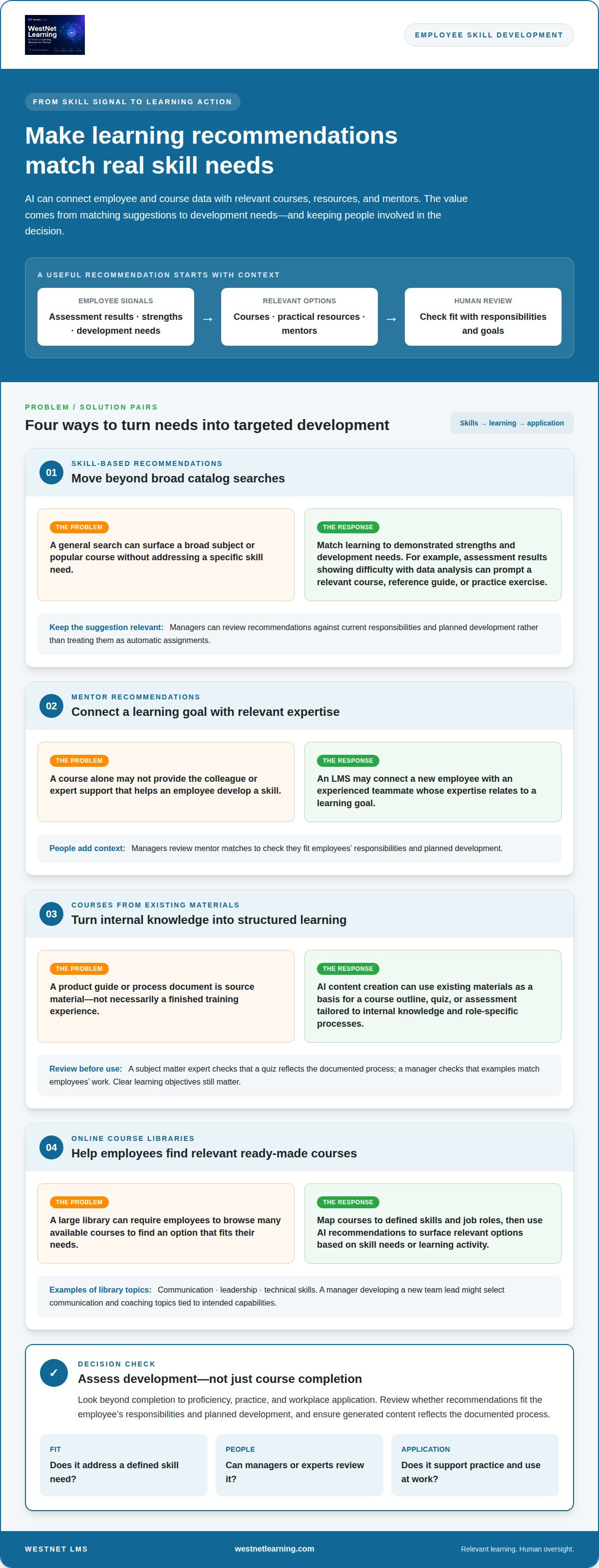
AI-driven recommendations connect skill needs with courses, practical resources, and people who can support development. Assess their value by looking beyond course completion to proficiency, practice, and workplace application.
Skill-Based Course Recommendations
A skill-based recommendation matches learning materials to an employee’s demonstrated strengths and development needs. For example, assessment results showing difficulty with data analysis can prompt a relevant course, reference guide, or practice exercise. Unlike a general catalog search, the suggestion addresses a specific skill need rather than a broad subject or popular course.
Recommendations can also include mentors. An LMS may connect a new employee with an experienced teammate whose expertise relates to a learning goal. Managers can review suggested courses or mentor matches to ensure they fit current responsibilities and planned development, rather than treating an algorithm’s recommendation as an automatic assignment.
Courses Generated from Existing Materials
AI content creation can turn existing materials into structured learning components. An organization might use a product guide or process document as the basis for a course outline, quiz, or assessment. Unlike recommendations for existing courses, this approach helps shape learning content around internal knowledge and role-specific processes.
Generated materials still need clear learning objectives and human review. A subject matter expert can check that a quiz reflects the documented process, while a manager confirms that examples match employees’ work. This connects AI-generated courses to operational practice instead of treating source documents as finished training.
Online Course Libraries
An online course library offers ready-made courses on topics such as communication, leadership, or technical skills. AI recommendations can help employees find relevant options based on skill needs or learning activity. Unlike generated courses, library recommendations draw on available content rather than creating a course from internal materials.
Organizations can make a library more useful by mapping courses to defined skills and job roles. For example, a manager developing a new team lead might select communication and coaching topics, then review which options address the intended capabilities. The LMS can surface relevant resources without requiring employees to browse the entire catalog.
Measure whether recommendations support skill development, not just participation. Course completion shows that an employee finished a learning activity, but not whether proficiency improved or the skill was applied at work. Track assessment results, practice performance, changes in skill ratings, and evidence of on-the-job application. Employee performance tracking can help connect learning records with workplace outcomes.
Use a consistent review process: define the target skill, inspect the recommendation, and assess progress after learning. For example, a sales employee could complete a negotiation module, practice a customer conversation, and receive manager feedback. Reviewing these measures together gives learning and development teams a clearer basis for refining courses, resources, or mentor matches.
How are skill gaps actually identified?
Skill-gap analysis compares the capabilities employees need with evidence of what they can currently do. AI analytics can combine role and performance data with learning activity, assessments, and skill application to flag potential gaps for review.
Start with a defined skills framework. For a customer support role, this might include product knowledge, issue diagnosis, and clear communication. The software can organize available evidence around those capabilities, rather than treating course completion as proof of proficiency. A missing course record may raise a question, but it does not necessarily mean a skill is missing.
AI-powered skills-gap analysis can surface patterns across employees and teams. Assessment results, for example, may show that employees in one role often struggle with a particular product feature. Learning analytics can compare those results with course activity and feedback, helping teams distinguish an individual development need from a broader training issue.
A practical review can follow these steps:
- Define the target. Identify the skills associated with a role, task, or business objective.
- Gather evidence. Bring together role data, assessments, learning records, and performance indicators.
- Compare patterns. Look for differences between expected proficiency and observed results.
- Review the signal. Check whether the data points to a genuine gap or an incomplete record.
- Choose a response. Assign relevant courses, practice, or manager support, then assess progress.
A low assessment score combined with repeated errors on a task may suggest a skill need. A missed course, by contrast, only shows that the learning record is incomplete. Combining evidence helps teams interpret signals more carefully and focus feedback on a specific capability.
Predictive skill-gap analysis looks beyond current results. By examining performance and learning patterns, AI can flag emerging needs or areas where a team may require support. If product processes change, managers can use those signals to plan learning before a capability gap affects more work.
These insights support training decisions, but they should be understandable to the people acting on them. A useful analysis connects each flagged skill to its evidence, the relevant role, and a possible learning response. Managers can then review the recommendation alongside employee feedback and job context.
Track what happens after the response. Compare later assessment results, observed skill application, and team patterns with the original gap. This feedback loop helps organizations refine skill definitions, courses, and development priorities as work changes.
Automatic skill-gap detection
Automatic detection uses artificial intelligence to surface possible skill needs from learning and performance signals. Its value is practical: training teams can spot patterns earlier, prioritize relevant programs, and adjust learning plans using evidence rather than relying only on manual reviews.
A platform can combine assessment answers, course progress, learner engagement, and skill application to identify patterns. Repeated errors on questions about a workplace process, for example, may reveal a knowledge gap. Low engagement alone tells a different story: it may prompt a closer look, but does not show that an employee lacks the skill. Combining signals helps distinguish learning needs from incomplete records or disengagement.
AI-generated questionnaires offer a direct way to detect potential gaps. Regular assessments can test specific knowledge areas, then flag repeated weak responses for follow-up. A customer service team could use questions about product troubleshooting to identify topics needing reinforcement. Results can guide targeted practice or a course, while a later assessment shows whether employees have improved.
Automatic analysis can also identify patterns across a team. If assessment results and performance indicators point to the same difficulty, learning leaders can investigate whether training content needs adjustment. If the pattern appears across roles after a process change, it may indicate a broader capability need. Platforms can surface these trends to help teams prioritize where support may be useful.
To make detection actionable, connect each system signal to a clear response:
- Define the skill: Specify the capability an assessment or performance indicator represents.
- Set evidence: Identify which learning or performance signals can reveal a gap.
- Review the pattern: Separate recurring results from a single missed response or incomplete course.
- Choose support: Match the identified need with practice, relevant courses, or manager coaching.
- Measure progress: Use a follow-up assessment or observed skill application to evaluate the response.
This workflow turns detection into a feedback loop. If follow-up answers improve but workplace performance still shows difficulty, for example, the training program may need more applied practice. If both assessment results and skill application improve, the response appears aligned with the need. Learning teams can use these outcomes to refine their criteria and future recommendations.
Predictive analytics adds a forward-looking layer by identifying emerging needs from performance and learning patterns. A new process, changing role requirements, or recurring team-wide weakness can prompt earlier review. Detection supports decision-making, not automatic judgments about an employee’s potential or success. Keep each signal tied to defined skills, relevant evidence, and a learning response employees can understand.
Which AI LMS platforms are best for employee upskilling and reskilling in 2026?
The best fit depends on the skills your organization needs to build and how learning connects with existing systems. Compare platforms by personalization, automation, scalability, integrations, relevant learning content, and evidence that training develops proficiency.
Start by defining the use case. An organization reskilling employees for changing roles may prioritize skill-gap analysis and pathways that adapt as proficiency develops. A team building role-specific knowledge may value course creation and assessments. For distributed workforces, scalability and integration with existing enterprise systems may matter more than a large content catalog.
| Platform approach | Best-fit priority | Compare these criteria |
|---|---|---|
| Adaptive learning platform | Personalized development paths | Skill signals, recommendations, progress updates |
| Course-authoring platform | Role-specific learning content | Source materials, assessment creation, review workflow |
| Content-library platform | Broad access to ready-made courses | Skill relevance, catalog coverage, recommendation quality |
| Enterprise learning system | Connected programs across teams | Scalability, automation, system integrations, analytics |
These are comparison profiles, not interchangeable product labels. Some platforms combine several approaches, while others focus on a narrower learning workflow. Evaluate the capabilities that serve your priorities instead of assuming every AI feature supports every development goal.
Use a consistent evaluation process:
- Set the outcome. Define the target skills and how your organization will recognize progress.
- Map the workflow. Identify how employees find learning, complete practice, and receive feedback.
- Assess the fit. Compare personalization, automation, integrations, and scalability against current systems.
- Review the evidence. Consider customer feedback and measures beyond completions, such as proficiency movement and skill-gap closure.
An organization developing technical skills, for example, may compare how well platforms connect role requirements to assessments and relevant content. A company preparing employees for new responsibilities may focus on pathways, practice, and whether managers can see meaningful progress. In both cases, business outcomes and skill application provide a stronger basis for comparison than course counts alone.
Costs and customer feedback can also inform a shortlist, but compare them alongside functionality and fit. A platform with extensive automation may not suit a program that needs close manager involvement. Conversely, a simple course library may fall short when learning must adapt to changing proficiency. Use the criteria that reflect your actual training model, then review relevant LMS capabilities against those priorities.
WestNet LMS
WestNet LMS brings AI-powered learning, course creation, analytics, and existing systems together to support employee development. WestNet AI LMS combines personalized learning with advanced analytics, helping teams connect training activity to workforce development priorities.
For organizations building role-specific materials, AI Course Creator supports course creation, while Off-the-Shelf eCourses provide ready-made learning content. LMS Integrations connect learning workflows with existing tools. Together, these offerings can align learning resources with employee development needs.
If you’re considering how an AI LMS could support your skill-development goals, contact WestNet LMS to discuss your organization’s needs.
Turn learning insight into a clear next step
Choose a development priority that matters to your organization, then define what progress should look like in daily work. That focus gives an AI LMS for employee skill development a practical direction: assess learning recommendations against a real business need, not just the size of the course catalog. Keep managers involved in interpreting results, and use employee feedback to refine the approach as roles and priorities evolve.
WestNet LMS brings together WestNet AI LMS, AI Course Creator, and LMS Integrations to support connected employee learning. Consider how these capabilities fit your training goals, current systems, and approach to skill development. A focused conversation can help clarify which learning workflows to address first and how to build from there.
Contact WestNet LMS to discuss your employee learning priorities. A thoughtful next step can turn skill development into a more intentional part of how your organization grows.
Frequently Asked Questions
Do learning paths adjust automatically?
Yes, adaptive learning paths can change as employees progress or new skill needs emerge. After an employee demonstrates product knowledge in an assessment, for example, the next activity could focus on applying that knowledge to customer scenarios. Keep a manager review point for role changes or recommendations that do not match an employee’s responsibilities. This combines automated sequencing with context that learning data may not capture.
How Is AI Changing Learning and Development?
AI helps learning and development teams connect content creation, learning recommendations, and performance insights in one workflow. A team launching a new process, for example, can use AI tools to draft course materials, then use learner responses to identify where explanations need refinement. The technology can support decisions and reduce repetitive administration, while subject matter experts remain essential for reviewing accuracy and relevance.
How does the platform integrate with your existing HCM system?
WestNet LMS supports LMS integrations and HRIS integration, connecting learning workflows with existing tools. In an HCM environment, the goal is to align employee information with training administration so role or organizational changes can inform learning assignments. Define which employee records and learning events need to connect before setting up the workflow.
How is success measured beyond completion rates?
Measure whether employees can demonstrate and apply the targeted skills, not only whether they completed a course. For example, compare assessment results with manager observations during relevant work tasks. Organizations can also examine skill-gap closure, practice performance, and links between development and internal mobility or business outcomes. Choose measures that match the learning objective, then review them consistently to understand whether training supports the intended capability.
How long does a typical AI-driven upskilling rollout take?
WestNet LMS says the platform can be live in minutes, with implementation framed as “days, not months.” This describes platform launch and implementation, not the time every employee needs to complete a development program. Rollout planning also covers course selection, system connections, user setup, and communications. Sequencing these tasks around organizational needs helps create a clear path from setup to employee participation.
What AI controls exist for administrators?
Administrators can manage users, organizational structures, custom roles, course catalogs, and learning settings. WestNet LMS also provides role-based access, bank-level encryption, daily backups, SOC 2 compliance, GDPR and HIPAA compliance, and 99.9% uptime. Its supported content standards are SCORM, xAPI, AICC, and cmi5. These controls help administrators manage access, course workflows, and records within a defined system structure.
What is an AI LMS for employee skill development?
An AI LMS for employee skill development is a learning management system that uses AI to support employee training and development. It can help organize learning content, create courses, recommend relevant materials, and provide analytics for training decisions. Unlike a general file repository, an LMS also manages learning activity and records. Organizations use it to connect development programs with role needs and workforce capabilities.
How do AI LMS platforms personalize learning paths based on employee skills and roles?
Platforms can use role information, skill assessments, learning records, and development goals to shape recommendations. Two employees moving into supervisory roles, for example, may receive different learning sequences if one needs coaching practice and the other needs support with planning. Learning managers can map required skills to roles, then use assessment and progress evidence to guide relevant courses and practice activities.