Training can improve workplace productivity by helping employees complete tasks efficiently, prevent avoidable errors, and use effective workflows. The connection between employee learning and productivity is strongest when new skills apply directly to employees’ work. Learning alone is not the outcome; putting it into practice is.
That is why training is more than time away from daily tasks. Relevant learning can build confidence and engagement, support career growth, and help employees adapt as tools and business needs change. But broad, one-size-fits-all courses may not address the skills an employee needs now.
Explore how a learning culture turns training into practical performance, why engagement and retention matter, and how analytics can reveal skill gaps and guide relevant development. You will also see how organizations can link learning objectives to measurable work outcomes, so development supports both employees and business priorities.
Key Takeaways
- Connect training to real tasks so employees can apply new skills, adapt to change, and improve their workflows.
- Support a learning culture by recognizing development and creating opportunities to use newly acquired skills.
- Understand how engagement and career growth can influence productivity and employee retention.
- Use learning data to identify skill gaps and make development more relevant to employees’ needs.
- Explore how an integrated learning platform can help bring courses, course creation, and training analytics together.
How Does Training Increase Productivity in the Workplace?
Training supports workplace productivity when employees apply new skills to real tasks, workflows, and changing business needs. Its impact depends on whether learning addresses a practical need and carries over into daily work.
Training for Adaptation and Improvement
Training for adaptation and improvement helps employees use new tools, adjust processes, and refine how work gets done. It is especially useful when outdated methods or unfamiliar technology slow teams down.
For example, a team adopting project-management software can practice core tasks before using it on active projects. Employees can then share process improvements across the workforce. Cross-functional training also helps colleagues understand how one department’s work affects another. For distributed teams, connected learning across global teams can support consistent development across locations.
Training Across Workplace Needs
Workplace training develops skills and shared standards for different responsibilities. Training on company vision and brand guidelines can help employees make consistent decisions, while role-specific instruction prepares them for everyday interactions.
For example, customer service training can help employees practise responding to a difficult complaint, while sales training can strengthen product explanations. Diversity training can support respectful collaboration. Safety training can build hazard awareness, and compliance training can explain relevant internal procedures. Cybersecurity training can help employees recognize phishing attempts, protect passwords, and follow safe online practices.
Productivity Gains from Employee Training
Productivity gains are improvements in useful output, quality, or efficiency after employees develop relevant skills. Companies can assess them by linking learning objectives to work indicators and comparing results before and after training.
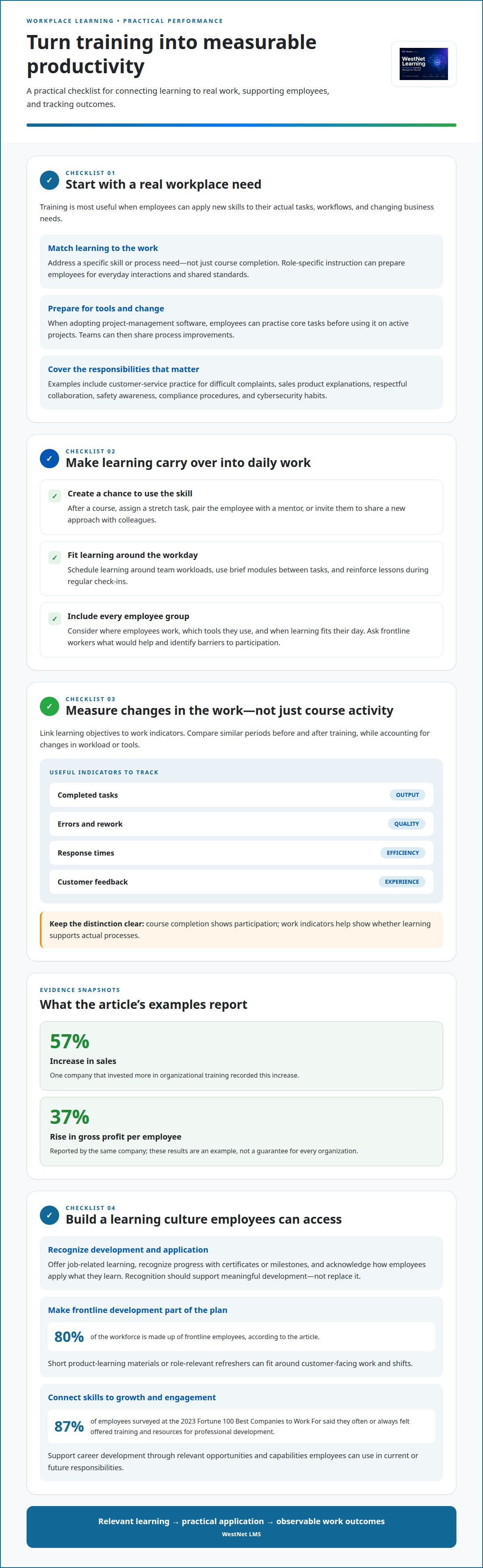
For example, a team could track completed tasks alongside errors, rework, response times, or customer feedback. Compare similar periods and account for changes in workload or tools. Training may help employees work more efficiently and reduce corrections. These indicators show whether learning supports actual processes, rather than simply tracking course completion.
Employee Training Costs and Productivity Research
Research on training costs and productivity can help organizations weigh investment against workplace outcomes. This figure describes average organizational spending, not the price of a particular course.
Research quantifying training’s impact includes a company that invested more in organizational training and recorded a 57% increase in sales and a 37% rise in gross profit per employee. These results illustrate why evaluation can include business outcomes as well as individual task performance. Compare relevant indicators over time to see whether training aligns with the intended improvement.
What is a culture of learning?
A learning culture makes development part of how employees work, grow, and share knowledge. Recognition, relevant opportunities, and time to apply new skills help make training an ongoing part of professional development.
Professional Development Support and Recognition
Professional development combines opportunities to build skills with recognition of learning progress. This matters because employees can see how development connects to their careers and how their organization values their effort.
For example, an organization can offer a job-related course, recognize completion with a certificate, and acknowledge how an employee applies the learning. Rewards might mark a learning milestone or a newly earned certification. They work best alongside meaningful development, not as a substitute for it. Managers can also discuss employees’ goals and explain how new capabilities may fit future responsibilities.
Learning Opportunities for Frontline Employees
Frontline development gives customer-facing and operational workers access to learning that fits their responsibilities. It matters because frontline employees make up 80% of the workforce, so excluding them leaves a large part of the organization outside development efforts.
A retail team, for instance, could use short learning materials to reinforce product knowledge before employees assist customers. A healthcare operations team could offer role-relevant refreshers that workers can revisit around their shifts. Consider where employees work, which tools they use, and when learning fits into their day. Managers can ask frontline workers which topics would help and identify barriers to participation.
Skills Development and Employee Engagement
Skills development helps employees perform current responsibilities and prepare for new ones. It can support engagement when workers have opportunities to use their skills and see a path forward in their careers.
In a survey of employees at the 2023 Fortune 100 Best Companies to Work For, 87% said they often or always felt offered training and resources for professional development. Organizations can reinforce that support by assigning a stretch task after a course, pairing an employee with a mentor, or asking them to share a new approach with colleagues. Soft skills such as communication and problem-solving also matter. Leadership development can help employees practice delegation, feedback, and decision-making before taking on broader responsibilities.
Learning Time and Program Design
Learning time and program design make development manageable alongside daily responsibilities. Managers can schedule learning around team workloads, use brief modules between tasks, and reinforce lessons in regular check-ins.
Small businesses can build effective programs by starting with a specific performance need, choosing relevant materials, and reviewing employee feedback. A small customer service team, for example, could focus on handling complaints, then discuss real scenarios in team meetings. This keeps learning tied to work instead of adding disconnected activities. For teams developing digital course materials from internal expertise, an AI Course Creator can support course creation as part of that program.
Links between learning, engagement, productivity, and retention
Learning can connect development opportunities with stronger engagement, workplace performance, and employee retention. According to Gartner, engaged employees are 17% more productive, making engagement an important part of the business case for development.
Learning and Employee Engagement
Employee engagement reflects how involved and connected people feel at work. Learning can strengthen that connection when employees see development as relevant to their responsibilities and future, supporting both satisfaction and performance.
According to Gartner, companies with engaged employees yield 21% higher profits. This relationship doesn’t mean training alone creates higher profits. For example, a customer support team might learn a new problem-solving approach, then use it on complex cases. Managers can ask for feedback, identify barriers, and recognize improvements. That follow-through connects development to employees’ daily experience instead of treating course completion as the final goal.
Growth Opportunities and Retention
Growth opportunities give employees a visible way to develop skills and take on new responsibilities. They matter for retention because workers may leave when they cannot see a future within their organization.
In a 2021 Pew Research Study, 63% of respondents said having no advancement opportunities pushed them to leave their jobs. In a Great Place To Work LinkedIn poll, 43% identified a lack of growth opportunities as the top reason they quit their last job. Leaders can respond by connecting learning to career conversations, internal projects, and pathways to greater responsibility. Organizations focusing on skills are 98% more likely to retain their best performers.
Development can also relate to promotion and continued employment. Employees who received training were about twice as likely as untrained employees to receive promotions over the next three years. This supports linking learning with opportunities to demonstrate new capabilities, rather than expecting employees to return to the same responsibilities without using their skills.
Retention matters because departures can disrupt organizational knowledge and team processes. When experienced employees leave before sharing their expertise, colleagues must take on responsibilities while rebuilding that knowledge. Mentoring and internal development opportunities can help employees contribute while preparing for future roles. Track development participation alongside internal moves and retention, and use employee feedback to identify where career pathways need clearer support.
Learning culture definition and organizational support
MIT researcher Peter Senge introduced the learning organization concept in the early 1990s. Training Industry defines a learning culture as workplace practices, values, and processes that support learning. In practice, this means development is part of how an organization shares knowledge, responds to change, and builds talent. It requires more than offering courses. Leaders need to make learning relevant to corporate goals and give employees opportunities to apply new capabilities.
Leadership support is essential, but stated priorities and daily practice don’t always align. Over 76% of companies say business leaders would rate learning 4 or 5 on a 5-point importance scale. Yet only 45% rate learning 4 or 5 for its integration into organizational culture. That gap points to a practical challenge: learning must show up in decisions about time, resources, and work. For example, managers can include development goals in team planning and discuss progress during regular check-ins.
Skill gaps can affect operational efficiency and an organization’s ability to adapt. Connect learning priorities to business changes, such as new technology or revised processes. For example, a team adopting a new system needs role-specific practice and a way to share problems and improvements with colleagues.
Organizational readiness depends on whether talent development connects to future business needs. Only 38% of companies tie business objectives directly to talent development objectives, and about 36% believe they’re prepared to develop employees for future skills. About 50% said learning and development, including upskilling and reskilling, was one of their biggest challenges over the next six to 12 months. These figures underline why skills planning should include current gaps and emerging responsibilities.
Build support through practical options employees can use at work. Mentorship can transfer operational knowledge between experienced staff and newer colleagues. Job-relevant workshops let teams practise specific tasks, while online learning supports self-paced development. Flexible hours, remote work options, or dedicated learning time can help employees balance development with responsibilities. Regular feedback and assessments help an organization adjust its learning initiatives as workforce needs change.
Upskilling should reach beyond senior roles. For example, a company can help frontline employees develop skills for a new process, then guide supervisors in coaching those skills on the job. This connects learning across organizational levels instead of concentrating development among leaders. When employees can use new capabilities and managers can reinforce them, learning becomes part of how the organization adapts and improves.
Personalizing learning with data analytics
Learning analytics connect training activity with employee skills and workplace needs. Instead of assigning everyone the same course, organizations can use assessment results, course records, and role requirements to identify relevant development priorities. The aim is to help employees build the capabilities their work requires, then evaluate whether learning supports performance.
Start with a defined business challenge, such as recurring order-entry errors or slow customer responses. Map the tasks involved to the skills employees need, then compare those requirements with assessment results and training records. If order-entry mistakes cluster around a particular process, targeted instruction can address that gap more directly than a broad course on unrelated topics.
Learning platforms can track employee skill development and training records across an organization, helping leaders identify where additional training may be needed. For example, a manager could review assessment results by role, notice that a team struggles with a software workflow, and offer focused practice. Course completion alone does not prove mastery, so pair participation data with knowledge checks or observed task performance.
Personalization also means presenting learning in a useful format and context. An employee preparing for a customer call may need a concise product guide, while a new supervisor may need practice giving feedback. General training can cover information that does not apply to an employee’s current task. Role-specific content and just-in-time resources make the connection between learning and work clearer.
Measure program impact by linking learning objectives to operational indicators. For a customer support course, compare quality reviews, resolution patterns, and feedback before and after training. For a process update, examine error trends and whether employees complete required steps. Interpret these measures alongside changes in workload, tools, or procedures, since training may not be the only factor affecting results.
Use a continuous review cycle: identify a skill gap, assign relevant learning, assess understanding, and review workplace outcomes. Employee feedback adds context when assessment data shows a problem but not its cause. If workers understand the material but struggle to apply it, managers can examine process constraints or provide guided practice. If results improve, the organization can adapt programs for similar roles and challenges.
Keep the analysis useful and focused. A dashboard crowded with unrelated metrics can obscure whether employees are developing the capabilities the organization needs. Connect each measure to a specific learning objective, review patterns across relevant teams, and use the findings to refine content. Explore learning analytics tools to connect training data with workforce development decisions.
WestNet LMS
WestNet LMS helps organizations connect employee development with workplace goals through its AI-powered learning management system, analytics, and gamification. Build structured programs around learning priorities, then use training data to understand participation and development needs.
WestNet AI LMS supports corporate training, while LMS Integrations connect learning with existing tools. AI Course Creator helps create courses, and Off-the-Shelf eCourses provide ready-made learning content. Together, these offerings can help organizations build or refine learning programs across teams.
Consider WestNet LMS when fragmented training makes it difficult to coordinate development or understand learning activity. Contact WestNet LMS to discuss your organization’s learning needs.
Build learning into what comes next
Make your next development decision strategic. Choose a business priority, identify the capabilities employees need, and decide how to recognize progress in their work. This keeps employee learning and productivity tied to meaningful outcomes, rather than treating training as a separate activity.
Then make time to learn from the results. Ask employees and managers what helped, where applying new skills proved difficult, and what support would make the next step easier. Use those insights to refine learning priorities as roles, processes, and business goals evolve.
WestNet LMS can help organizations bring structure to employee development and connect learning with workplace needs. If you’re ready to explore how that could fit your goals, contact WestNet LMS to start a conversation.
Build on what your workforce already knows, and give its next capabilities room to grow.
Frequently Asked Questions
What is an employee training and development program?
An employee training and development program is a coordinated approach to building job-related knowledge and capabilities. It can combine onboarding, role-specific learning, manager coaching, and career development support. For example, a new account representative might learn the customer database, observe experienced colleagues, and practise responding to client scenarios. A program works best when learning goals connect to actual responsibilities and employees can apply what they learn.
What type of training can businesses offer?
Businesses can offer role-specific instruction, onboarding, process updates, leadership development, and training in communication or technology use. Delivery can include self-paced digital courses, live virtual sessions, peer mentoring, guided practice, or job aids employees can consult at work. For example, a new software rollout could pair a short course with a searchable task guide. The right mix depends on the skill, employees’ work environment, and how they need to demonstrate that skill.
How does employee learning affect workplace productivity?
Employee learning can improve productivity by helping people perform tasks more accurately, make informed decisions, and use work processes effectively. For example, training on a new inventory system can help staff record stock consistently and reduce avoidable follow-up. The effect depends on whether learning addresses a real performance need and employees can use the skill on the job. Managers can assess progress through work quality and task completion, not course attendance alone.
Which types of employee learning programs improve productivity most?
Programs that address a specific skill gap and match employees’ daily responsibilities are strong candidates for improving productivity. A broad course may offer useful context, but targeted practice can better prepare someone for a particular task, such as resolving a common support issue. Include opportunities to apply the skill and receive feedback. Then compare relevant work indicators, such as accuracy or completion quality, to see whether the program supports its intended outcome.
What role do online learning platforms and AI play in employee productivity?
Online learning platforms can centralize courses, learning records, and development resources. AI can support course creation and personalize learning recommendations, helping organizations tailor development to roles or skill needs. For example, an employee preparing for a new responsibility could receive related learning. Technology supports delivery and analysis, while managers still need to connect learning to work, check that content is relevant, and guide employees as they apply new skills.
How does continuous learning affect employee engagement and retention?
Continuous learning can strengthen engagement when employees see development as part of their work and have opportunities to grow. It can also support retention by helping workers prepare for new responsibilities without leaving the organization to advance. For example, a team member could build project coordination skills, then take on a suitable internal assignment. Regular career discussions help managers understand employees’ interests and connect learning opportunities with realistic development paths.
What are common barriers to employee learning and productivity?
Common barriers include limited time, irrelevant course content, unclear expectations, and few chances to practise new skills. For example, employees may complete training but return to a workflow that prevents them from applying what they learned. Managers can address this by scheduling learning around operational demands, clarifying the skill’s purpose, and adjusting processes where needed. Limited access to resources or weak follow-up can also make it harder to turn learning into better work.