A feature list alone won’t make the case for an LMS. Presenting an LMS proposal to the board means showing how the system supports organizational goals, what it requires, and how you will measure success.
Board members are right to scrutinize an investment’s costs, operational impact, and risks before approving a new platform. A clear proposal links learning goals to business priorities and gives decision-makers practical evidence to assess the case.
This article explains how to build that case: define outcomes, account for costs and total ownership, demonstrate vendor fit, and address integrations, data, implementation, and adoption. Use this structure to turn a technology request into a board-ready decision.
Key Takeaways
- Connect learning objectives to business priorities, then define how progress will be measured.
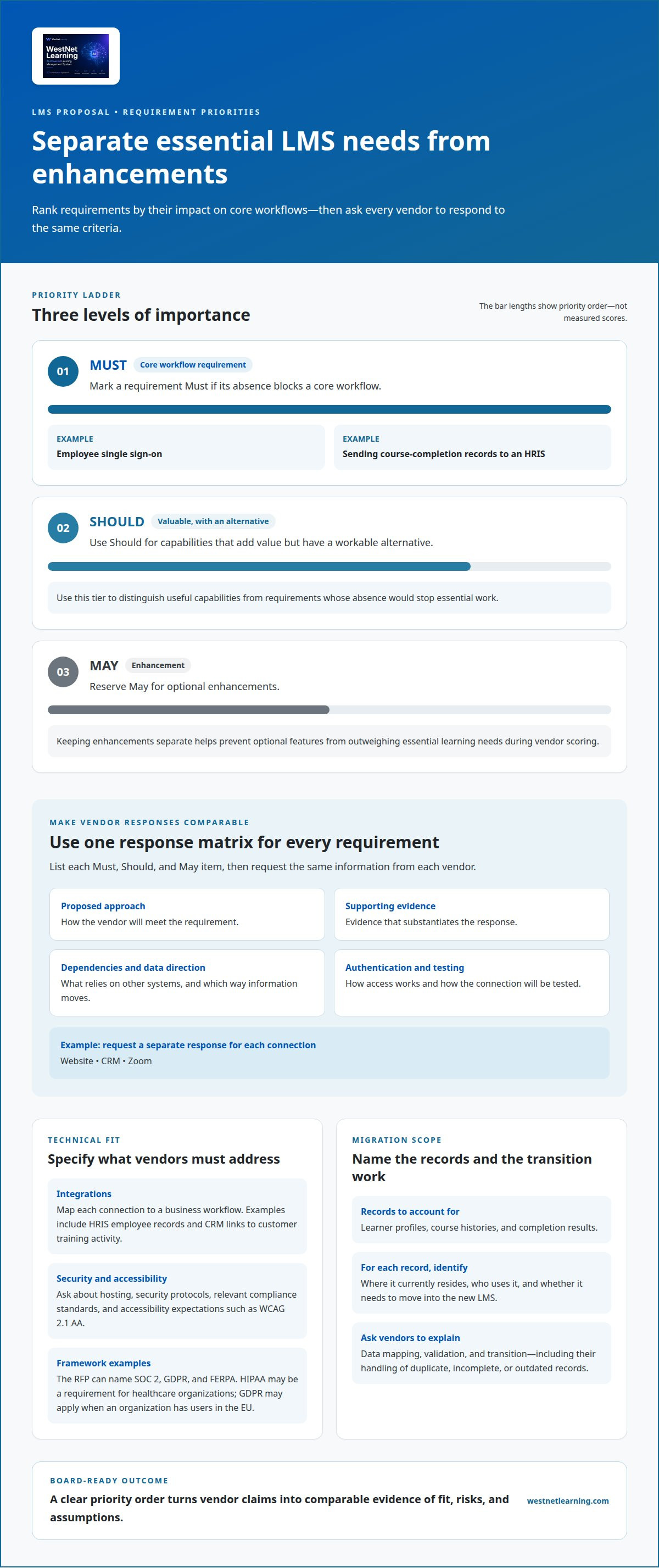
- Separate essential LMS capabilities from optional features, and show how integrations, authentication, and data migration fit existing systems.
- Present one-time and recurring expenses together so decision-makers can assess the broader ownership picture.
- Build confidence with vendor evidence, a practical implementation plan, and clear expectations for onboarding and support.
- Identify adoption, security, and delivery risks early, then explain how each will be managed.
Integration, authentication, and data migration requirements
Define the technical conditions that allow learning to work within your existing corporate systems. A focused request for proposal (RFP) turns those conditions into requirements vendors can address and the board can evaluate.
- Map each integration to a business workflow. Name the systems that must exchange information, such as an HRIS supplying employee records or a CRM linking learner activity to customer training. For each connection, describe the data moving in each direction and the intended update process. An HR data and learning workflow integration should be evaluated against actual needs, not a generic compatibility claim.
-
Prioritize Requirements by Importance
Before sending the RFP, group each requirement as Must, Should, or May. Mark an item Must if its absence blocks a core workflow, such as employee single sign-on or sending course-completion records to an HRIS. Use Should for valuable capabilities with a workable alternative, and May for enhancements. This prevents optional features from outweighing essential learning needs during vendor scoring.
- Specify technical, security, and accessibility evidence. Ask vendors to describe hosting, security protocols, and relevant compliance standards. The RFP can name SOC 2, GDPR, and FERPA as frameworks for vendors to address; SOC 2 Type II is a security-auditing standard they may need to demonstrate. The U.S. Department of Health and Human Services identifies HIPAA compliance as a possible LMS requirement for healthcare organizations. GDPR may apply when an organization has users in the EU, according to the European Union.
Set accessibility expectations explicitly, such as WCAG 2.1 AA. Distinguish required functions from optional capabilities, then ask vendors to respond against each requirement. For authentication, specify whether single sign-on is needed and which user groups rely on it. This makes technical fit assessable alongside learning features, rather than leaving security and accessibility buried in vendor descriptions.
-
Outline Data Migration Requirements
Specify which records the proposal must account for, such as learner profiles, course histories, and completion results. Identify where each record currently resides, who uses it, and whether it needs to move into the new LMS. Ask vendors to describe their data mapping, validation, and transition process, including how they will handle duplicate, incomplete, or outdated records. This makes migration scope clear before approval.
- Ask vendors to show how they will meet each requirement. Use a response matrix listing every Must, Should, or May item, the proposed approach, and supporting evidence. For a website, CRM, and Zoom integration, request a separate response for each connection. Ask vendors to explain dependencies, data direction, authentication, and testing. The result is a comparable view of fit, risks, and implementation assumptions for board members.
Implementation, onboarding, and support expectations
Turn the selected platform into a delivery plan with accountable owners and clear checkpoints. Include implementation, onboarding, user experience, and support expectations in the board proposal.
- Break implementation into phases, including configuration, integration testing, data migration, launch, and post-launch review. A planning example for a robust LMS implementation is 8 to 12 weeks, including migration, testing, and user training. Show dependencies and decision points, such as when departments must approve learning content. A timeline makes resource needs visible and gives the board a structured view of delivery.
-
Set Implementation Timelines
Ask vendors to map each phase to a deliverable, owner, and acceptance checkpoint. Compare the proposed schedule with your integration and training needs instead of relying on a headline launch date. A two-week deployment promise for a complex enterprise LMS can signal risk, so identify the work, testing, and onboarding included in that schedule.
Set support expectations for launch and ongoing operations. Specify support channels, escalation routes, and how maintenance or platform updates will be communicated. Email-only support with a 48-hour response time is unacceptable when the LMS is mission-critical. Define the response expectations that fit your operating needs and ask vendors to describe how they meet them.
-
Build Cross-Departmental Support
Ask representatives from learning, IT, HR, and affected business teams to review implementation decisions. Each group sees different adoption barriers: IT may focus on integrations, while managers need workable onboarding and reporting. Assign clear responsibilities for testing, communication, and issue escalation. For example, a department lead can identify the workflows employees need to complete first.
Connect user experience to practical launch tasks. Gather feedback on enrollment, course access, and completion tracking before rollout. A structured LMS onboarding approach can help frame how employees encounter training during their first learning activities.
-
Identify and Mitigate Implementation Risks
List delivery risks alongside their triggers and mitigation steps. Delayed data access can disrupt migration, so schedule data-owner reviews before testing begins. Integration failures can block key workflows, so include end-to-end tests and named technical owners. Low adoption can weaken a launch, so plan manager communications and learner guidance in advance.
Separate vendor responsibilities from internal tasks. Record who approves configuration, provides source data, tests workflows, and resolves defects. This ownership map helps prevent unresolved decisions from becoming launch blockers.
- Make commercial and support terms comparable in the proposal. Request a clear description of implementation responsibilities, ongoing support, maintenance, and any dependencies affecting delivery. One example vendor evaluation matrix assigns 15% of its score to support and implementation. Present the weighting as an evaluation choice, not a universal rule, and explain why it reflects your organization’s delivery priorities.
Defining LMS project goals and business needs
Build the proposal around organizational outcomes, not a feature catalogue. Define the learning need, its business impact, and the scope decision-makers are being asked to approve.
- Describe the current barrier with a specific workflow example. Explain how fragmented training records, inconsistent onboarding, or delayed certification tracking prevents the organization from meeting its goals. Then connect the gap to a board priority, such as return on investment, member engagement, or value delivery. This gives the learning management system proposal a clear business rationale before you discuss platform capabilities.
- Set measurable learning objectives that show what should change. For example, a proposal might target reducing new-hire time-to-productivity by 40%, or raising certification completion from 65% to 90%. Treat these as project objectives, not guaranteed results. Name the baseline, intended audience, and business process each objective supports, so leaders can assess whether the goal matters.
- Define scope around programs the organization plans to deliver in the next 12-24 months. List intended learner groups, course types, and delivery needs, such as 24/7 mobile access for frontline workers. Separate launch requirements from later expansion. This boundary helps prevent selection from drifting toward impressive functions that don't support planned learning or the organization’s immediate priorities.
- Choose outcome measures before comparing systems. For a certification initiative, track enrollment, completion, and the proportion of learners meeting the required standard. For onboarding, use the agreed time-to-productivity measure. Assign an owner and reporting cadence to each measure. A simple template can connect every goal to its baseline, target, data source, and responsible team.
- Translate objectives into project milestones and approval decisions. A practical sequence might begin by confirming business needs, then approving scope, evaluating solutions, and authorizing implementation. Give each milestone a decision owner and clear deliverable, such as an agreed requirements document. Set calendar dates only after you understand dependencies, internal capacity, and procurement steps.
- Close the case by explaining the expected organizational impact. Depending on the project, connect learning outcomes to workforce readiness, compliance completion, or employee development. State exactly what the board is approving: the selection process, project scope, or investment decision. A proposal focused on impact helps decision-makers assess why the system is needed, not just how extensive its feature list is.
Pricing, licensing, and total cost of ownership
Give decision-makers a complete cost framework, not just a license figure. A transparent pricing document shows what the estimate covers and how the costs relate to functional needs.
- Request a cost breakdown that separates one-time and recurring expenses. Include licensing, implementation, and support, and state the assumptions behind each category. For example, show whether the estimate reflects the expected learner population and the functions required at launch. This helps board members understand what the investment covers and which operational needs it supports.
- Ask vendors to estimate total cost of ownership for Years 1-3. Include subscription charges, implementation, support, and any other costs they identify for the proposed scope. Compare the same period and categories across proposals. A three-year view helps reveal how recurring commitments and launch expenses affect the full investment, rather than letting an initial license figure dominate the selection decision.
- Explain the pricing model and billing terms in plain language. An RFP can ask vendors to describe subscription-based, perpetual-license, or pay-per-use pricing. For each option, request the billing basis, payment schedule, renewal terms, and any conditions that could change charges. If member counts affect the model, state the assumptions used. Clear terms make proposals easier to compare and budget.
- Connect costs to functional requirements instead of treating price as a standalone score. Identify which costs support essential workflows, such as onboarding, compliance learning, or reporting. Then separate optional capabilities from must-have functions. One recommended LMS evaluation approach assigns 10% to pricing and total cost of ownership. Treat that weighting as a governance choice, and explain how it fits your priorities.
- Review contract terms alongside the cost summary. Record the commitment period, renewal process, included support, and conditions for adding or removing users. Ask vendors to show how estimates change as the organization’s needs evolve. This exposes assumptions that could affect future planning without relying on one fixed learner count.
- Present the board with a consistent comparison table showing each vendor’s cost categories, billing model, contract terms, and Years 1-3 estimate. A useful LMS pricing comparison can help frame the questions. Explain any differences in scope before recommending a selection. That way, members can assess value against requirements, not just compare headline amounts.
What are the risks of an LMS implementation, and how can they be mitigated?
- Create a risk register before approval. For each risk, record its cause, likely effect, owner, and mitigation. For example, an unclear project scope can lead to late requests and competing priorities. Assign a decision owner to resolve scope changes and document their impact on requirements, timing, and resources. This gives the board a practical view of project exposure and the team’s response plan.
Separate risks the organization can control from external dependencies. Internal examples include delayed decisions, limited staff capacity, or inconsistent course content. Vendor dependencies may include agreed technical deliverables or support responsibilities. Naming both types prevents the proposal from treating implementation risk as solely a technology issue.
- Protect data and privacy with explicit governance. Identify the learner information the LMS will hold, who needs access, and how that access will be reviewed. Assign an internal data owner and document the approval path for changes. GDPR may apply when an organization has users in the EU, according to the European Union. Include applicable privacy requirements in the project risk review.
Make the review specific. For example, identify who can view completion records and export learner data. Ask the project team to document decisions and escalation routes. These steps clarify data-handling responsibilities before launch, rather than leaving them to informal practice.
- Reduce adoption risk with a staged communication and feedback plan. Identify affected groups, explain what will change in their learning workflows, and provide a clear route for reporting access problems. For example, managers can receive launch guidance before employees are assigned courses. Track recurring questions and assign each issue an owner so small obstacles do not go unnoticed.
Set a review point after each rollout phase. Use learner feedback and support requests to spot confusing instructions or workflow barriers. Base the response plan on observed issues instead of assuming a launch announcement alone will lead to consistent participation.
- Prepare for disruption by defining operational responsibilities. Document who communicates a service interruption, who coordinates with the vendor, and how learners receive updates. For a required compliance course, identify how managers will track affected learners during an outage. Link the risk review to the organization’s learning continuity needs, including compliance training workflows.
Document assumptions that could affect continuity, such as reliance on a specific integration or internal system owner. Assign someone to review each dependency before the project advances. Clear ownership helps teams respond without duplicating work or overlooking unresolved issues.
- Turn the risk register into a board-level monitoring tool. Select risks that could affect project scope, delivery, security, or adoption, then report their status and mitigation progress at agreed decision points. Escalate a risk when its trigger occurs, such as a missed approval or failed workflow test. This gives decision-makers a defined way to oversee delivery and respond to emerging concerns.
Close the proposal by specifying the decisions required from the board, including risk tolerance and escalation authority. A concise approval record clarifies accountability as the LMS project moves from selection to implementation.
WestNet LMS
WestNet LMS helps organizations turn an approved learning strategy into a connected corporate training platform. WestNet AI LMS combines automated course creation, analytics, and gamification to support employee development. AI Course Creator supports course development, while LMS Integrations connect learning with existing tools. Off-the-Shelf eCourses provide ready-made learning content.
Consider WestNet LMS when your proposal needs a practical fit between learning goals, platform capabilities, and existing systems. Discuss how its offerings align with your organization’s priorities and implementation needs. Contact WestNet LMS to talk through your proposal and the requirements behind it.
Turn Approval Into Organizational Momentum
For teams presenting an LMS proposal to the board, the next step is to make approval actionable. Treat the board’s decision as a clear handoff, not the finish line. Record the decision, name its executive sponsor, and agree how leaders will receive updates as the project progresses. This connects the strategic case to the work employees will experience.
Use the approval meeting to confirm what success means to decision-makers and how they want to see progress. A concise decision record can capture open conditions, ownership, and the next governance checkpoint. Keep it focused on choices that shape delivery so project teams can act without reopening settled questions. This makes board alignment an operating reference, not a presentation that disappears after the meeting.
When you’re ready to advance the conversation, connect with WestNet LMS about your proposal. Give your board a clear path from decision to meaningful learning progress.
Frequently Asked Questions
What should an LMS proposal to a board include?
An effective proposal gives the board a decision-ready case, not a product tour. Include the business need, intended learning outcomes, scope, options considered, ownership, and the approval requested. Presenting an LMS proposal to the board is clearer when the decision is explicit, such as approving a selection process or authorizing a project phase. Add a short executive brief so directors can understand the recommendation before reviewing the supporting detail.
How do you align an LMS proposal with organizational goals and strategy?
Show how the learning initiative supports a strategic priority, then connect it to a business process leaders recognize. For example, a workforce capability goal might involve preparing employees for changing responsibilities. Identify the executive sponsor and the department accountable for the outcome. Explain how leaders will use progress information in planning, rather than treating the LMS as a standalone technology purchase.
What data supports investing in an LMS, such as training completion and employee performance?
Use existing records to establish a baseline, then define what evidence would show progress. Useful measures include course completion, time to complete required learning, assessment results, and employee performance indicators relevant to the training. Separate observed data from projected benefits. WestNet AI LMS provides analytics for learner progress, completion rates, and ROI metrics, helping teams report on learning activity and outcomes.
How do you calculate LMS total cost of ownership and return on investment?
Calculate total ownership costs by adding platform, implementation, support, and ongoing operating costs over the period your organization is evaluating. Estimate ROI by comparing those costs with measurable benefits, such as reduced administrative effort or improved completion of required training. Use internal data to value benefits, state assumptions clearly, and avoid counting the same benefit twice. Show how results might change if participation or adoption differs from expectations.
What are typical LMS pricing models and implementation costs in the United States?
Common pricing structures include subscriptions, perpetual licenses, and pay-per-use arrangements. Subscription pricing may scale by user count; WestNet LMS offers SaaS subscriptions for platform access. Implementation costs depend on the work included, such as migration, integration, testing, and training. Compare proposals using the same scope and billing assumptions, and separate recurring charges from one-time project expenses. This makes the comparison useful beyond headline pricing.
What LMS security, privacy, accessibility, and compliance requirements should boards consider?
Boards should consider access controls, data protection, applicable compliance needs, and accessibility expectations. WestNet LMS includes bank-level encryption, SOC 2 compliance, GDPR and HIPAA compliance, role-based access, daily backups, and 99.9% uptime. The LMS technical requirements can also specify WCAG 2.1 AA accessibility. Requirements should reflect the organization’s users, data, and operating context, with responsible teams assigned to oversee security and privacy decisions.
What are the steps and timeline for LMS selection, implementation, and rollout?
Start by defining organizational needs, then issue a focused request for proposal, evaluate responses, select a solution, and plan rollout. An LMS RFP process typically takes 8-14 weeks from internal kickoff to final vendor selection. After selection, sequence configuration, integrations, migration, testing, and learner communications according to project dependencies. Set approval points for key decisions, and track readiness before expanding access beyond the initial rollout group.
How should you present LMS options, budget, and recommendations in a board presentation?
Structure the presentation around the decision, not a feature-by-feature walkthrough. Introduce the organizational need, compare options against agreed criteria, summarize cost assumptions, and recommend a path with clear reasoning. Use one comparison visual and put supporting detail in an appendix. Close by stating the approval requested, who will own the next phase, and when the board will receive a progress update. Prepare concise answers to likely concerns.