What if watching a colleague handle a difficult customer teaches more than a training module alone? Social learning theory explains how people learn by observing others and noticing the consequences of their actions. Observation alone, however, does not guarantee learning: attention, memory, the ability to reproduce a behavior, and motivation all affect whether it takes hold.
The workplace makes the theory easier to understand. A team member sees a process modeled, remembers its steps, tries them in a similar situation, and decides whether to repeat them based on the result. Each part matters. Learning is more likely to transfer when people have a chance to practise and receive useful feedback.
This article explains Bandura’s four processes, shows how social learning works at work, and offers practical ways to apply the theory in corporate learning. It also explains how an LMS can organize formal training and reinforce learning, while recognizing that technology supports, but does not replace, observation and interaction between people.
Key Takeaways
- Social learning theory helps explain how people learn from models and the outcomes of their actions, not only from direct instruction.
- Use attention, retention, reproduction, and motivation to identify what may support or hinder learning, rather than treating them as a guaranteed sequence.
- Interpret the Bobo doll research as evidence that modeled behavior can influence actions, not proof that observation affects everyone in the same way.
- Build workplace learning around a specific behavior, a credible model, focused observation, and opportunities to practise.
- Use an LMS to organize formal learning and review learner progress, while keeping human modeling and interaction at the center of social learning.
What Is Social Learning Theory? A Clear Definition of Bandura’s Idea
People can learn by observing a model and noticing what happens after that model acts. They may take in a new approach without performing it immediately or receiving direct instruction. Later, they might use it, adapt it, or avoid it, depending on what they remember and expect the outcome to be.
Psychologist Albert Bandura developed social learning theory to explain learning that a strictly behavior-focused account could not fully capture. Direct rewards and consequences matter, but so do mental processes: people notice actions, interpret results, and form expectations. The theory connects behavioral and cognitive perspectives, helping explain how learning can happen through observation as well as experience.
How Social Learning Theory Defines Learning
Observational learning is the process of noticing how someone behaves, remembering what they do and what follows, and using that information to guide later choices. A model might be an individual, a group whose shared behavior is visible, or a represented example, such as a video demonstration or written scenario.
Learning and performing are not the same thing. Someone may understand a procedure after watching a colleague but decide not to try it, or lack the opportunity or skill to carry it out. A model’s success may make an action seem worthwhile; a negative consequence may make it seem risky. Neither response determines what the observer will do.
Why Bandura’s Theory Broadened Earlier Learning Models
Earlier behaviorist explanations often emphasized how actions change through direct reinforcement: a person tries something, then responds to a reward or consequence. Bandura’s account widened that picture. An observer can learn from another person’s experience without personally receiving the reward or consequence. They also need to notice what happened, interpret it, and form expectations about whether copying the behavior is likely to help.
This cognitive layer makes the theory relevant beyond a controlled lesson. A child may observe how a family member responds to frustration; a student may notice which study strategies a classmate uses; an employee may watch a teammate resolve a customer issue. In each setting, observers interpret what happened rather than simply repeat a visible action.
The classic Bobo doll research helped demonstrate that children could reproduce aggressive actions they had observed in adults. It is evidence that modeled behavior can influence what people do, not proof that every observer will imitate every action or that observation alone explains behavior. Context, expectations, and the observer’s own capabilities still matter. For a broader history and overview, see Social Learning Theory on Wikipedia.
This distinction also matters in distributed workplaces, where colleagues may observe examples in person or through shared digital learning experiences. WestNet’s overview of connected learning for global teams explores how learning can connect across teams. The practical point remains the same: seeing a behavior provides a model, but applying it depends on how people interpret it and whether they can put it into practice.
How Social Learning Theory Works: Bandura’s Four Stages
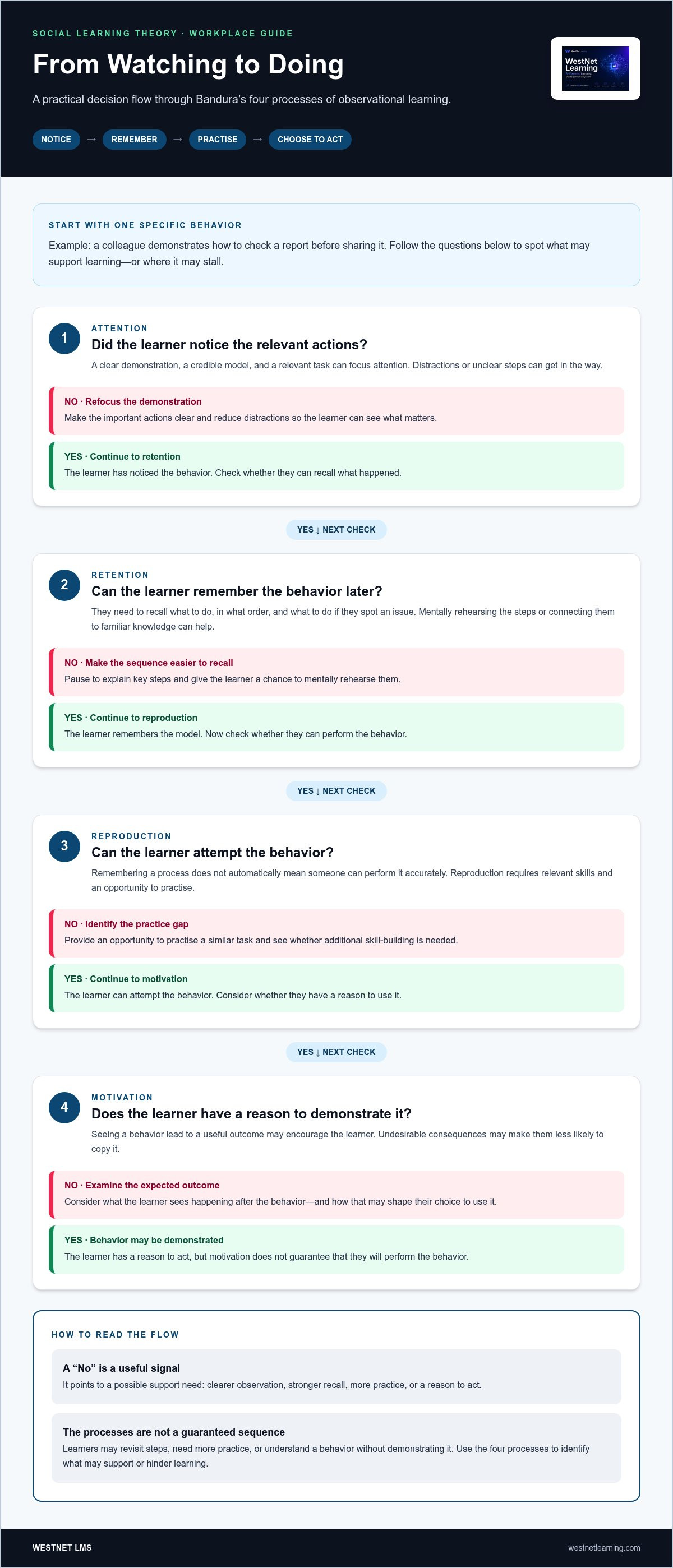
Bandura’s four processes help explain what can happen between seeing a behavior and choosing to perform it. A colleague might demonstrate a quality check, but watching does not mean a learner noticed every step, can remember the sequence, or is ready to carry it out. Use the processes to pinpoint what supports learning and where it may stall.
- Attention: The learner notices the relevant actions. A clear demonstration, a credible model, and a task that feels relevant can focus attention. Distractions or unclear steps can get in the way.
- Retention: The learner remembers what happened. They may mentally rehearse the sequence or connect it to familiar knowledge so they can recall it later, when the model is not present.
- Reproduction: The learner can attempt the observed behavior. This requires relevant skills and an opportunity to practise. Remembering how a quality check was done does not automatically mean someone can perform it accurately.
- Motivation: The learner has a reason to demonstrate the behavior. Seeing it lead to a useful outcome may encourage them, while undesirable consequences may make them less likely to copy it.
Attention helps people notice a model, retention preserves what they saw, reproduction turns memory into action, and motivation influences whether they choose to act. This is a useful summary, not a guaranteed, one-way sequence. Learners may revisit steps, need more practice, or understand a behavior without demonstrating it.
Attention and Retention: Notice, Then Remember
Consider an employee watching a teammate check a report before sharing it. To learn from the demonstration, the employee needs to focus on the relevant checks, not just see the report being opened. They also need to remember the sequence: what to inspect, in what order, and what to do if they spot an issue. Pausing to explain key steps can make the demonstration easier to follow and recall.
Reproduction and Motivation: Practise, Then Choose
Next, the employee needs a chance to complete a similar check. Practice reveals whether they can perform the steps, while motivation influences whether they want to apply them. In vicarious reinforcement, an observer sees someone else receive a positive consequence and may become more inclined to imitate the behavior without receiving the reward directly. Observed negative consequences can also discourage imitation, but neither response is automatic.
Related Ideas: Self-Efficacy and Reciprocal Determinism
Self-efficacy is a person’s belief in their ability to perform a specific task. An employee who understands a process but doubts their ability to carry it out may hesitate to practise. Bandura’s later Social Cognitive Theory gives greater emphasis to how personal factors, behavior, and environment influence one another, a relationship known as reciprocal determinism. In workplace learning, confidence, opportunities to practise, and team norms can shape one another over time.
For organizations putting these ideas into practice, an LMS can organize formal learning alongside workplace practice. Explore how WestNet’s AI LMS can support structured corporate learning.
What Social Learning Theory Explains, and What It Does Not
Seeing a behavior is not the same as learning it, and learning it is not the same as performing it well. An observer may miss a key step, remember only part of a demonstration, lack the ability or resources to reproduce it, or decide the action does not suit the situation. At work, watching a colleague handle a task can introduce a useful approach, but it does not prove someone can apply it independently.
Observation can inform behavior; appropriate practice helps show whether a person can perform it. This boundary keeps social learning theory useful without treating it as a complete explanation for every action. Models and observed consequences can influence what people notice or attempt, while individual experience, confidence, expectations, and the surrounding environment also shape what happens next.
What the Bobo Doll Studies Show, and What They Cannot Prove
In a 1961 study, Albert Bandura and his colleagues examined how children responded after observing adults behave aggressively toward an inflatable doll. Children who saw an aggressive model later displayed more imitative aggressive behavior in the study setting than children who saw a non-aggressive model or no model. The research offered evidence that people can acquire behavioral patterns by watching others, rather than only through direct reward or punishment.
It does not show that every child will imitate aggression or that observing an action guarantees it will be used elsewhere. A behavior can be learned without being performed in a particular moment. The study also cannot settle every question about how learning works across different people, behaviors, and environments. Treat it as evidence for modeling, not a universal rule.
Common Misreadings of Observational Learning
Imitation is not automatic. An employee observing a teammate follow a safety procedure may not attend to each step, retain the sequence, or have the equipment and practice needed to perform it. Even when the person can reproduce the procedure, workplace expectations, time pressure, confidence, and the likely consequences of acting can affect whether they choose to do so.
Separate these questions: Did the learner notice the behavior? Can they recall it? Can they perform it under the relevant conditions? Are they willing to use it? A gap at any point changes what support makes sense. Repeating a demonstration may help someone who missed a step; guided practice may help someone who remembers but cannot yet perform the task. Feedback can identify errors and reinforce accurate performance.
For managers, the practical takeaway is to avoid equating exposure with competence. Pair observation with an opportunity to practise and feedback suited to the task. Then assess what the learner can do in context. This respects the theory’s insight that people learn from models while recognizing that successful performance depends on more than watching.
How to Apply Social Learning Theory in Workplace Training
Turn social learning theory into a practical design method by starting with a behavior employees need to perform, not with a course format. Make that behavior visible through a credible model, help learners focus on the important details, and give them a chance to practise. A demonstration can introduce a skill; structured practice shows whether learners can use it.
Design a Learning Experience Around the Four Stages
Use these steps to connect observation with action:
- Select one observable behavior. Define what the employee should do, such as checking required information before submitting a request. A precise target makes it easier to align the demonstration and practice.
- Choose a credible model. A supervisor can demonstrate a process, while an experienced peer can share how they handle a recurring challenge. The model should follow the expected standard and explain decisions, not just show the final result.
- Support focused observation and recall. Break the process into clear steps, point out decisions that matter, and provide a concise checklist or job aid for later reference. When a peer shares experience, invite them to explain both what they did and why.
- Enable practice and useful feedback. Give learners a realistic opportunity to try the behavior, then offer specific feedback on what they did well and what to adjust. Recognition can reinforce accurate application, but it should reflect the quality of the behavior, not participation alone.
For example, a supervisor might demonstrate how to respond when a customer’s request is incomplete, explaining which details to clarify and how to document the response. Learners can then practise with a similar scenario. A peer discussion can add examples of different situations, while feedback helps learners distinguish a sound approach from surface-level imitation.
Evaluate Whether Observation Transfers to the Job
Decide what competent performance looks like before training begins. Identify the actions or decisions that matter and how someone can demonstrate them in a realistic task. This gives you a more useful measure than completion alone.
- Separate engagement from capability. Attendance, viewing, or course completion indicates exposure to learning material. It does not establish that a learner can perform the task.
- Gather evidence of application. Where appropriate, a manager can observe the behavior during work, review a completed task, or ask the learner to reflect on how they applied the approach.
- Use feedback to refine the learning experience. If learners recall the steps but struggle to perform them, they may need more practice or clearer guidance. If they can perform the task in training but not at work, examine whether the work environment supports the behavior.
Keep conclusions proportionate to the evidence. A change in a business result may have several contributing factors, so do not attribute it to social learning without evidence connecting the training to the outcome. To organize formal learning alongside workplace practice, explore WestNet’s AI LMS.
How an LMS Can Support Social Learning Without Replacing People
Technology can bring learning materials, schedules, and progress information into one system. It cannot replace a trusted colleague demonstrating a task, explaining a judgment call, or answering questions in context. Use an LMS to organize and reinforce learning, then build human modeling and workplace practice into the experience. The platform supports structure; people provide the example and interaction.
Match LMS Capabilities to Specific Learning Needs
WestNet AI Enhanced LMS includes virtual and instructor-led modules that can support organized instruction. A facilitator or subject matter expert can demonstrate a process in a structured learning session, while learners observe, discuss key decisions, and later practise the behavior in their work setting. The module provides structure; the human model makes the behavior visible.
AI-generated course recommendations can surface learning options for learners. Use them to connect formal material with a skill or topic employees may need to revisit, rather than treating a recommendation as a substitute for colleague guidance or hands-on practice.
Gamification features such as leaderboards and badges can recognize participation or progress. They can make milestones more visible, but a badge or leaderboard position is not evidence that someone can perform a task competently. Pair recognition with practice and feedback. For more ideas on using employee engagement gamification tools, focus on how recognition supports learning without confusing activity with skill.
Use Reporting to Review Learning Progress
Learning Analytics and Reporting can help teams review learner activity and progress across formal training. This information can prompt useful follow-up. For example, a manager might notice that an employee completed a course and arrange an opportunity to practise the related process. Reporting provides visibility into learning activity, but it does not establish that the learner has transferred a skill to the job or that training caused a business result.
Build a fuller picture by combining LMS reporting with appropriate workplace evidence, such as manager observation, task review, and learner reflection. Use the results to identify where learners may need clarification or additional practice. Course completion alone does not demonstrate competence.
When evaluating an LMS, consider whether its capabilities support the structure your learning approach requires. WestNet’s LMS features for corporate learning include course recommendations, learning analytics, and virtual and instructor-led modules. These tools can organize formal learning and make progress easier to review, while credible models and human interaction remain essential to social learning.
See how the platform could support your organization’s learning structure. Request a WestNet AI Enhanced LMS demo.
Build a Learning Culture That Moves From Example to Action
Make the next step practical: choose one important workplace behavior and create a focused learning experience around it. Give employees a clear model to observe, then make room to discuss, practise, and apply what they have learned. This keeps social learning theory grounded in real work rather than treating exposure to content as the finish line.
Technology can help sustain that approach. AI-powered e-learning creation can support the development of formal learning materials, while virtual and instructor-led modules can add structure. Learning Analytics and Reporting can help you review learner activity and progress alongside evidence of how skills are used on the job.
Build a system that supports people as they learn from one another. Request a WestNet AI Enhanced LMS demo to explore how the platform can support your organization’s learning approach. Start with one behavior, one credible model, and a clear opportunity to practise.
Frequently Asked Questions
What is social learning theory in simple terms?
Social learning theory explains that people can learn by watching others and noticing what follows their actions. For example, a new team member may observe how colleagues coordinate a shift handover and learn what information the team expects to share. The person might understand the routine before taking part. To see whether they can use it, give them a suitable chance to try the handover themselves.
What are the four stages of social learning theory?
The four processes are attention, retention, reproduction, and motivation. In a training session, use them as a practical check: was the demonstration clear enough to notice, can learners recall its key steps, can they perform those steps, and do they have a reason to apply them? The processes help identify where support may be needed, rather than predicting that everyone will imitate a model.
Who developed social learning theory?
Psychologist Albert Bandura developed social learning theory, highlighting that people can learn through observation, not just through their own direct experience. His work helped explain how seeing another person’s behavior and its consequences may influence an observer. Bandura later expanded the framework into Social Cognitive Theory, which gives additional attention to factors such as confidence and the interaction between people, their actions, and their environment.
What is an example of social learning theory at work?
A project coordinator might observe an experienced colleague prepare a clear handoff between teams, including how they flag unresolved decisions. Later, the coordinator can use the same approach on a live project. A manager can review the handoff and offer feedback on whether key details were communicated. This makes the example more than exposure: it creates a way to assess whether the observed approach works in practice.
Is social learning theory the same as social cognitive theory?
No. They are closely connected, but Social Cognitive Theory is Bandura’s later, broader framework. Social Learning Theory emphasizes learning through observing models and outcomes. Social Cognitive Theory also considers how personal beliefs, behavior, and the environment affect one another. This distinction can help learning teams account for barriers beyond course content, such as whether employees feel capable of applying a skill or have the opportunity to use it.
Can people learn a behavior without being directly rewarded?
Yes. An observer may learn about a behavior by seeing how another person is treated after using it. For instance, seeing a colleague receive constructive support for raising a concern may influence whether someone else feels encouraged to speak up. The observer does not need to receive the same response to be affected by it. Still, learning about the behavior does not mean they will choose to perform it.
What are the limitations of social learning theory?
Social learning theory can explain how models and observed outcomes influence behavior, but it cannot by itself establish why every person acts as they do. A learner may interpret a demonstration differently, lack practice, or face workplace conditions that make applying the behavior difficult. For training decisions, pair observation with a task that reflects real working conditions, then review both the learner’s performance and any relevant context.